 Blaine Siding
 Why Ferndale Roofs Take a Different Kind of Beating
Ferndale sits close enough to the water that salt-laden air reaches roofs across the whole area, not just the ones with a water view. Add in the driving, wind-pushed rain that blows through Whatcom County during winter storms off the Strait, and a moss season that can run from early fall well into spring, and you get a roofing environment that ages differently than what you'd find further inland. Metal flashing and fasteners corrode faster near the coast. Asphalt shingle granules wear down ahead of schedule. And moss doesn't just sit on the surface looking bad — it works its rhizoids under shingle tabs and lifts them, which is exactly the kind of quiet damage that turns an ordinary wind event into a real leak.
That combination matters for storm damage repair specifically. A wind gust that would do nothing to a clean, well-maintained roof can be the last straw on one that's already been softened up by months of moss growth and salt exposure. So when we look at storm damage in Ferndale, we're not just looking at what the storm did — we're looking at what the roof's condition let the storm do.
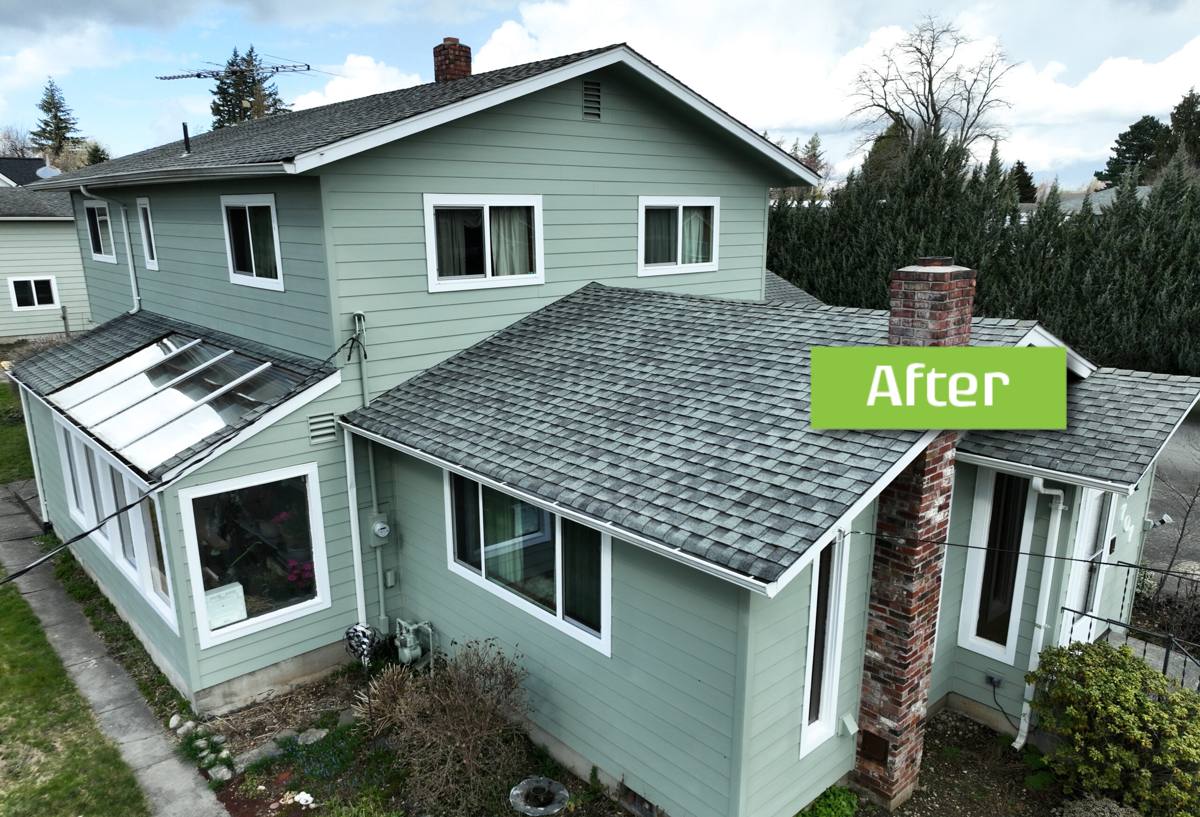
Signs Your Ferndale Roof Has Storm Damage
Storm damage is rarely as obvious as a hole you can see from the driveway. Most of the damage we find on Ferndale roofs after a wind or rain event is subtle enough that homeowners live with it for weeks before a stain shows up on a ceiling. Worth checking after any significant storm:
- Shingles that look curled, cracked, or creased, especially on slopes that face the prevailing wind
- Granules collecting in gutters or at the base of downspouts — a sign the shingle surface has been abraded
- Lifted or missing shingle tabs, particularly near ridges, hips, and valleys
- Bent, loose, or missing flashing around chimneys, vents, and skylights
- Soft or discolored patches on interior ceilings, even faint ones, especially near exterior walls
- Debris, moss clumps, or branch damage sitting on the roof after the storm has passed
- Gutters pulling away from the fascia or sagging under storm debris
Any one of these on its own might not mean much. Two or three together, especially after a storm, is a good reason to get an inspection before the next round of rain finds the weak spot for you.
What a Correct Storm Damage Repair Actually Involves
It starts with an actual inspection, not a guess from the ground
A lot of storm damage repair goes wrong because it starts with patching the one obvious problem — a missing shingle, a torn section — without checking whether the storm caused damage elsewhere that isn't visible yet. A proper repair starts with someone on the roof, checking every slope, every penetration, and every valley, not just the area the homeowner pointed to. Wind damage in particular tends to show up in more than one spot, because the same gust that tore one shingle usually stressed the ones around it too.
Matching materials, not improvising with what's on the truck
A repair is only as good as how well it blends into the existing roof, structurally and visually. That means matching shingle type, weight, and where possible color, and using flashing and underlayment details that are actually compatible with what's already there rather than whatever happens to be in the truck. Mismatched repairs are one of the most common reasons a "fixed" roof leaks again in the next storm — the new material doesn't shed water the same way the surrounding roof does, so water finds the seam.
Fixing the cause, not just the symptom
If moss contributed to the damage, patching the shingle without addressing the moss just guarantees a repeat. Same with clogged gutters that caused water to back up under the roof edge, or flashing that was already failing before the storm hit. A correct repair looks at what let the storm cause damage in the first place, not just what the storm broke.
Our Storm Damage Repair Process
We keep this process straightforward because storm damage is stressful enough without a confusing scope of work. Here's how it typically goes for a Ferndale home:
- Emergency stabilization, if needed. If there's an active leak or exposed decking, the first priority is getting the roof watertight — tarping, temporary flashing, whatever stops water from getting into the structure while a full repair is planned.
- Full roof inspection. We walk the entire roof, not just the damaged area, and document what we find with photos.
- Written scope and estimate. You get a clear breakdown of what needs to be repaired, what materials will be used, and a real price — not a vague range.
- Insurance documentation, if you're filing a claim. We provide the photos and written findings your adjuster will want to see, in the format they typically expect.
- The repair itself. Matching materials, proper flashing details, and attention to the surrounding areas that took stress from the same storm.
- Cleanup and final walkthrough. Debris removed, gutters cleared if they were affected, and a chance for you to ask questions before we consider the job done.
Insurance Claims and Storm Damage
Most storm damage repairs in this area involve a homeowner's insurance claim at some point, and the process goes more smoothly when the documentation is solid from the start. Adjusters are looking for clear evidence that the damage is storm-related and recent, not gradual wear that happened to get noticed after a storm. That's part of why a thorough, dated inspection with photos matters — it gives you something concrete to work with rather than a verbal description after the fact.
We're not a public adjuster and we don't negotiate your claim for you, but we can provide the kind of documentation that makes your claim easier to support, and we're happy to talk through what we found so you understand what you're dealing with before you call your carrier.
Repair or Replacement — How to Think About It
Not every storm-damaged roof needs to be replaced, and not every roof is a good candidate for another round of patching. The right call usually comes down to a few practical factors:
| Factor | Leans toward repair | Leans toward replacement |
|---|---|---|
| Age of the roof | Roof is well within its expected service life | Roof is already near or past typical lifespan for its material |
| Extent of damage | Damage is localized to one or two areas | Damage is spread across multiple slopes |
| Condition before the storm | Roof was in good shape prior to the storm | Roof already showed significant moss, wear, or prior repairs |
| Material availability | Matching shingles are still available | Original product is discontinued or heavily faded elsewhere |
| Underlying decking | Decking is sound where exposed | Decking shows rot or soft spots |
We'll always tell you honestly which side of that table your roof falls on. A repair that's likely to fail again within a year or two isn't a good use of your money, and we're not going to sell you one just because it's a smaller job.
Materials and Methods Suited to This Climate
Whatcom County's coastal weather is part of why we pay close attention to a few details that matter more here than they would in a drier, inland climate:
- Corrosion-resistant fasteners and flashing to hold up against salt air over the long run, rather than standard-grade metal that pits and stains within a few years
- Proper underlayment as a second line of defense under the shingles, since driving rain can push moisture further under roofing edges than a straight-down rain ever would
- Ventilation checks during any repair, because a roof that traps moisture underneath is more likely to develop rot and mold regardless of how good the shingles on top look
- Moss-resistant products where appropriate, understanding that no product eliminates moss entirely in this climate — regular maintenance still does most of the work
None of this is about upselling premium materials for the sake of it. It's about not repeating the same repair every couple of years because the materials weren't suited to the conditions in the first place.
Why a Crew That Already Works Ferndale Matters
A roofer who works Ferndale regularly already knows what the local weather does to roofs before they ever climb the ladder. They know which slopes tend to catch the worst of the wind off the water, how fast moss reestablishes itself in this climate, and what flashing details tend to fail first on homes built in this area during different eras. That local pattern recognition shortens the inspection and sharpens the diagnosis — instead of treating your roof as a generic case, we're comparing it against dozens of similar roofs we've already worked on nearby.
It also means faster response when a storm actually causes damage. Being local to Whatcom County means we're not driving in from two counties away after every homeowner in a wider region calls at once — we can get eyes on your roof and get it stabilized without a long wait while water sits on exposed decking.
After the Repair: Keeping the Same Damage From Coming Back
A repair is only worth doing if it holds up. A few habits go a long way toward protecting that investment in this climate:
- Clear moss off the roof surface at the first sign of growth rather than waiting for a thick mat to form
- Keep gutters and downspouts clear so storm rain has somewhere to go instead of backing up under the roof edge
- Trim back overhanging branches that drop debris and shade damp areas of the roof, which encourages moss
- Have the roof looked at after any major wind event, even if nothing looks obviously wrong from the ground
- Address small issues — a lifted shingle corner, a loose flashing edge — as soon as they're noticed rather than waiting for the next storm to make them worse
If you're dealing with storm damage on a Ferndale roof, or you just want an honest opinion on what a recent storm may have done, we're glad to come take a look. Fill out the form below for a free, no-pressure estimate.