 Blaine Siding
 Siding Built for Ferndale's Climate, Not Just Its Curb Appeal
Ferndale sits close enough to the water and the marine air moving in off the Salish Sea that its homes take on a different kind of weathering than houses further inland. It's not one dramatic storm that wears siding down here — it's the accumulation. Salt-tinged air settles onto exterior surfaces day after day. Driving rain off Georgia Strait comes in sideways during winter fronts, working into every lap, seam, and fastener hole it can find. And for a good stretch of the year, shaded north walls and tree-lined lots stay damp long enough for moss and algae to take hold. None of this is exotic — it's just steady, patient pressure. Siding that isn't built for that kind of exposure shows it early: swelling at the bottom edges, peeling paint, soft spots around trim, and a general tired look years before it should.
We're a Blaine-based exterior contractor covering the Whatcom County coastal corridor, and Ferndale is core territory for us — not a stretch assignment. We know what this specific stretch of Pacific Northwest coastline does to a house, and we build our recommendations around that reality rather than a generic siding pitch.
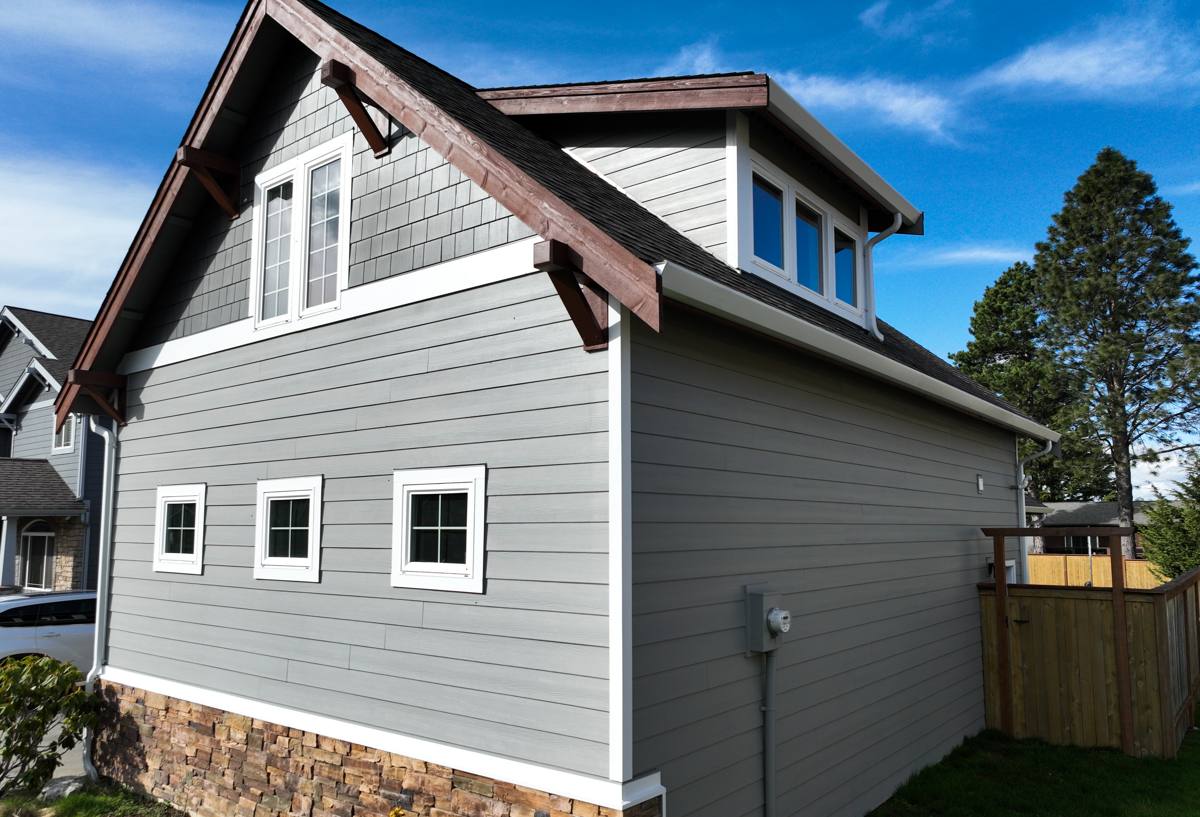
What Ferndale Homes Actually Face
Salt Air and Slow Corrosion
Coastal salt air doesn't just affect metal — it accelerates the breakdown of paint films and can speed up moisture absorption in porous or engineered wood products. Over years, homes closer to the water tend to need repainting and caulk maintenance more often than the same house would inland. Siding material matters here: some products handle salt-air exposure with minimal fuss, others need more frequent upkeep to keep ahead of it.
Driving Rain and Wind-Driven Moisture
Whatcom County's winter storm pattern regularly pushes rain horizontally against west- and south-facing walls. That means water isn't just running down siding — it's being forced up under laps and into any gap where caulking has failed or flashing was cut short. Homes with wide eave overhangs fare better than homes with tight or nonexistent overhangs, but installation detail matters more than roof design alone.
Moss, Algae, and the Long Wet Season
Between fall and spring, a lot of Ferndale properties simply don't dry out fully between rain events, especially on shaded elevations or under mature trees. That sustained dampness is exactly what moss and algae need to establish on siding surfaces, in gutters, and along roof lines. It's cosmetic at first, but left unchecked it holds moisture against the wall assembly longer than it should.
Temperature Swings and Material Movement
Whatcom County doesn't see extreme heat, but the daily and seasonal swings still cause wood-based and vinyl products to expand and contract. Over enough cycles, that movement works fasteners loose, opens up caulk joints, and telegraphs through paint as hairline cracking.
Why We Install Only James Hardie Fiber Cement
We made a deliberate call as a company to install James Hardie fiber cement siding exclusively — not vinyl, not LP SmartSide, not cedar, not primed spruce, not other fiber cement brands. That's not a marketing angle; it's a standard we hold because of what we've seen these products do, and not do, in exactly the kind of climate Ferndale sits in.
Fiber cement is a mix of cement, sand, and cellulose fibers, engineered to be genuinely inert to moisture, insects, and the freeze-thaw stress that affects the Pacific Northwest. It doesn't swell when it gets wet, it doesn't feed rot, and it's non-combustible. James Hardie specifically manufactures a version of this product engineered for our region's humidity and rainfall — the HZ5 product line — with an emphasis on resisting moisture-related damage rather than just looking good on install day.
The factory-applied ColorPlus finish is the other half of why we standardized on Hardie. It's baked on under controlled conditions, not brushed or sprayed on-site, which gives it more consistent coverage and a longer service life before repainting is needed — a real advantage given how often salt air and driving rain force repaint cycles on other materials in this area.
What We're Passing On, and Why
| Product | The trade-off in this climate |
|---|---|
| Vinyl siding | Can warp or distort under heat and impact, and seams are a long-term entry point for wind-driven rain |
| LP SmartSide (engineered wood) | Wood-based core is more moisture-sensitive than fiber cement; cut edges and fastener points need diligent sealing to hold up |
| Cedar | Beautiful material, but requires ongoing staining/sealing and is more vulnerable to moss, rot, and insect damage in a wet climate |
| Primed spruce / other wood panel | Primer is a starting point, not a finish — repainting cycles come faster, and moisture intrusion risk is higher over time |
| Other fiber cement brands | We've standardized on Hardie's engineering, factory finish process, and warranty structure specifically — consistency matters for installation quality and long-term service |
None of these products are inherently bad — vinyl and engineered wood both have a place, and cedar remains a genuinely attractive option for people willing to maintain it. Our decision is about what we're willing to put our name behind, install to spec, and stand behind for a coastal Whatcom County climate specifically.
How This Plays Out on a Ferndale Job
Assessment First
Every project starts with a walk-around of the existing exterior — siding condition, trim, flashing at windows and rooflines, and any signs of moisture intrusion already underway. On older homes we pay particular attention to areas that don't get direct sun, since that's where moss and slow-drying moisture tend to concentrate.
Installation Detail Matters More Than the Material
Even the best siding fails early if it's installed wrong. For a marine climate like Ferndale's, that means correct fastener placement and spacing, proper flashing and kick-out details at rooflines and windows, adequate clearance at grade so siding isn't sitting in splashback or standing moisture, and caulking only where Hardie's specifications actually call for it — over-caulking traps moisture just as badly as under-caulking lets it in.
Beyond Siding
We also handle roofing, windows, and decks, which matters because these systems aren't independent of each other. A roof with poor flashing dumps water straight onto a siding wall. Old windows with failed seals push moisture into the wall cavity behind brand-new siding. Decks attached to the house need proper ledger flashing so they're not funneling water into the wall assembly. We look at the whole exterior envelope, not just the piece someone called about.
What a Ferndale Siding Project Typically Involves
- On-site inspection of existing siding, trim, and moisture-prone areas
- Removal of old siding and inspection of the sheathing and weather barrier underneath
- Repair of any water-damaged sheathing found once old siding comes off
- Installation of a compliant weather-resistant barrier before new siding goes on
- James Hardie fiber cement installation to manufacturer spec, including fastener pattern and clearances
- Flashing and sealant detailing at windows, doors, and roof intersections
- Final walkthrough covering care and what to watch for seasonally
Cost Factors Worth Knowing Upfront
Every home is different, and we don't quote sight-unseen, but a few things reliably move the number up or down on a Ferndale job:
| Factor | Why it matters |
|---|---|
| Condition of sheathing underneath old siding | Hidden moisture damage found during tear-off adds repair scope before new siding goes up |
| Home size and wall complexity | More corners, dormers, and trim detail mean more labor and material cuts |
| Siding profile and color choice | Lap width, panel style, and ColorPlus color all affect material cost |
| Access and site conditions | Tight lots, mature landscaping, or multi-story walls affect scaffolding and labor time |
| Trim and accessory scope | Fascia, soffit, and trim replacement alongside siding changes the total project size |
Why a Local Crew Matters Here
Whatcom County's coastal microclimate isn't uniform — a house a few miles inland dries out differently than one closer to the water, and shaded lots behave differently than open ones. A crew that works this specific area regularly builds a feel for where moss shows up first, which elevations take the worst of the winter rain, and what kind of prep work tends to be hiding under older siding in homes of a certain age. That's the kind of judgment that doesn't come from a spec sheet — it comes from doing the work here, on these streets, in this weather, repeatedly.
Being based out of Blaine also means we're not treating Ferndale as a drive-by market. Scheduling, warranty follow-up, and any callback needs are handled by a crew that's already local, not dispatched from somewhere hours away.
Maintenance Realities for This Climate
Even the right siding benefits from basic upkeep in a climate like this. Rinsing off accumulated grime and early moss growth once or twice a year keeps surfaces cleaner and prevents buildup from taking hold. Keeping gutters clear reduces water running down siding faces during heavy rain. Trimming back vegetation that keeps a wall shaded and damp helps siding dry out properly between storms. None of this is heavy maintenance — it's the kind of light, occasional attention that keeps a good siding job looking good for its full service life instead of fighting an uphill battle against the climate from year one.
Get a Straight Answer for Your Ferndale Home
If your siding is showing its age — soft spots, peeling paint, persistent moss, or just a tired look after a few too many wet winters — we're glad to come take a look. We'll walk the exterior with you, tell you honestly what we see, and explain what James Hardie fiber cement would involve for your specific home. There's no pressure and no obligation. Reach out below for a free estimate.