 Blaine Siding
 Sandy Point's Exposure: Living Where Land Meets the Strait
Sandy Point sits right up against the water in northern Whatcom County, close enough to the Strait of Georgia and the Canadian border that the weather off the water is a daily fact of life, not an occasional event. Homes here take on a steady diet of salt-laden air, wind-driven rain, and the kind of persistent shade and moisture that lets moss get a foothold on almost any surface that isn't actively shedding water. It's a beautiful place to live, and it's also one of the more demanding micro-climates for exterior building materials anywhere in this part of the state.
We work throughout Blaine and the surrounding Whatcom County communities, and Sandy Point is one of the areas where we see the clearest difference between siding, roofing, and trim products that are built for this exposure and products that simply aren't. A material that performs fine forty miles inland can fail early here, and homeowners often don't find out until the damage is already behind the surface.
What Salt Air Does to a Home's Exterior
Salt air isn't just a coastal cliché — it's a chemical reality. Airborne salt is hygroscopic, meaning it pulls moisture out of the air and holds it against whatever surface it lands on. On a home's exterior, that means fasteners, flashing, trim, and siding are exposed to more sustained moisture contact than the same materials would see a few miles inland, even on days that aren't technically rainy.
Over time, that translates into a few predictable problems on Sandy Point homes:
- Faster corrosion on unprotected or low-grade metal fasteners and flashing
- Paint and finish failure that shows up years earlier than the manufacturer's timeline suggests
- Wood trim and siding that stays damp longer between rain events, accelerating rot at joints and end cuts
- Caulk and sealant joints that break down faster under repeated wet-dry, salt-laden cycling
None of this means a home near the water is doomed to constant repair. It means the materials and installation details matter more here than they do in a drier, more sheltered part of the county.
Rain, Moss, and the North Whatcom Wet Season
Whatcom County's wet season runs long, and Sandy Point's proximity to open water tends to add wind-driven rain to the mix — rain that hits siding at an angle instead of running straight down, working its way into laps, seams, and trim joints that would stay dry in a calmer setting. That combination of volume, duration, and wind is what separates "rainy" from "driving rain" in a builder's vocabulary, and it's a big part of why siding detailing around windows, doors, and butt joints deserves more attention here than in a typical inland install.
Why Moss Matters More Than Cosmetics
Moss gets treated as a cosmetic nuisance, but on a home's exterior it's a moisture problem wearing a green coat. Moss and algae hold water against the surface they're growing on, and on siding, trim, or roofing that means a longer wet-dry cycle in exactly the spots — north-facing walls, shaded eaves, low-sun corners — that are already slowest to dry out. On products that absorb or trap moisture, that sustained dampness is where rot and finish failure start. On products engineered to shed water and resist moisture intrusion, moss stays a surface issue that a periodic gentle cleaning handles.
Why We Install Only James Hardie Fiber Cement in Sandy Point
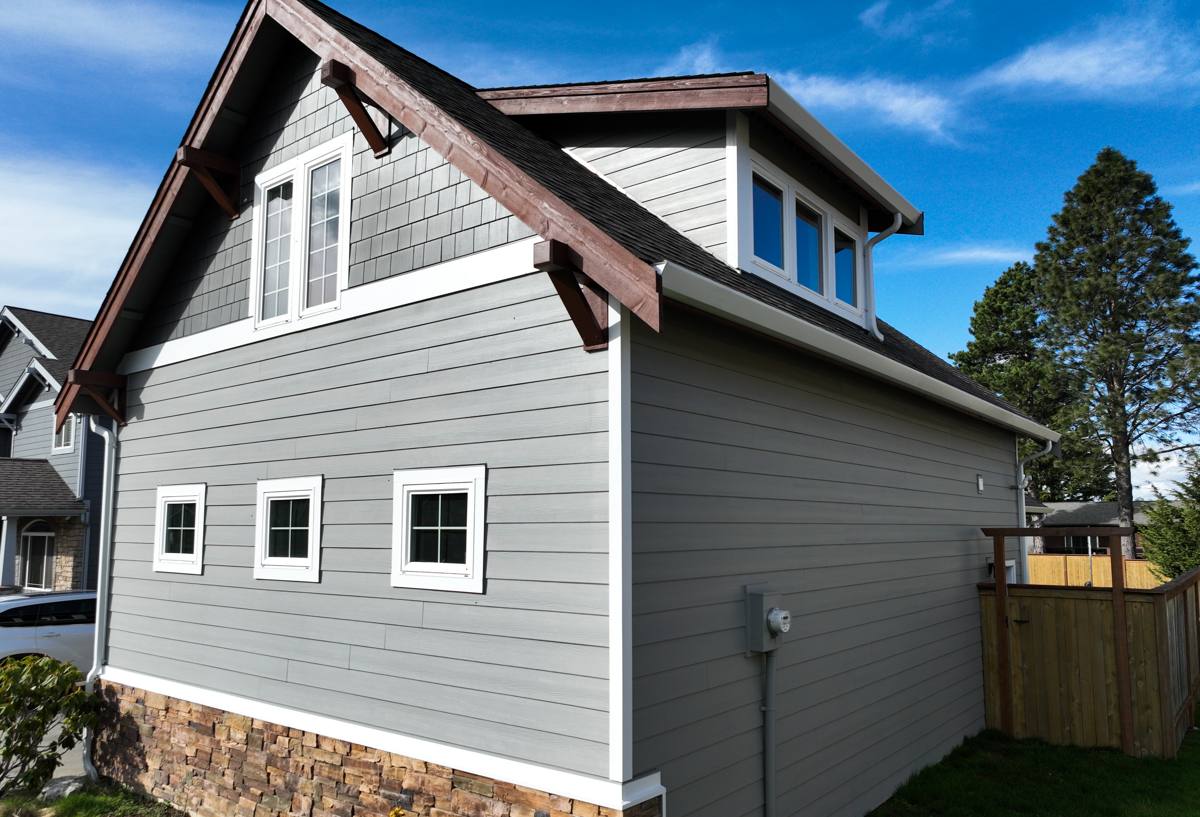
We made a decision a while back to stop installing several products that are common elsewhere in the industry, and Sandy Point is one of the areas where that decision matters most. We install James Hardie fiber cement siding exclusively — no vinyl, no LP SmartSide, no Cemplank, no Allura, no primed spruce or cedar. That's not a marketing position; it's a standard we hold because of what we've seen these products do, and not do, in coastal exposure over time.
Fiber cement is non-combustible and dimensionally stable, meaning it doesn't expand and contract with moisture the way wood-based products do. That matters directly in a salt-air, high-moisture environment: materials that swell and shrink repeatedly develop gaps and stressed joints, and those gaps are where water gets in. James Hardie's ColorPlus finish is baked on in a factory-controlled process and backed by its own finish warranty, which holds up better against UV and salt exposure than field-applied paint on wood trim typically does.
What About Vinyl or Wood?
Vinyl siding has a real place in the market — it's inexpensive and low-maintenance in the right setting. But it's a thin, heat-sensitive material that can warp, and its seams and panel joints rely heavily on correct installation to shed wind-driven rain rather than let it track behind the panel. Wood and wood-composite products like primed spruce, cedar, or LP SmartSide can look excellent and perform well when meticulously maintained, but they depend on an intact paint film and regular upkeep to keep moisture out — and in a spot like Sandy Point, where moisture pressure is higher and the maintenance window is shorter, that dependency is a real trade-off. James Hardie's HZ product lines are specifically engineered for the moisture and climate conditions of the Pacific Northwest, which is why it's what we put on homes in this area rather than asking homeowners to manage a higher-maintenance product against a demanding exposure.
Beyond Siding: Roofing, Windows, and Decks for Waterfront Exposure
Siding doesn't work in isolation — it's one piece of a building envelope that has to work together to keep water out. We handle roofing, windows, and decks in Sandy Point as well, and the same salt-air, moss, and driving-rain logic applies to each:
- Roofing: flashing details and underlayment choices matter more under wind-driven rain, and moss control on a roof protects both the roofing material and the decking underneath it
- Windows: proper flashing integration between the window and the siding is one of the most common failure points we find on coastal homes, regardless of who installed the siding
- Decks: fasteners, ledger flashing, and board spacing all need to account for a wetter, saltier environment than a deck built inland would face
When one contractor handles the full exterior envelope, those transition points — where siding meets roof, where window meets wall, where deck meets house — get built by people who understand how all of it needs to work together, instead of being handed off between trades that never talk to each other.
What Working With a Local Blaine Crew Looks Like
A crew that works Whatcom County's water-adjacent neighborhoods regularly develops a feel for which details actually matter here — where wind-driven rain tends to hit hardest on a given lot orientation, which north-facing walls will hold moss longest, which flashing details are worth the extra time. That's knowledge you build by working the same coastline repeatedly, not something you get from a general installation manual. When you're hiring for a home in Sandy Point, it's worth asking any contractor directly about their experience with coastal exposure specifically, not just siding installation in general.
Cost Factors for Sandy Point Homes
| Factor | Why It Matters Here | Effect on the Job |
|---|---|---|
| Wall orientation and wind exposure | West and north-facing walls take the brunt of driving rain and stay damp longest | May need extra flashing detail or trim attention in those areas |
| Existing moss or moisture damage | Long-term moss growth can mask rot in sheathing or trim behind old siding | Tear-off may reveal repair work beyond the original scope |
| Home access and site conditions | Waterfront lots can have tighter access, slopes, or landscaping to protect | Affects staging, scaffolding, and material handling time |
| Fastener and flashing grade | Salt air accelerates corrosion on lower-grade metal | Corrosion-resistant fasteners cost more but last considerably longer |
| Scope: siding only vs. full envelope | Roofing, windows, or decking issues found mid-project add work | Bundling assessment upfront avoids surprise change orders |
A Maintenance Checklist for Salt-Air Homes
Whatever your current siding, these habits go a long way toward protecting an exterior in Sandy Point's climate:
- Rinse salt residue off siding and windows periodically, especially after windy storms off the water
- Keep gutters and downspouts clear so water isn't sitting against fascia or siding longer than it needs to
- Trim back vegetation that shades walls and slows drying time, since shaded, damp areas are where moss and rot take hold first
- Inspect caulking and trim joints once a year, and reseal before small gaps become water paths
- Address moss on siding or roofing promptly with a gentle, non-pressure-washing method rather than letting it spread
- Watch north-facing and low-sun corners closely — they're consistently the first place problems show up
Getting Started
If you're weighing a siding, roofing, window, or deck project on a Sandy Point home, we're happy to take a look and walk you through what we're seeing and why we'd recommend one approach over another. Reach out for a free, no-pressure estimate — there's a form right below to get that conversation started.