 Blaine Siding
 A Community That Takes Weather Seriously
Point Roberts sits on its own peninsula, cut off from the rest of Whatcom County by water and land border, surrounded by the Strait of Georgia and Boundary Bay. That geography is what makes the place special, and it's also what makes exterior building materials work harder there than almost anywhere else in the region. Homes here face a near-constant flow of marine air, long stretches of driving rain off the water, and the kind of persistent dampness that keeps moss and algae established on rooflines and siding for most of the year.
We work in Point Roberts as part of our normal Blaine and Whatcom County service area, and we treat it as its own case, not a smaller version of a mainland job. The exposure is different, the wind loading off open water is different, and the margin for error on flashing and sealing is smaller. A house built or sided without that in mind tends to show it early — usually at trim joints, corners, and anywhere water is asked to run off rather than being properly shed.
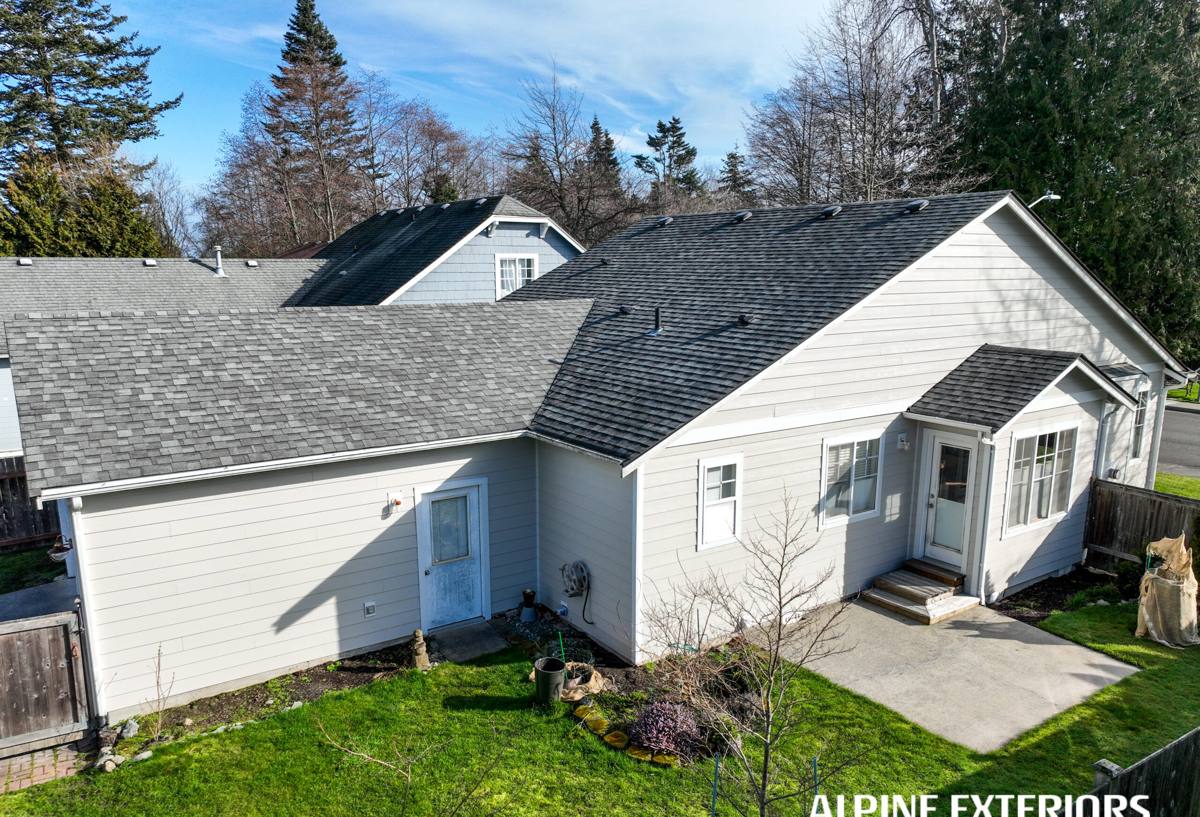
What Salt Air and Driving Rain Actually Do to a House
Salt Air
Airborne salt doesn't just sit on the surface of a house — it works into fasteners, metal flashing, and any exposed edge of a building material. Over years, that accelerates corrosion in ungalvanized or lower-grade hardware, degrades some paint systems faster than inland exposure would, and can cause certain siding products to fail chemically at the surface, not just wear down.
Driving Rain
Wind off open water doesn't just drop rain straight down — it drives it sideways into wall assemblies, especially on the water-facing sides of a home. That means seams, laps, and butt joints in siding take on more water pressure than they would on a sheltered inland lot. Products and installation details that are "good enough" in a calm setting can start to leak or wick moisture in a driving-rain environment.
Moss and Persistent Moisture
Point Roberts' moss season runs long. Shaded roof slopes, north-facing walls, and anywhere airflow is limited stay damp for extended periods, which is exactly the environment moss, algae, and mildew need to take hold. On wood-based or moisture-sensitive siding, that persistent dampness is a slow path toward rot, delamination, or paint failure, even if the surface looks fine from the street for the first few years.
Why We Only Install James Hardie Fiber Cement Siding
We install James Hardie fiber cement exclusively — not vinyl, not LP SmartSide, not primed spruce or cedar, not other fiber cement brands. That's a deliberate standard, not a default, and it matters more in a place like Point Roberts than almost anywhere else we work.
How It Handles Moisture
Fiber cement is cement-based, not wood-based, so it doesn't absorb water the way engineered wood siding does and it doesn't provide the organic material that rot depends on. In a location with a long wet season and driving rain, that's the difference between siding that shrugs off years of damp exposure and siding that needs the moisture kept perfectly away from it to perform as advertised.
Climate-Engineered for This Region
James Hardie makes region-specific product formulations, and the HZ5 line is engineered for the Pacific Northwest's freeze-thaw cycles and wet climate specifically, as opposed to a one-formulation-fits-all product. That's a meaningful distinction for a peninsula community where the weather doesn't let up for months at a time.
ColorPlus Factory Finish
Salt air is hard on field-applied paint. Hardie's ColorPlus finish is baked on in a factory-controlled process, which gives it better fade and wear resistance than most site-applied paint jobs, and it comes with its own finish warranty. In a salt-air environment, a factory finish that's cured and tested under controlled conditions holds up more predictably than paint applied on-site in variable weather.
Non-Combustible
Fiber cement doesn't burn. That's not the primary driver for a coastal job like this one, but it's a real, permanent advantage over vinyl and wood-based products regardless of where the home sits.
Why We Steer Homeowners Away From the Alternatives
None of these products are inherently bad — they all have a place in the market. Our position is about what we're willing to put our name on in this specific climate, not a blanket condemnation.
Vinyl Siding
Vinyl is affordable and low-maintenance in mild conditions, but it can become brittle in cold snaps, and its seams and panel joints rely on lap-and-overlap installation that isn't sealed the way fiber cement can be. In a driving-rain, salt-air setting, that reliance on gravity and overlap rather than a true weather seal is a real trade-off.
LP SmartSide and Other Engineered Wood
Engineered wood siding has improved a great deal over the decades, but it's still wood-based at its core, which means it's more sensitive to sustained moisture exposure than cement-based siding. In a location with as much standing dampness and moss pressure as Point Roberts, that sensitivity is exactly the wrong trait.
Primed Spruce and Cedar
Real wood siding has genuine appeal, but it demands an ongoing maintenance commitment — recoating, caulking, and monitoring for rot — that most homeowners underestimate until they're several years in. On a water-exposed peninsula lot, that maintenance clock runs faster than it would inland.
Roofing for a Wind-and-Salt Environment
Roofing takes the most direct hit from both wind and moisture on a Point Roberts home. We look closely at flashing quality, fastener corrosion resistance, and ventilation when we're on a roof out here, because a roof that's fine on paper can still fail early if the details weren't built for salt exposure and heavy wind-driven rain. Proper attic and roof ventilation also matters more in a persistently damp climate — trapped moisture under a roof deck accelerates the same rot and moss problems we see on siding.
Windows: Sealing Against Driving Rain
Window failures in this kind of environment are usually not glass failures — they're seal and flashing failures. Wind-driven rain finds any gap in the flashing detail around a window opening, and once water gets behind the frame, it can sit there and cause damage that isn't visible until it's advanced. When we replace windows in Point Roberts, proper flashing integration with the surrounding siding is treated as part of the job, not an afterthought, because a good window installed with poor flashing will leak regardless of the window's own quality.
Decks: Standing Up to Moss Season
Decks in Point Roberts deal with the same long wet season as everything else — shaded areas stay damp, and moss and algae can build up on decking surfaces, making them slippery as well as unsightly. Material choice, proper spacing for drainage and airflow underneath, and fastener quality all affect how well a deck holds up through repeated wet-dry cycles year after year.
Comparing Siding Options for a Coastal Exclave Property
| Factor | Vinyl | Engineered Wood (LP SmartSide) | Cedar / Primed Spruce | James Hardie Fiber Cement |
|---|---|---|---|---|
| Moisture resistance | Fair (seam-dependent) | Moderate | Low without upkeep | High |
| Salt air durability | Moderate | Moderate | Moderate to low | High |
| Finish longevity | Fades over time | Field-painted, variable | Requires recoating | Factory-cured ColorPlus finish |
| Combustibility | Combustible | Combustible | Combustible | Non-combustible |
| Ongoing maintenance | Low | Moderate | High | Low |
Why a Local Crew Matters Here
Point Roberts is only reachable by land through Canada, which changes how a contractor has to think about a job — material staging, scheduling, and being available to actually show up matter more when the community is somewhat isolated from the rest of Whatcom County. A crew that's used to working the Blaine area and understands that logistics reality tends to plan better and follow through more reliably than one treating it as an occasional out-of-the-way job. We also simply know the weather pattern here — the salt exposure, the wind direction off the water, and how long the wet season really runs — and that shapes the installation details we pay closest attention to.
What to Check Before Hiring for a Point Roberts Exterior Project
- Confirm the crew has actually worked in Point Roberts or similar water-exposed sites, not just the general Blaine area
- Ask what fastener and flashing materials they use for salt-air exposure
- Ask how they handle scheduling and material delivery given the location
- Get specifics on the siding product line and warranty, not just a brand name
- Ask how they detail window and door flashing against wind-driven rain
- Confirm whether roof ventilation is assessed as part of any roofing or siding project
- Ask for a written scope that covers trim, flashing, and fastener specs, not just "siding installation"
What a Project Typically Involves
Every home is different, but most exterior projects in Point Roberts start the same way: a walk-around assessment of current siding, trim, flashing, and roof condition, with particular attention to water-facing walls and shaded, moss-prone areas. From there we talk through material and color options, explain how the HZ5 Hardie line performs in this specific climate, and put together a scope that addresses not just the visible siding but the flashing, trim, and ventilation details that determine whether it holds up long-term.
Get a Free, No-Pressure Estimate
If you're dealing with siding, roofing, window, or deck concerns on a Point Roberts property, we're happy to take a look and give you an honest read on what's going on and what it would take to fix it right. Use the form below to request a free estimate — no pressure, no obligation.