 Blaine Siding
 Siding Built for Grandview's Coastal Exposure
Grandview sits close enough to the water that its homes take on a different weathering pattern than houses even a few miles inland. Salt-laden air moves through the area on a regular basis, driving rain comes in sideways during winter storms off the Strait of Georgia and Boundary Bay, and the shaded, damp stretches of the neighborhood stay wet long after a storm has passed through the rest of Whatcom County. That combination — salt, wind-driven moisture, and a moss season that can run half the year — is hard on exterior building materials, and it shows up first and worst on siding.
We work on homes throughout Grandview and the surrounding Blaine area, and the pattern we see is consistent: siding that was a fine choice somewhere drier or more sheltered starts showing problems here years before it should. That's not a knock on any one homeowner's choices — it's just what this stretch of coastline does to a building envelope over time. Our job is to put products and installation methods on your house that are actually engineered for this exposure, not just siding that looks good on a showroom sample.
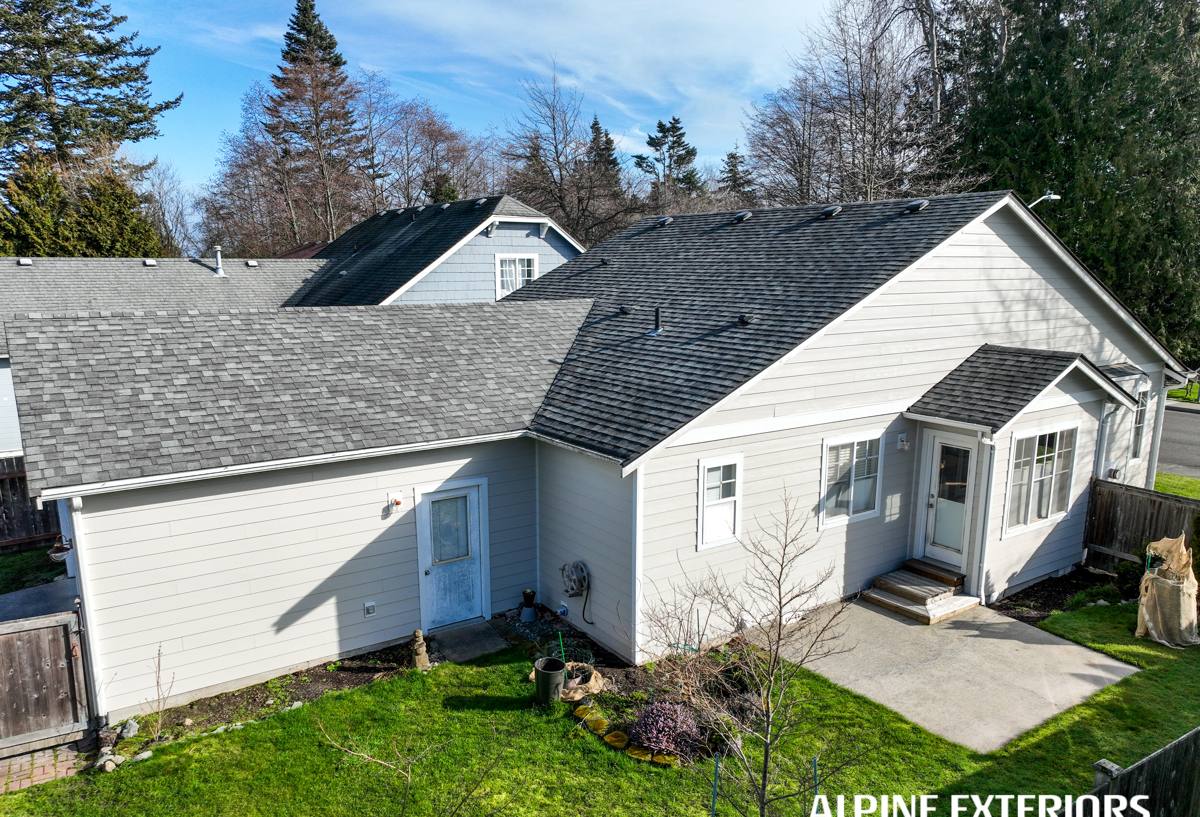
What the Local Climate Actually Does to a House
Salt Air and Corrosion
Airborne salt doesn't just affect metal fasteners and flashing — it accelerates the breakdown of paint films, softens caulk faster than manufacturers' published lifespans suggest, and works its way into any seam or gap in the exterior. Homes closer to open water in Grandview feel this more, but even properties set back from the shoreline get enough salt drift to matter over a couple of decades.
Driving Rain
Rain that falls straight down is manageable for almost any siding product. Rain that's being pushed sideways by wind off the water is a different problem — it gets forced up under laps, into unsealed joints, and behind trim that wasn't flashed correctly the first time. Most of the siding failures we're called out to look at in this area trace back to water intrusion at a seam, a butt joint, or a penetration (a hose bib, a light fixture, a deck ledger) rather than failure of the siding material itself.
Moss, Algae, and Prolonged Dampness
Whatcom County's moss season is long, and Grandview's tree cover and proximity to water keep humidity elevated even between rain events. Wood-based sidings and some engineered wood products absorb that moisture, swell, and eventually delaminate or rot at the edges. Moss and algae growth on siding surfaces isn't just cosmetic — it holds moisture against the substrate and shortens the useful life of whatever's underneath it.
Why We Only Install James Hardie Fiber Cement
Blaine Siding Contractor installs one siding system: James Hardie fiber cement. We don't offer vinyl, LP SmartSide, Cemplank, Allura, primed spruce, or cedar as options, and that's a deliberate standard, not a lack of range. In a climate like Grandview's, the material itself matters as much as the installation.
Fiber cement is non-combustible and dimensionally stable — it doesn't expand and contract with moisture the way wood-based products do, and it doesn't soften or swell at cut edges and joints the way engineered wood siding can when water finds its way in. James Hardie's ColorPlus factory-applied finish is baked on rather than field-painted, which means the pigment and topcoat hold up better against UV and salt exposure than a site-applied paint job, and it removes one common failure point: peeling or fading paint at the seams.
Hardie also builds region-specific product lines engineered for different climate zones (their HZ5 and HZ10 designations), which lets us match the substrate and engineering to what a coastal Pacific Northwest home actually needs rather than installing a one-size-fits-all product. Combined with a strong transferable warranty, it's the system we're comfortable standing behind on a house that's going to sit a few miles from saltwater for the next several decades.
We're upfront that other products have real advantages in the right situation — vinyl is inexpensive and low-maintenance in mild climates, cedar has a look some homeowners want, LP SmartSide is lighter and easier to handle on some job sites. But in Grandview's exposure, the trade-offs those products carry (moisture sensitivity, seam and caulk maintenance, shorter realistic service life before repainting or replacement) outweigh their upfront advantages. We'd rather install fewer products well than a broad menu of products we can't fully stand behind in this climate.
How Correct Installation Actually Works Here
Fiber cement siding performs the way it's supposed to only when it's installed to spec, and in a high-exposure area like Grandview the details matter more than usual. Our installation approach on every project includes:
- Correct rainscreen or drainage plane behind the siding so any moisture that does get past the surface has somewhere to go
- Proper flashing at every window, door, and roof-to-wall intersection — the majority of local siding failures start at these transitions, not in the field of the siding itself
- Manufacturer-specified fastener patterns and clearances, including gaps at butt joints and around penetrations to allow for the product's expansion and contraction
- Sealant and caulk products rated for coastal exposure, applied only where Hardie's specifications actually call for it (over-caulking traps moisture just as often as under-caulking lets it in)
- Correct clearance between the bottom of the siding and grade, decks, patios, and roof lines, so splash-back and standing water don't sit against the material
None of this is exotic — it's the manufacturer's published installation guide, followed completely, on a house where corner-cutting shows up faster than it would somewhere drier and calmer. A big share of the "siding failures" we get called to diagnose in Whatcom County are installation failures on a perfectly good product, not a material defect.
Siding Doesn't Work Alone — The Rest of the Envelope
Siding is one piece of a house's exterior, and in a climate this wet it doesn't perform in isolation. We also handle roofing, windows, and decks, and on most Grandview projects at least one of those comes up alongside a siding conversation:
Roofing
Roof-to-wall flashing details and gutter performance directly affect how much water your siding has to deal with. A roof that's dumping water onto a wall section, or a gutter that's overflowing during a heavy Pacific storm, will overwhelm even correctly installed siding at that spot.
Windows
Window flashing is one of the most common origin points for the water intrusion we find behind siding. If we're replacing siding around older windows, we look closely at whether the flashing needs to be corrected at the same time — patching siding around a bad window flashing detail just relocates the problem.
Decks
Deck ledger boards attached directly to a house are a frequent moisture entry point if they weren't flashed correctly when built. We see this on older Grandview properties where a deck was added without proper ledger flashing, and it's worth addressing as part of any siding project on that wall.
Comparing Siding Materials in a Coastal Whatcom County Climate
| Material | Moisture behavior in salt air / driving rain | Maintenance burden | Realistic lifespan here |
|---|---|---|---|
| James Hardie fiber cement | Non-combustible, dimensionally stable, factory finish resists salt and UV | Low — periodic wash, occasional caulk check at joints | Decades with correct installation and upkeep |
| Vinyl | Doesn't absorb moisture, but can warp/crack in temperature swings and wind-driven rain finds gaps at seams | Low, but seams and trim are common failure points | Variable; often needs replacement well before other materials |
| Cedar | Absorbs moisture readily; moss and algae growth accelerate rot in shaded, damp areas | High — regular refinishing, moss treatment, sealant renewal | Shorter without diligent, ongoing maintenance |
| LP SmartSide / engineered wood | Engineered to resist moisture but remains wood-based; edge and joint sealing is critical | Moderate — edge sealing and paint maintenance | Depends heavily on installation quality and sealant upkeep |
This isn't a claim that other products fail outright — it's a summary of the trade-offs we weigh when we tell homeowners why our crew standardized on one system for this climate.
Signs Your Siding May Already Be Struggling
Homeowners in Grandview often notice a problem well before they know what's causing it. A few signs worth a closer look:
- Soft or spongy spots when you press on the siding, especially near the bottom courses or around windows
- Persistent moss or algae streaking that comes back quickly after cleaning
- Visible gaps, cracking, or separation at butt joints and corners
- Peeling or bubbling paint, particularly on the sides of the house that face prevailing storms
- Musty smells or visible staining on interior walls that share a wall with exterior siding
- Warping or bowing panels, especially on wood-based or engineered wood siding
Any one of these is worth a look before it turns into sheathing or framing damage, which is a far more expensive repair than the siding itself.
What to Expect Working With a Local Crew
A crew that works Whatcom County regularly knows which walls of a Grandview house take the worst weather, how the local permitting process runs, and what correct flashing looks like for this specific rain-and-salt combination — not just what a national installation manual says in the abstract. That local knowledge shows up in small decisions throughout a project: where to add extra flashing attention, which sealants actually hold up here, and how to sequence work around the wetter months so the wall assembly isn't left exposed longer than necessary.
Our process on a typical Grandview project starts with an on-site assessment of the existing siding and any related roofing, window, or deck issues, followed by a written estimate that spells out the product, the installation scope, and the timeline. We handle the removal of existing siding, correction of any flashing or sheathing issues we find underneath, and installation of the James Hardie system to manufacturer specification, with cleanup included.
Ready for a Straightforward Estimate
If your Grandview home is showing signs of wear from salt air, wind-driven rain, or long-term moss exposure, we're happy to take a look and give you an honest read on what's going on and what it would take to fix it right. There's a free, no-pressure estimate form below — reach out whenever you're ready to talk through your options.