 Blaine Siding
 Vinyl siding is the most common siding product in America for a reason: it's inexpensive, it goes up fast, and for a lot of climates it does an adequate job for a decade or two. We get asked about it constantly by homeowners in Blaine and across Whatcom County, and we want to answer honestly rather than just say "we don't do that." This page explains what vinyl actually gets right, where it struggles specifically in our corner of the Pacific Northwest, and why our crews only install James Hardie fiber cement.
What Vinyl Siding Gets Right
To be fair to the product: vinyl siding is lightweight, low in upfront cost, and doesn't need repainting. It's manufactured with integral color, so a scratch doesn't always mean bare substrate showing through. In dry, moderate climates with less temperature swing and less driving rain, vinyl can perform reasonably well for many years with minimal maintenance. None of that is in dispute.
The issue isn't that vinyl is a bad product everywhere. It's that Blaine's specific combination of salt air, driving rain off the Strait of Georgia, and a long, wet moss season creates conditions that expose vinyl's weaknesses faster and more visibly than they'd show up in, say, eastern Washington.
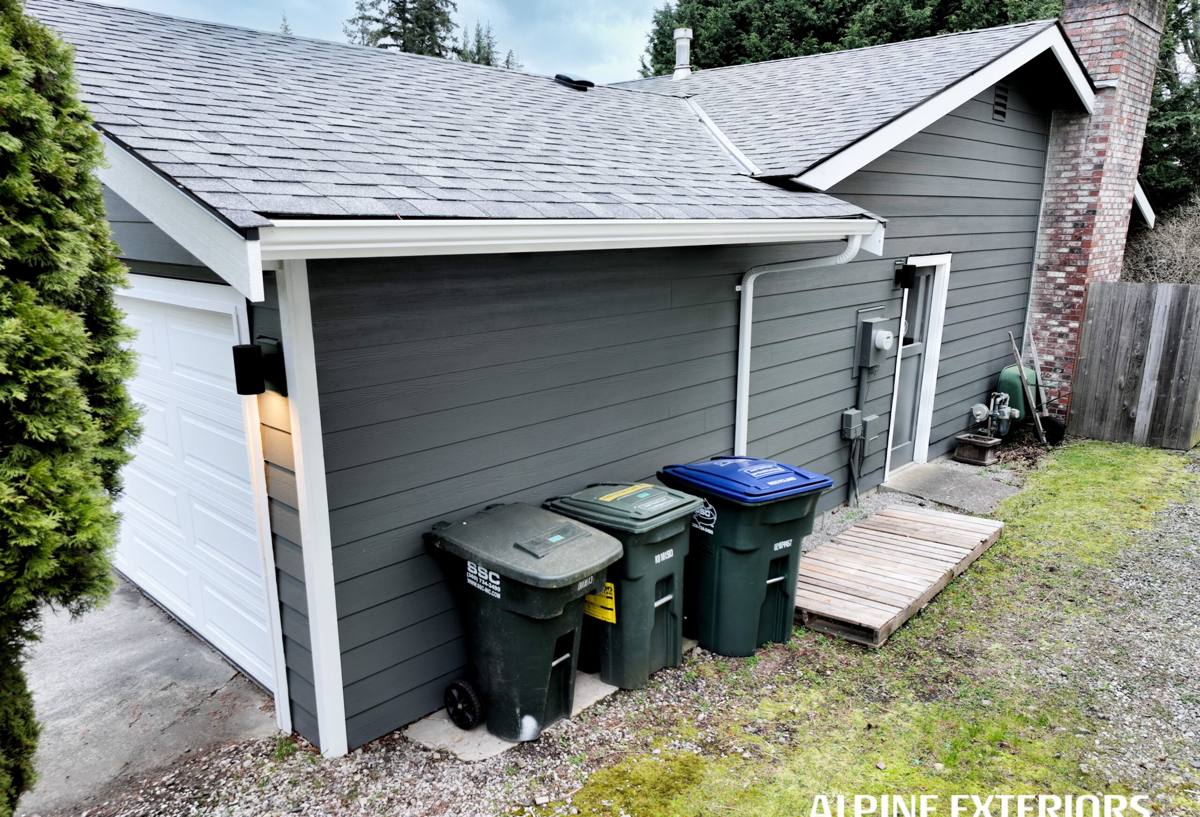
Blaine's Coastal Climate Is a Tough Test
Blaine sits right on the water, at the northern edge of Whatcom County, which means homes here deal with a combination of stressors that inland siding jobs rarely see all at once: salt-laden air blowing off the Strait, wind-driven rain that hits walls at an angle instead of falling straight down, and a wet season that runs long enough to grow moss on anything that stays damp for more than a few days. Any siding product has to hold up to all three, not just one.
Salt air is corrosive to fasteners and trim accessories over time, driving rain tests every lap joint and seam a siding system has, and a long moss season means anything with texture or trapped moisture behind it becomes a growing surface. Vinyl's design — thin, flexible panels that hang loosely on a wall and rely on overlapping laps rather than a sealed surface — was engineered around cost and ease of installation, not around resisting this specific combination.
Heat, Cold, and the Buckling Problem
Vinyl siding is a plastic product, and plastic expands and contracts with temperature more than wood-based or cement-based products do. Manufacturers account for this by requiring installers to nail it loosely, in the center of the nailing slot, so the panel can move behind the nail heads as it expands and contracts through the seasons. That sounds fine in theory, but it depends entirely on the installer doing it correctly, on every panel, on every wall exposure.
In practice, panels nailed too tightly buckle and ripple within a year or two, especially on south- and west-facing walls that see the widest daily temperature swings. Panels nailed correctly can still show waviness after enough thermal cycles. It's a product that looks best on day one and asks the installer and the material to keep behaving perfectly for the next twenty years — with no repainting option if it starts to look tired.
Moss Season and Moisture Behind the Panels
Vinyl siding is installed as a rain-screen-style overlapping system, not a sealed one. Water is expected to get behind it — the system is designed to let it drain and dry out. That works fine when drying happens quickly. It's a bigger question in a climate where the marine layer, fog, and steady drizzle mean walls can stay damp for extended stretches, particularly on north-facing elevations and in shaded side yards that don't get much sun exposure to dry things out.
Moss and algae growth on vinyl siding in Whatcom County is common, especially near the coast, and it tends to show up first in the low spots where water runs and lingers — inside corners, under window trim, along the bottom courses near grade. Cleaning it off is manageable, but it's an ongoing maintenance item rather than a one-time job, and pressure washing vinyl too aggressively can crack panels or force water behind the laps rather than removing it.
Wind, Impact, and Fastener Realities
Blaine gets its share of winter wind events off the water, and vinyl siding's wind rating depends heavily on fastener spacing and panel engagement being done correctly during installation — there's less margin for error than with a heavier, more rigid material. Impact resistance is also a fair consideration: vinyl can crack in cold weather when it's least flexible, which in our area lines up with the same cold snaps that bring wind-driven rain.
None of this means vinyl siding will fail on every home. Plenty of vinyl-sided houses in this region hold up fine for many years. But as a company, we've made a decision to only install products where we're confident in the long-term outcome across the full range of conditions Blaine actually throws at a house — not just the average year.
Vinyl Siding vs. Fiber Cement: A Side-by-Side Look
| Factor | Vinyl Siding | James Hardie Fiber Cement |
|---|---|---|
| Material behavior in heat/cold | Expands and contracts noticeably; can buckle if nailed incorrectly | Minimal thermal movement; engineered for climate-specific performance |
| Fire behavior | Combustible plastic; can melt or deform near heat sources | Non-combustible fiber cement core |
| Moss/algae resistance | Prone to growth in damp, shaded, coastal conditions | Dense surface resists moisture intrusion; factory finish sheds growth more easily |
| Finish | Integral color only; fades over time, cannot be repainted easily | ColorPlus factory-baked finish with a dedicated finish warranty; can be repainted later if desired |
| Impact resistance | Can crack, especially in cold weather | Denser, more impact-resistant material |
| Typical lifespan before replacement | Often 15-25 years depending on exposure | Manufacturer-rated for decades of service life when installed to spec |
| Warranty structure | Varies by manufacturer; often prorated | Long-term transferable warranty backed by James Hardie |
Why We Standardize on James Hardie
We install James Hardie fiber cement siding exclusively, and it's not a marketing preference — it's the product we're willing to put our name behind in this climate. Hardie's HZ5 product line is specifically climate-engineered for regions with more moisture and temperature swing, which describes Whatcom County's marine climate well. The material itself is non-combustible, dimensionally stable, and dense enough to resist the moisture intrusion that drives moss and algae growth on softer or more porous sidings.
The ColorPlus factory finish is baked on under controlled conditions rather than applied on site or built into a vinyl extrusion, which means better long-term color retention and a finish warranty that vinyl products generally don't offer in the same form. And because it's a real, paintable substrate, a Hardie-sided home can be refreshed with paint decades down the road if a homeowner wants a change — vinyl locks you into whatever color it shipped as.
We also like that fiber cement rewards correct installation with a genuinely long service life, rather than requiring near-perfect installation just to avoid early buckling. That matters to us because our name is on every job, long after the crew has moved on to the next one.
What to Ask Before You Choose a Siding Product in Blaine
- How does this siding perform specifically in coastal, high-moisture climates — not just the national average?
- Is the product combustible, and does that matter for your insurance or wildfire-adjacent concerns?
- What's the real-world maintenance schedule — cleaning, repainting, moss treatment — over 20 years?
- What does the warranty actually cover, and is it prorated or full-value if something fails?
- Can the product be refreshed or repainted later, or are you locked into the original color forever?
- How sensitive is correct performance to installer skill — how much margin for error does the system have?
Our Honest Bottom Line
Vinyl siding isn't a scam or a bad product in general terms — it's a reasonable, budget-friendly choice for a lot of houses in a lot of climates. But Blaine isn't a low-stress climate for exterior materials. Between the salt air off the Strait, wind-driven rain, and a moss season that runs long, we've seen enough to know we'd rather stand behind one product we trust completely than offer several and let cost be the deciding factor. That product is James Hardie fiber cement, and it's the only siding we install.
If you're weighing options for a home in Blaine or anywhere else in Whatcom County, we're happy to walk your property, look at your specific exposure — sun, wind, shade, proximity to the water — and give you a straight answer about what we'd recommend and why. Reach out for a free, no-pressure estimate using the form below.