 Blaine Siding
 One Product, On Purpose
Most siding contractors carry a catalog: vinyl for the budget jobs, LP SmartSide for the middle tier, fiber cement for the upsell, maybe cedar if a customer asks for it. We don't work that way. Every siding job we take on in Blaine goes on the house as James Hardie fiber cement. That's not a sales pitch dressed up as a standard — it's the result of watching how different siding materials actually perform on Whatcom County homes over years of exposure to salt air, wind-driven rain, and a moss season that can stretch from October through May.
When a contractor installs everything, they have no reason to steer you away from a product that's cheaper to buy or faster to hang, even when it isn't the best fit for the site. We removed that conflict by narrowing our own options. This page explains what that decision is actually based on — not hype about one brand, but the physical realities of this climate and how different siding materials respond to them.
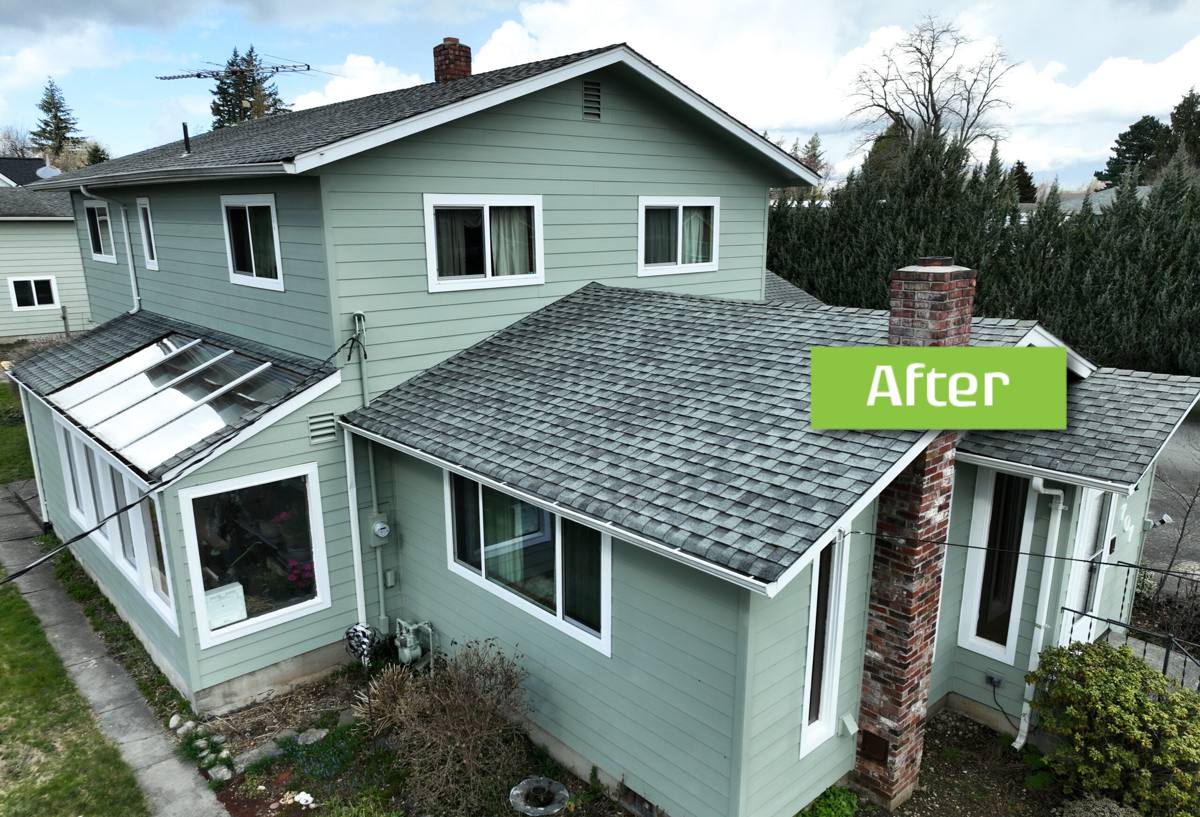
What James Hardie Fiber Cement Actually Is
James Hardie siding is fiber cement: a mix of Portland cement, sand, and cellulose fiber, cured under pressure and heat. It isn't a plastic product like vinyl, and it isn't wood or a wood byproduct like LP SmartSide or cedar. That composition is the reason it doesn't burn, doesn't feed insects, and doesn't swell or rot the way wood-based products can when they take on water.
Climate-Engineered Product Lines
Hardie doesn't sell one formulation nationwide. Its HZ5 product line is engineered specifically for cold, wet climate zones like ours — the Pacific Northwest, where freeze-thaw cycles and sustained moisture exposure are the norm rather than the exception. That's a meaningful distinction for a house in Whatcom County versus one in Arizona, and it's part of why we spec HZ5 by default here rather than a generic formulation.
Why Blaine's Climate Makes This Decision, Not Us
Blaine sits at the very top of Washington, with Semiahmoo Bay and Drayton Harbor on one side and the open exposure of the Strait of Georgia not far off. That geography creates three conditions that are hard on siding, and they show up together, not one at a time.
Salt Air and Coastal Exposure
Homes within a few miles of the water pick up salt-laden air, especially on west- and north-facing elevations. Salt accelerates corrosion on fasteners and metal trim, and it degrades some paint and coating systems faster than manufacturers' generic warranty language assumes. Fiber cement itself doesn't corrode, and Hardie's factory-applied ColorPlus finish is baked on under controlled conditions rather than sprayed on-site, which gives it more consistent adhesion in salt-air environments than field-applied paint on wood siding.
Driving Rain
Whatcom County doesn't get the heaviest rainfall totals in the state, but Blaine's wind patterns mean rain frequently arrives sideways, driven straight into wall assemblies rather than falling straight down. That kind of exposure tests the weakest point in any siding system: the seams, laps, and butt joints. Wood-based panel products are more sensitive to water intrusion at cut edges and joints, because that's where the underlying wood fiber is most exposed. Fiber cement's cut edges and joints, when properly sealed and back-primed per Hardie's install spec, hold up far better under repeated wetting.
Moss Season
Between the marine humidity and shaded, tree-lined lots common in and around Blaine, moss and algae growth on siding is a long-season problem here, not an occasional one. Sustained dampness against a wall is exactly the condition that accelerates rot in wood-based siding and can degrade some engineered wood products from the inside out if moisture gets past the surface coating. Fiber cement doesn't feed moss or rot from trapped moisture the way wood fiber does, which matters enormously on a north-facing wall that may stay damp for weeks at a stretch in winter.
What We Don't Install, and the Honest Trade-Offs
We're not going to tell you these products are junk — they're not. Each has a legitimate use case somewhere. Here's why we don't use them on Whatcom County homes.
Vinyl Siding
Vinyl is inexpensive and low-maintenance in mild climates, but it's a thin plastic product that becomes brittle in sustained cold and can warp or buckle under direct heat exposure — reflected sunlight off windows or dark-colored surfaces is a known issue. It also doesn't offer the impact resistance or the non-combustible profile that fiber cement does, and its appearance reads as lower-end on higher-value homes, which affects resale perception.
LP SmartSide
LP SmartSide is an engineered wood product — strand board with a resin-saturated overlay. It performs reasonably well when installation is precise and maintenance is kept current, but it's still wood-based, meaning any breach in the surface coating (a nail pop, a poorly sealed cut edge, ice damage) opens a path for moisture to reach wood fiber underneath. In a climate with our moss season and driving rain, that's a maintenance burden we don't want to hand a homeowner.
Cedar and Primed Spruce
Real wood siding has genuine visual appeal and a long tradition in the Northwest, but it demands the most maintenance of any option: regular refinishing, vigilant caulk and seal upkeep, and real vulnerability to rot and insect damage in a marine climate. Primed spruce in particular is prone to swelling and paint failure at joints if not maintained on a strict schedule. We'll be honest with any homeowner who wants that look: it's achievable, but the upkeep commitment is real and ongoing.
| Material | Moisture Behavior in Marine Climate | Ongoing Maintenance | Combustibility |
|---|---|---|---|
| James Hardie Fiber Cement | Does not rot or swell; factory finish resists salt-air degradation | Periodic caulk/inspection; no refinishing cycle | Non-combustible |
| Vinyl | Won't rot, but can warp/crack in cold and heat cycling | Low, but panels are replaceable, not repairable | Combustible plastic |
| LP SmartSide | Vulnerable at breaches in surface coating; wood-based core | Regular coating and seam inspection required | Treated wood composite |
| Cedar / Primed Spruce | Highest vulnerability to rot and swelling in sustained damp | Frequent refinishing and sealing | Combustible wood |
The James Hardie Product Lines We Install
HardiePlank Lap Siding
The most common product on Blaine homes — horizontal lap boards in several profiles and textures, from smooth modern to a more traditional cedar-grain look, without the wood's maintenance liability.
HardiePanel Vertical Siding
Used for board-and-batten looks or as an accent alongside lap siding, common on garages, gables, and modern-style builds.
HardieShingle
A shingle-profile product for homes going for a Cape Cod or cottage aesthetic, without the maintenance burden of real cedar shingles in a wet climate.
ColorPlus Technology
Hardie's factory finish is baked on in multiple coats under controlled conditions, rather than sprayed or brushed on-site after installation. It carries its own dedicated finish warranty separate from the substrate warranty, and it holds color and adhesion better in UV and salt-air exposure than field-applied paint.
Installation Standards That Actually Determine Performance
Fiber cement's real-world performance depends heavily on installation quality — this is true of any siding product, but Hardie is explicit about its specifications, and deviating from them is the single most common cause of premature failure we see on homes that weren't installed by a crew following the spec closely.
- Minimum clearance maintained between siding and roofline, decks, and grade
- Proper fastener type, spacing, and embedment depth — not just "close enough"
- All cut edges sealed before installation, not after
- Correct water-resistive barrier and flashing details behind every siding plane
- Butt joints and panel seams treated per manufacturer spec, not caulk alone as a substitute
- Manufacturer-specified starter strips and trim details, not improvised shortcuts
Skipping any one of these doesn't usually cause an immediate visible problem. It shows up two, five, or ten years later as a moisture issue at a joint or a warranty claim that gets denied because the installation didn't meet spec. That's part of why we install exclusively — a crew that only ever installs one product develops a much deeper working knowledge of that product's failure points than a crew rotating between four different systems.
Warranty and Long-Term Value
James Hardie's product warranties are transferable to a subsequent homeowner within the coverage period, which matters for resale value — a documented, transferable warranty on the exterior envelope is a real selling point in a market where buyers are increasingly asking about siding age and condition. ColorPlus finishes carry their own separate finish warranty terms from the substrate warranty, and both depend on installation meeting the manufacturer's published specifications, which is another reason correct installation isn't optional in our shop.
Fiber cement siding typically costs more upfront than vinyl and is comparable to or somewhat above engineered wood pricing, with real wood and premium shingle profiles often costing the most. The gap narrows considerably when you factor in the refinishing and repair costs that wood-based and painted products accumulate over a couple of decades in this climate — but we won't quote you a specific number here, because your home's siding needs, trim complexity, and square footage all move that estimate, and that's what a walkthrough is for.
What This Means for Your Blaine Home
If you're re-siding a home near Semiahmoo Bay, Drayton Harbor, or anywhere else in Whatcom County exposed to salt air and driving rain off the Strait, the material decision matters more than most homeowners realize going in. We'd rather walk you through why we made this call — including the trade-offs of the products we don't install — than have you find out the hard way five years down the road. If you'd like a free, no-pressure estimate and a straight answer about what your home actually needs, we're glad to come take a look.