 Blaine Siding
 Blaine Harbor's Climate Is Harder on a House Than It Looks
Blaine Harbor sits right where the land meets Semiahmoo Bay, and that proximity to open water shapes everything about how a home ages here. It's easy to underestimate what daily exposure to marine air does to exterior building materials, because the damage doesn't show up as a single storm event — it shows up as a slow accumulation over years. Salt-laden air, near-constant humidity, and a wet season that stretches from fall well into spring put a specific kind of stress on siding, trim, roofing, and anything else on the outside of a house. Homes a mile inland in Blaine don't face quite the same conditions. Homes in Blaine Harbor, closer to the water, get the full effect.
We work throughout Whatcom County, but we pay close attention to microclimates like this one. A house on a shaded lot two blocks from the water behaves differently than a house on an open, sun-exposed slope. Knowing that difference — and building the exterior work around it instead of applying one generic approach everywhere — is a big part of what a local crew brings that an out-of-area company doesn't.
What Salt Air Actually Does to a House
It's Not Just Rust
Most people think of salt air as a metal problem — fasteners, flashing, gutters corroding faster near the coast. That's real, but it's only part of it. Salt-laden moisture also accelerates the breakdown of paint films, softens caulking faster than it would inland, and works its way into any gap or seam in the building envelope. Materials that are only marginally water-resistant get pushed past their limit faster near the water than they would a few miles inland.
Why This Matters for Siding Choice
Some siding materials handle this environment poorly. Wood-based products — including engineered wood siding and primed spruce or cedar — depend on an intact paint or coating layer to keep moisture out. In a marine environment, that coating takes more abuse: more UV, more salt, more freeze-thaw-adjacent moisture cycling even in a relatively mild coastal climate. Once the coating starts failing at a seam, edge, or fastener point, the substrate underneath is exposed to conditions that are actively worse than average. Vinyl siding, for its part, doesn't rot, but it can become brittle over time with UV and temperature cycling, and it doesn't hold paint if a homeowner ever wants to change color — it just gets replaced.
Moss, Shade, and the Long Wet Season
Blaine Harbor has plenty of tree cover and plenty of homes tucked into shaded lots, which is great for privacy and terrible for moisture management. Moss doesn't just grow on roofs here — it establishes on north-facing siding, in corner boards, behind gutters, and anywhere air doesn't move freely and sunlight doesn't reach. Once moss takes hold on a wall, it holds moisture against the surface far longer than open exposure would, which is exactly the condition that causes rot in wood-based siding and paint failure in almost anything.
The wet season here isn't a few big storms — it's months of low-grade dampness punctuated by driving rain off the water. That combination of persistent ambient moisture and periodic wind-driven rain is a tougher test for a wall system than a drier climate with occasional heavy rain. Siding, trim, and flashing details all have to be able to shed water actively and dry out fully between wet spells, and they have to do it for years without a homeowner needing to intervene every summer with pressure washing, caulk touch-ups, and repainting.
Where Moss and Moisture Cause the Most Damage
- Butt joints and seams where siding pieces meet, especially if they weren't properly sealed or flashed at installation
- Corner boards and trim where two materials or two planes meet
- Areas under overhangs and behind shrubs where airflow is limited and surfaces stay damp longer
- Bottom courses of siding close to grade, splashback zones, and areas near downspouts
- North- and west-facing walls that get the least sun exposure to dry things out
Why We Only Install James Hardie Fiber Cement
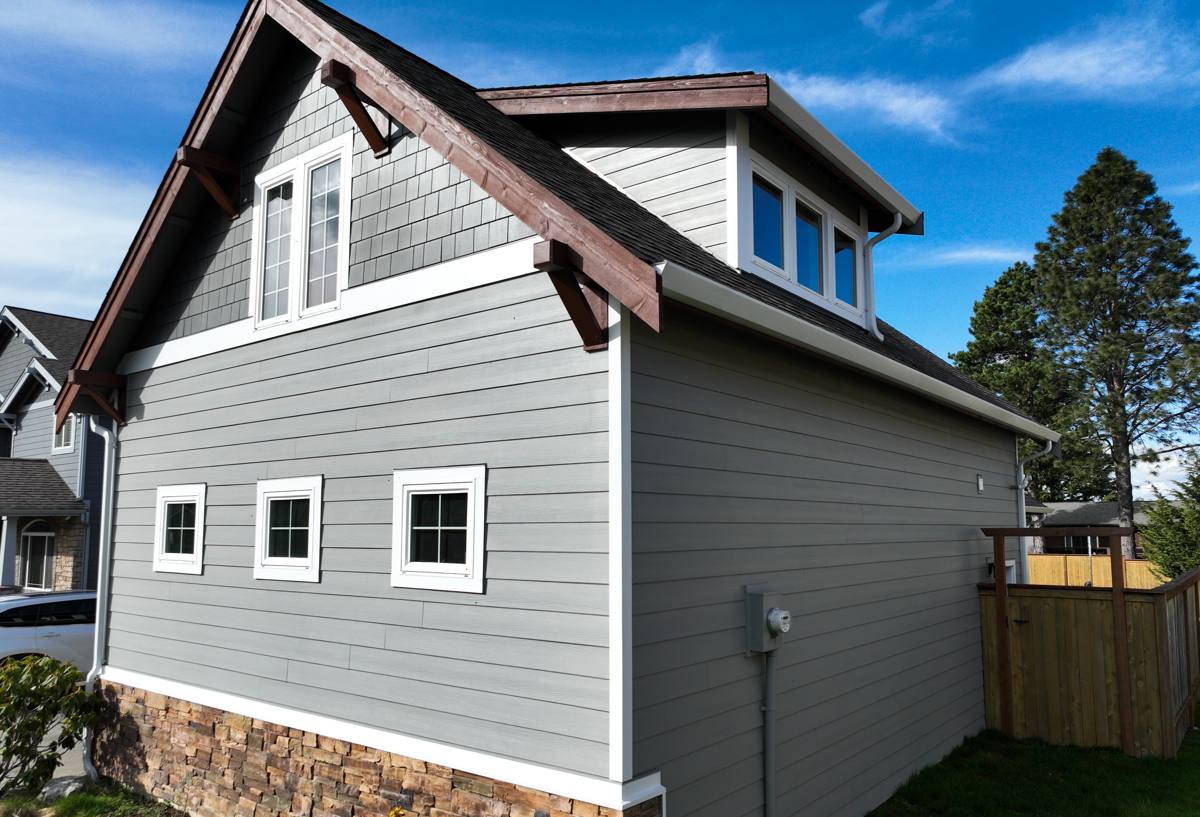
We made a decision a while back to standardize on one siding product line rather than offering several. We install James Hardie fiber cement exclusively — we don't install LP SmartSide, vinyl, Cemplank, Allura, or unfinished cedar or spruce siding, even though all of those products have a place in the market and each has genuine strengths. For a climate like Blaine Harbor's, fiber cement's core advantage is that it isn't organic material. It doesn't feed rot, it doesn't need a perfect paint film to keep water out of a wood substrate, and it's engineered specifically for moisture and temperature swings rather than adapted from a drier-climate product.
James Hardie's HardiePlank and related products are manufactured with regional climate engineering in mind, and the ColorPlus factory-applied finish is baked on and cured under controlled conditions rather than field-applied. That matters here specifically because field-applied paint is the first thing to fail under sustained coastal exposure. A factory finish holds up longer and comes with a stronger, transferable warranty structure than most site-applied coatings can offer. Fiber cement is also non-combustible, which matters given the periods of dry, windy weather the Pacific Northwest sees in late summer, even in a generally wet region like Whatcom County.
None of this means other products are junk — they're just not what we'd choose to put on a home a quarter mile from Semiahmoo Bay, and we'd rather be straightforward about that than install something we don't think holds up as well here.
How This Plays Out in a Real Installation
Assessment First
Before we talk product lines or colors, we look at the specific conditions of the house: sun exposure, tree cover, prevailing wind and rain direction, existing moisture damage, and how the current siding or trim has aged. A house set back from the water under heavy tree cover gets a different conversation than an open, wind-exposed lot closer to the marina.
Installation Details That Matter More Here Than Elsewhere
Correct fiber cement installation always matters, but in a marine environment the margin for error is smaller. Proper flashing at windows, doors, and horizontal trim; correct fastener spacing and type (coastal environments call for corrosion-resistant fasteners); proper clearance from grade, decks, and roof lines; and correctly sealed or shiplap joints all directly affect how the wall performs over the next 20-30 years. We follow James Hardie's installation specifications closely because deviating from them is exactly what turns a durable product into one with problems — the material isn't the weak link, poor installation is.
Siding Isn't the Only Thing Salt Air and Rain Attack
We do roofing, windows, and decks as well as siding, and in a place like Blaine Harbor those systems are connected — a failure in one accelerates wear in another. A roof with degraded flashing sends water down behind siding. Old, poorly sealed windows let moisture into wall cavities. A deck built without adequate ventilation and moisture-resistant fasteners rots from the underside up, often before problems are visible on top. Looking at the whole exterior envelope together, rather than treating each component as an isolated project, is how you actually stop water intrusion instead of just moving it around.
Rough Comparison: How Common Siding Materials Handle This Climate
| Material | Moisture/Rot Risk in Coastal Climate | Maintenance Burden | Finish Durability |
|---|---|---|---|
| James Hardie fiber cement | Low — non-organic, won't rot | Low — occasional wash, no repainting cycle with ColorPlus | Factory-cured finish, strong transferable warranty |
| Engineered wood (e.g. LP SmartSide) | Moderate — wood-based, depends on intact coating | Moderate — coating and seams need monitoring | Field or factory finish, shorter track record in wet coastal use |
| Vinyl | Low rot risk (not organic) but can trap moisture behind it | Low, but can't be repainted — replace to change color | Can fade/become brittle with UV and temperature cycling over time |
| Primed cedar or spruce | High — real wood, fully dependent on maintenance | High — regular repainting/staining and caulk upkeep | Field-applied finish, most exposed to salt-air breakdown |
What to Look for in a Contractor Near the Water
Blaine Harbor homeowners have hired plenty of contractors over the years who didn't fully account for how much harder the marine environment is on exterior work than a typical inland job. A crew that doesn't regularly work this close to the water may not think twice about fastener corrosion resistance, flashing details at grade, or how much clearance siding needs from a deck or roofline. Those are small line items on a bid, but they're the difference between a wall system that lasts decades and one that starts showing problems in five or six years.
- Ask whether the crew is factory-trained or certified on the specific siding product being installed
- Ask how they handle flashing at windows, doors, and roof-to-wall transitions — this is where most water intrusion starts
- Ask about fastener type and spacing, especially for a home close to salt water
- Get a written scope that specifies product line, color/finish, and installation standard, not just "siding replacement"
- Check that the warranty is transferable if you sell the home — this matters more on the coast where buyers ask about exterior condition
- Ask how they handle moss and existing moisture damage they find once old siding comes off
What Affects Cost for a Blaine Harbor Project
| Factor | Why It Matters Here |
|---|---|
| Extent of existing moisture/rot damage | Homes with long-neglected moss or trapped moisture may need sheathing repair before new siding goes on |
| Home exposure (open water vs. tree-shaded) | More exposed homes may benefit from higher-tier HZ products; shaded homes need attention to airflow and drying |
| Trim and detail complexity | More corners, dormers, and transitions mean more flashing and finishing work |
| Scope — siding only vs. combined with roofing/windows/decks | Addressing the whole envelope at once can reduce total disruption and catch interconnected issues early |
| Access and site conditions | Waterfront and hillside lots can affect staging, scaffolding, and material delivery |
We don't quote real numbers without seeing the house — anyone who does is guessing — but these are the factors that actually move a bid up or down, and we'll walk through each one with you during an estimate.
Working Locally in Whatcom County
Being based in this area means we're not learning Blaine Harbor's quirks on your project. We've seen how moss establishes on the shaded side of a house here, how far wind-driven rain travels under an inadequate overhang, and which details actually hold up after a few winters this close to the water. That local knowledge shapes how we scope, price, and install every job, not just the sales pitch.
If you're dealing with aging siding, moss buildup, water staining, or you're just planning ahead for a home this close to Semiahmoo Bay, we're glad to take a look. Reach out for a free, no-pressure estimate — we'll assess the house, explain what we're seeing, and give you a straight answer on what it would take to do the job right.