 Blaine Siding
 Cherry Point's Shoreline Climate Is Hard on Siding
Cherry Point sits right on the water along the Blaine shoreline, in a part of Whatcom County where wind off the Salish Sea carries salt spray onto exterior walls almost year-round. Combine that with the Pacific Northwest's long wet season and the shade that many rural, tree-lined lots around here provide, and you get three things working against ordinary siding at once: salt exposure, near-constant moisture, and moss growth that can run from fall through spring. Homes set back from the water aren't off the hook either — wind-driven rain still finds its way into gaps, seams, and fastener holes that a coastal storm track pushes harder than it would further inland.
None of this is exotic to us. It's the normal operating environment for every siding job we do out here, and it's why we're deliberate about both the material and the install details on Cherry Point homes specifically, rather than treating this stretch of Blaine the same as a dry, sheltered inland lot.
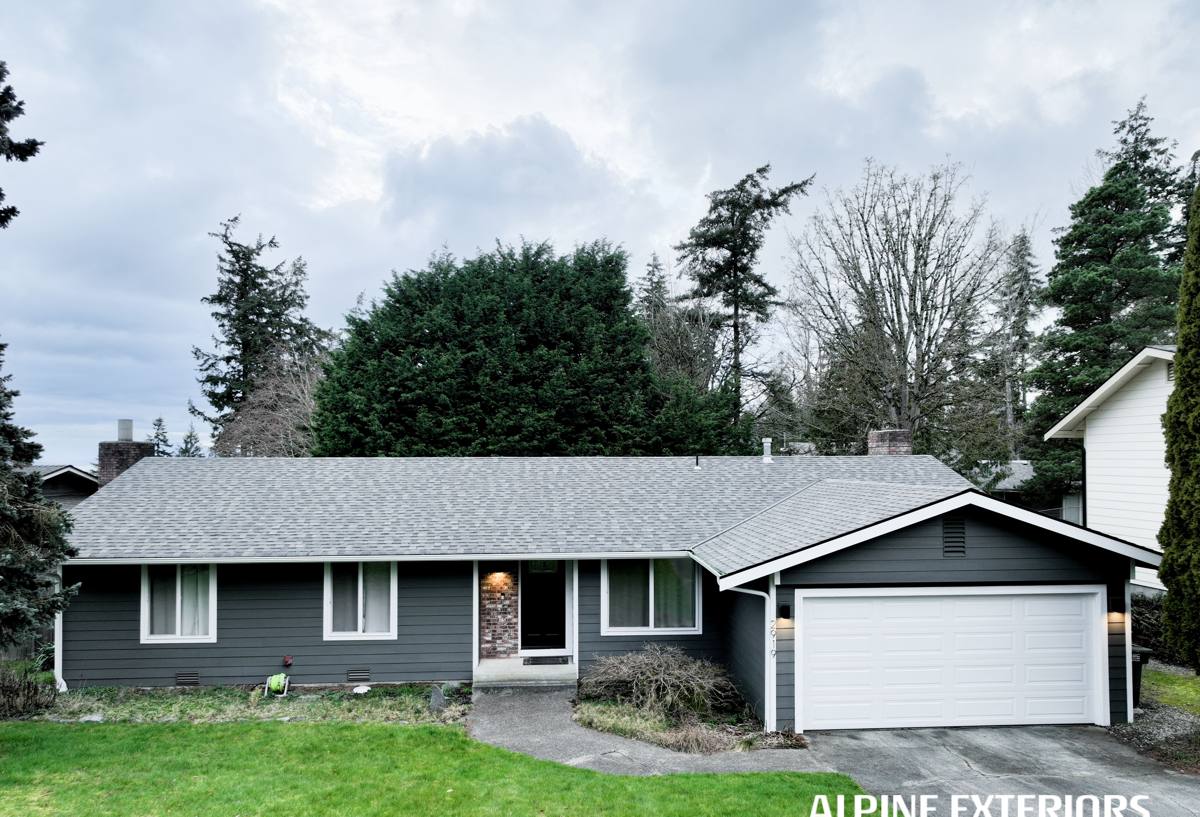
Why We Only Install James Hardie Fiber Cement
We install James Hardie fiber cement siding exclusively. We don't install vinyl, LP SmartSide, Cemplank, Allura, primed spruce, or cedar — not because those products can't be installed correctly by someone, but because we've set a standard for our own crew and we'd rather turn down work than put something on a Cherry Point home that we don't think holds up long-term to this climate.
Fiber cement is non-combustible, doesn't expand and contract with humidity the way wood-based products do, and doesn't rely on a thin paint film alone to keep water out the way vinyl seams and some engineered wood products can. In a salt-air, high-moisture environment, that combination matters more than it does in a dry inland climate. Cedar looks good going up but demands a maintenance schedule most homeowners can't realistically keep up with once moss and algae take hold; primed spruce and other engineered wood sidings are vulnerable at cut edges and fastener penetrations if moisture works its way behind the surface. Hardie's fiber cement composition and factory finish are built to handle exactly the conditions Cherry Point throws at a house year after year.
The HZ5 Product Line: Built for This Exposure Zone
Moisture and Freeze-Thaw Behavior
James Hardie makes region-specific formulations under its HardieZone system, and homes in this part of Washington fall into the HZ5 engineered zone, formulated for wetter, cooler climates rather than hot, dry ones. The HZ5 formulation is engineered to resist moisture intrusion and hold up through repeated wet-dry cycling better than a generic, one-formula-fits-all fiber cement product would. That distinction is easy to miss when comparing bids side by side, but it's one of the reasons we specify HZ5 product on every Cherry Point job rather than whatever happens to be cheapest to source.
ColorPlus Factory Finish vs. Field-Painted Siding
Most of what we install carries Hardie's ColorPlus finish — a coating baked on at the factory under controlled conditions, rather than field-applied paint that has to cure on-site in whatever weather shows up that week. In a location where a dry, low-humidity painting window can be hard to find for weeks at a stretch, a factory-applied finish removes that variable entirely and delivers a more consistent, longer-lasting color result than site-applied paint typically achieves on a coastal job.
What a Correct Install Requires in Cherry Point
Fiber cement siding is only as good as the installation behind it. Hardie's published instructions are specific about clearances, fastening, and water management, and skipping steps is exactly how a good product ends up with a bad reputation on a house it was never actually installed correctly on in the first place.
Flashing and Drainage Details
Every horizontal joint, window head, and penetration needs proper flashing so water sheds outward instead of tracking behind the panel. On a site exposed to driving, wind-pushed rain, we also pay close attention to the drainage plane behind the siding — a code-compliant water-resistive barrier and, where called for, a drainage gap so any moisture that does get past the cladding has somewhere to go besides sitting against the sheathing.
Fastening and Clearances
Hardie specifies minimum clearances from grade, roof lines, and decks, along with fastener spacing and penetration depth. Those numbers aren't arbitrary — get them wrong and you create the exact entry points for moisture that fiber cement is otherwise good at resisting. We also caulk and seal penetrations with sealant products rated for this climate rather than whatever happens to be on the truck, since cheap sealant is often the first thing to fail in a salt-air environment.
How James Hardie Siding Compares in This Climate
| Material | Salt Air / Moisture Behavior | Maintenance Burden | Typical Longevity Here |
|---|---|---|---|
| James Hardie fiber cement (HZ5, ColorPlus) | Non-combustible, engineered for wet climates, factory finish resists fading and moisture | Occasional wash; no repainting needed on the ColorPlus finish for years | Decades when installed to spec |
| Vinyl | Won't rot, but can warp, crack, or fade under sun and wind cycling; seams can let water track behind panels | Low day-to-day, but damaged sections usually mean replacement, not repair | Variable, often shorter under harsh coastal wind exposure |
| Cedar | Attractive but absorbs moisture readily; moss and algae take hold quickly in shaded, damp settings | High — regular sealing, staining, and moss treatment | Shorter without an aggressive, ongoing maintenance routine |
| Primed spruce / engineered wood | Vulnerable at cut edges and fastener points once moisture penetrates the surface | Moderate to high, depending on exposure and install quality | Sensitive to both installation quality and upkeep |
This isn't a knock on any of these products in a different setting — it's simply why, for Cherry Point's specific mix of salt air, wind-driven rain, and shade-driven moss, we've standardized on Hardie and don't deviate from it on jobs out here.
Our Process on a Cherry Point Siding Project
Every property here is a little different — some are close enough to the water to catch spray directly, others sit back among trees where shade and moss are the bigger issue. We start with an assessment specific to that exposure rather than running through a generic checklist meant for any house anywhere.
- Site walk and exposure assessment. We look at wind direction, water proximity, shading, and the condition of the existing siding and water-resistive barrier before quoting anything.
- Tear-off and substrate check. Once the old siding is off, we inspect the sheathing for hidden rot or moisture damage — common on older coastal homes — and address it before anything new goes up.
- Water-resistive barrier and flashing. We install or verify the barrier, flash every penetration and horizontal joint, and set up drainage per Hardie's requirements for this exposure zone.
- Hardie panel and trim installation. Panels go up to Hardie's fastening and clearance specifications, with joints and penetrations sealed using climate-appropriate sealant, not shortcuts.
- Final walk-through. We check clearances, caulking, and finish quality before calling the job done, and walk the homeowner through basic care going forward.
Keeping Cherry Point Siding Looking Right Year After Year
Hardie siding installed correctly needs very little upkeep, but "very little" isn't "none" in a moss-prone, salt-air environment. A short seasonal routine keeps it looking the way it did on install day and protects the finish over the long run:
- Rinse salt residue off exterior walls with a garden hose a few times a year, especially on sides facing open water or the prevailing wind.
- Keep gutters and downspouts clear so runoff isn't sheeting down the siding face during heavy rain events.
- Trim back vegetation and tree cover where practical to cut down on the shade and standing moisture that feed moss growth.
- Gently remove moss or algae with a soft wash rather than a pressure washer, which can force water behind panels or damage the finish.
- Inspect caulking at trim, windows, and penetrations every year or two, and re-seal anything that's cracked or pulled away.
Why Hiring a Crew That Already Works Cherry Point Matters
A siding crew that mostly works dry, sheltered inland jobs can install Hardie siding by the book and still get details wrong for a place like this, because the manufacturer's instructions leave some judgment calls to the installer — where to add extra flashing, how tight to run clearances, which sealant actually holds up to salt air over time. A crew that's already worked this stretch of the Blaine shoreline has already made those calls, seen how the details hold up a few winters later, and adjusted its practices accordingly.
Local familiarity also means fewer surprises on scheduling — knowing which weeks in Whatcom County's wet season are workable for exterior work and which aren't, and not starting a tear-off with no plan for wind-driven rain moving in off the water partway through the job.
Warranty and Long-Term Value
James Hardie backs its siding with a substantial, transferable limited warranty, and the ColorPlus finish carries its own finish warranty separate from the substrate warranty. That's a meaningful backstop, but it's worth being direct about one thing: manufacturer warranties typically require installation according to Hardie's published instructions, which is another reason correct installation isn't optional if you actually want that coverage to mean something years down the road. Between a product engineered for this climate and a warranty that's only as good as the install behind it, Cherry Point homeowners get siding that's meant to be a long-term fix, not a five-year patch job.
If you're weighing options for a Cherry Point home, we're happy to walk the property, take a look at what your current siding is telling us about the exposure it's dealing with, and put together a free, no-pressure estimate for a correctly installed James Hardie system.