 Blaine Siding
 Dakota Creek Homes Take a Different Kind of Beating Than Inland Siding
Homes near Dakota Creek sit close enough to the water that siding has to deal with three things at once, almost year-round: salt-laden air drifting in off the Strait of Georgia and Drayton Harbor, driving rain that comes in sideways during winter storms, and a long, damp moss season that can run from fall through spring. Any one of those is manageable. All three together is what actually wears siding out early in this part of Whatcom County, and it's why the siding choice and the installation details matter more here than they would on a home twenty miles inland.
Salt Air Doesn't Just Affect Metal
Salt air gets blamed mostly for corroding fasteners and flashing, and it does — but it also accelerates the breakdown of paint films and caulk joints on wood-based and engineered-wood sidings. Coatings that would hold up fine in a dry climate chalk, crack, and lose adhesion faster near saltwater. Once a coating starts to fail, whatever's underneath is exposed to moisture on every damp day, which in Dakota Creek is most days.
Why Moss Season Is a Bigger Deal Than People Expect
Moss and algae need shade, moisture, and time to establish, and Dakota Creek's tree cover combined with the Pacific Northwest's wet season gives them plenty of both. On siding, moss growth isn't just cosmetic — it holds moisture against the surface long after the rain stops, which is exactly the condition that causes rot in wood-based products and paint failure on anything with a lower-quality factory finish. A siding material's real test in this area isn't a sunny day, it's how it performs after four straight months of low light and standing dampness.
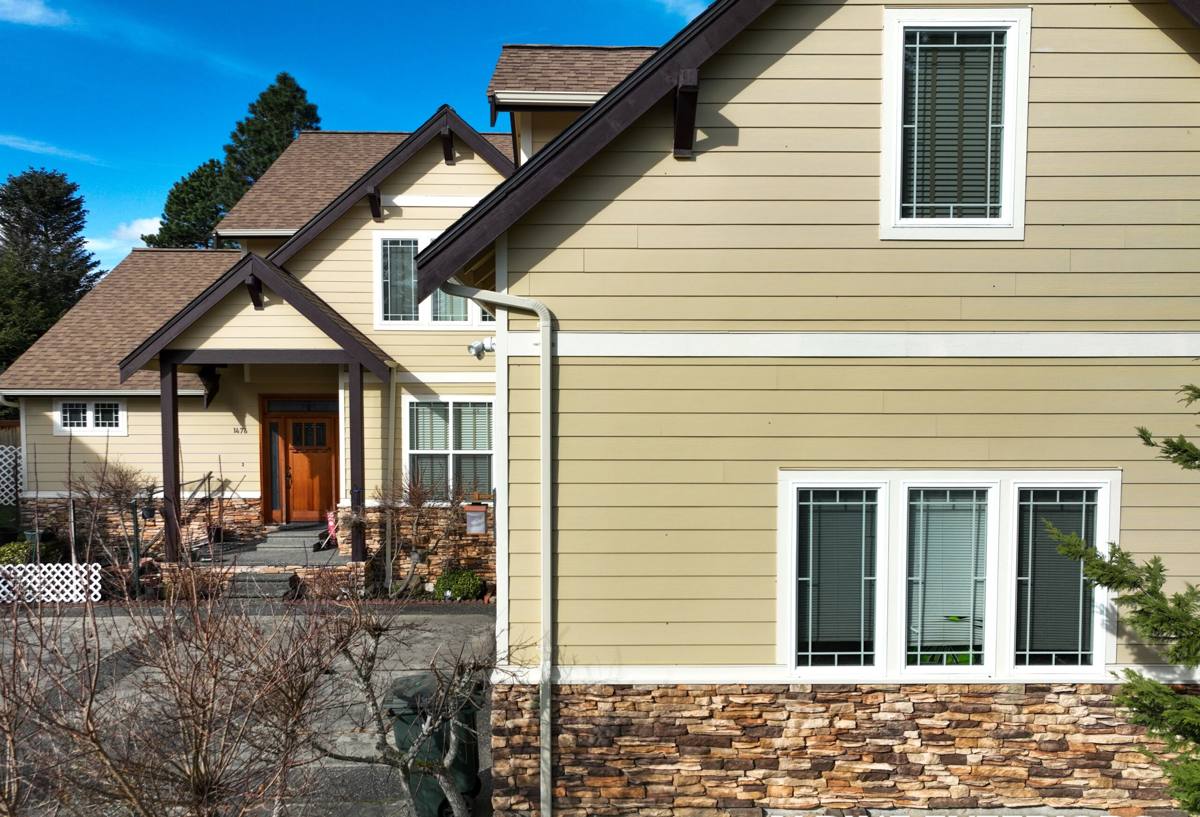
What Correct Fiber Cement Installation Actually Requires Here
Fiber cement siding is engineered to resist moisture, salt, and moss far better than wood or vinyl, but the material only performs as well as the installation. A rushed or generic install erases most of that advantage. In a climate like Blaine's, a few details are non-negotiable.
Clearances and Drainage
Manufacturer specs call for specific clearances between the bottom of the siding and roofing, decks, and grade, plus a gap above concrete or paved surfaces. Those clearances exist so wind-driven rain and splashback have somewhere to go instead of wicking into the bottom edge of the boards. On a lot near the creek where soil stays damp longer into the season, skipping or shorting these clearances is one of the fastest ways to shorten the life of an otherwise good siding job.
Flashing and Water-Resistive Barrier
Every window, door, and penetration needs proper flashing integrated with a continuous water-resistive barrier behind the siding — not caulk used as a substitute for flashing. In a marine climate, wind-driven rain finds any gap in that system eventually, and once water gets behind the cladding, it's the sheathing and framing that pay for it, not just the siding face.
Fastening for Coastal Wind and Rain
Fastener spacing, type, and placement all affect how well a wall system sheds wind-driven rain rather than letting it work its way behind the boards. This matters more on exposed elevations facing open water or cleared land, which is common for homes in and around Dakota Creek. Correct fastening isn't visible once the job is done, but it's one of the biggest factors in whether the siding stays tight through the wet season for the next thirty years or starts working loose after five.
Why We Install Only James Hardie Fiber Cement
We standardized on James Hardie products for every siding job we do, including in Dakota Creek, for reasons specific to this climate. Hardie's fiber cement is non-combustible and dimensionally stable, meaning it doesn't swell, cup, or delaminate the way wood-based and some engineered-wood products can when they take on repeated moisture. The ColorPlus factory finish is baked on under controlled conditions and backed by a separate finish warranty, which matters in an area where field-applied paint has to fight salt air and shade-driven moss from day one.
HZ5 Engineering for This Region
Hardie engineers its HZ product line by climate zone, and the Pacific Northwest falls into the HZ5 category, formulated for regions with sustained moisture exposure. That's a meaningful distinction from a generic fiber cement product built to one national spec — it's a material actually formulated for the kind of weather Dakota Creek gets most of the year.
Warranty That Transfers
Hardie's product warranty is transferable to a new owner if the home sells, which is worth mentioning for anyone near the water thinking about resale. A documented, transferable warranty on the siding is a point in a home's favor during a sale, especially in a market where buyers are increasingly asking pointed questions about exterior maintenance history.
Fiber Cement vs. the Other Options Homeowners Consider
Most homeowners comparing siding for a property like this are weighing fiber cement against vinyl, cedar, or engineered wood siding. Here's how they generally compare under Dakota Creek's specific conditions:
| Material | Salt Air / Moisture Resistance | Moss & Mildew Maintenance | Typical Repaint Cycle |
|---|---|---|---|
| James Hardie fiber cement | Engineered for sustained moisture exposure; won't rot or swell | Dense, moisture-resistant surface; easier to clean without damaging the material | ColorPlus finish rated well beyond standard paint; field-painted trim on a normal cycle |
| Vinyl siding | Doesn't rot, but can warp or fade; seams are a moisture entry point | Moss and mildew show clearly on the surface; cleaning is limited by material thinness | Cannot be repainted reliably; color is fixed to the panel |
| Cedar / primed spruce | Absorbs moisture readily; high rot risk without diligent upkeep | Moss takes hold quickly in shaded, damp areas; needs regular treatment | Every 3-5 years, sooner in shaded or coastal exposure |
| Engineered wood (LP SmartSide-type) | Resin-treated but still wood-based; edges and cuts are vulnerable if not sealed correctly | Moderate; performance depends heavily on installation quality and field sealing | Every 5-7 years depending on exposure |
Fiber cement isn't the cheapest option up front, and it isn't the lightest to install, but for a home absorbing salt air and moss-season moisture for months at a time, it's the material that holds its shape and finish the longest with the least ongoing intervention.
How We Approach a Dakota Creek Siding Project
- Site and exposure assessment. We look at which elevations face open water or prevailing weather, where moss and shading are already a problem, and where past moisture damage shows up around windows, corners, and the bottom courses.
- Sheathing and moisture check. Before any new siding goes on, we check what's underneath. Installing new siding over damaged sheathing just hides a problem that will resurface.
- Water-resistive barrier and flashing. We install a continuous WRB and properly integrated flashing at every window, door, and penetration before the first board goes up.
- Hardie installation to spec. Clearances, fastening, and joint treatment follow manufacturer requirements for this climate zone, not a generic national standard.
- Caulking and finish detailing. Joints and trim are sealed with products suited to a marine climate, and any field-painted trim is finished for the same conditions the ColorPlus siding is engineered for.
- Final walkthrough. We go over the finished work with the homeowner, including what routine upkeep looks like for a property this close to the water.
Keeping Moss and Salt Residue From Taking Hold
Correctly installed Hardie siding needs far less upkeep than wood or engineered wood, but "far less" isn't "none." A short seasonal routine keeps it looking and performing the way it should:
- Rinse siding with a garden hose or low-pressure wash once or twice a year to clear salt residue and organic buildup, especially on shaded, north-facing walls.
- Keep gutters clear so overflow doesn't run down the siding face and create a constant damp strip where moss can establish.
- Trim back vegetation and tree cover that keeps any wall in shade for most of the day — shade plus moisture is the exact combination moss needs.
- Check caulking at trim, corners, and penetrations annually; caulk is the one component that wears faster than the siding itself in this climate.
- Address any moss or algae promptly with a gentle cleaning approach rather than pressure-washing directly at the joints, which can force water behind the boards.
What We Commonly Find on Older Homes Near the Water
On siding replacement jobs in this part of Whatcom County, a handful of issues show up repeatedly: rotted bottom courses where clearance to grade or a deck was never maintained, missing or improvised flashing above windows, fasteners driven in the wrong location that split the board's water-shedding lap, and caulk used in place of proper flashing at trim joints. None of these are visible from the street, which is exactly the problem — they only surface once moisture has already gotten behind the wall. Part of a proper tear-off and reinstall is finding and correcting these before new siding goes back up, not just covering them over.
Why It Matters That a Crew Already Knows This Area
Installation specs don't change from town to town, but judgment calls do — how much clearance to leave on a shaded, damp lot, which elevations need extra attention to flashing, how aggressive to be about ventilation behind the cladding on a property that stays wet longer into spring. A crew that's already worked homes around Dakota Creek and elsewhere along Blaine's waterfront has seen how this specific stretch of coastline treats siding over time, and builds the job accordingly instead of applying a one-size-fits-all approach.
If you're planning a siding project for a home near Dakota Creek, we're happy to take a look and talk through what your property specifically needs. Reach out for a free, no-pressure estimate using the form below.