 Blaine Siding
 Siding Replacement in Grandview: Built for Salt Air and Driving Rain
Grandview sits within reach of Blaine's coastal edge of Whatcom County, close enough to the water that homes here deal with salt-laden air, wind-driven rain, and a moss season that can stretch through most of the year. Siding in this part of the county doesn't age the way it does further inland, and a straight repaint or a handful of patched boards often isn't enough once the underlying material has taken on real damage. This page is about one job specifically: full siding replacement for Grandview homes, done the way it needs to be done in this climate rather than the way it might get done somewhere drier and calmer.
Replacement is a different project than repair. Repair patches what's failing and buys time. Replacement takes the whole wall system back to the sheathing, corrects whatever let moisture or damage in over the years, and puts a new, correctly installed system in its place. Knowing which one a house actually needs — and what a full replacement should include once it's underway — is the difference between a project that lasts decades and one that's fighting the same problems again in five years.
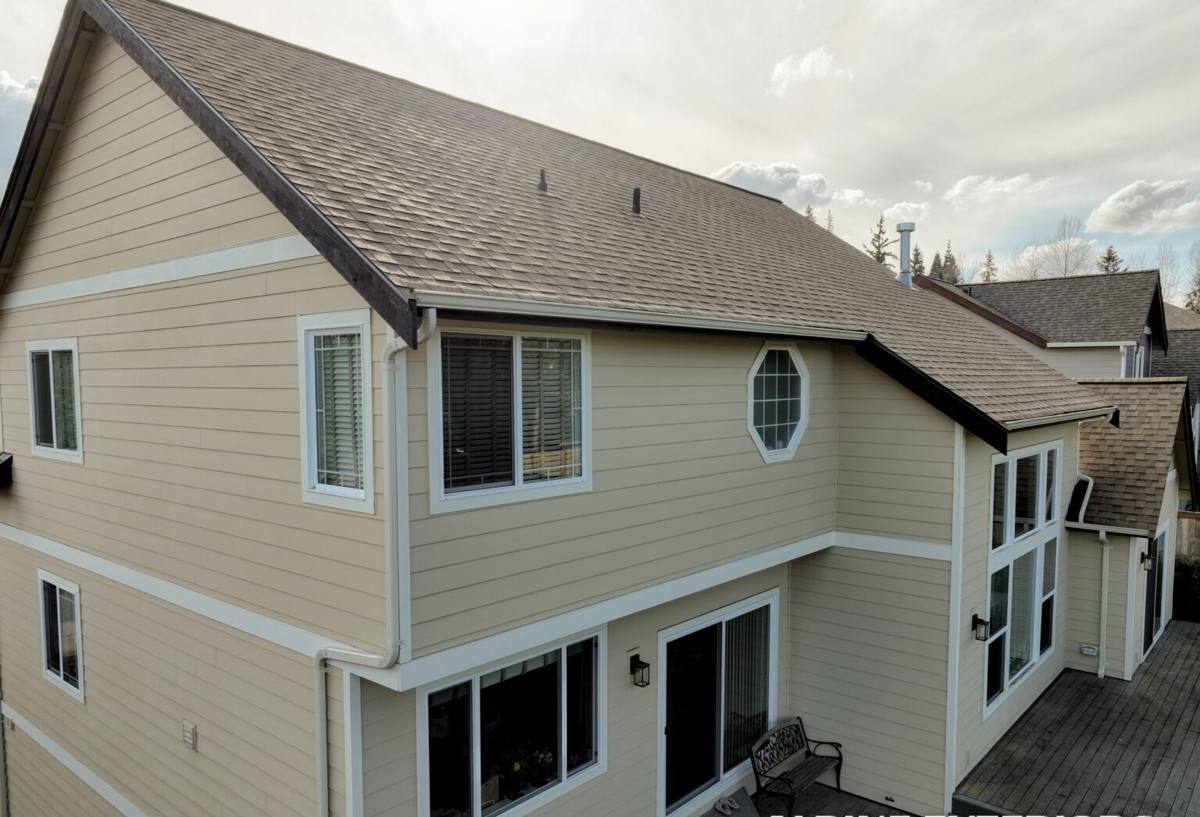
What Grandview's Climate Does to Siding Over Time
Salt Air
Homes in and around Blaine sit close enough to Semiahmoo Bay and the Strait of Georgia that salt-carrying air reaches most properties in the area, not just the ones with a direct water view. Salt accelerates corrosion on fasteners, flashing, and any exposed metal trim, and it breaks down lower-grade paints and coatings faster than a drier inland climate would. On older siding, that shows up as pitted or rust-streaked hardware and finishes that have chalked or faded well ahead of schedule.
Driving Rain
Storms coming off the water don't just fall straight down — wind pushes rain sideways into wall assemblies, trim joints, and the seams around windows and doors. That sideways load works moisture into gaps a calmer climate would never test, and over years it's often the real cause behind soft siding, stained sheathing, and trim that's gone spongy at the bottom. Grandview's exposure to that pattern is a big part of why replacement projects here so often turn up more moisture damage behind the old siding than a homeowner expected.
A Long Moss Season
Mild temperatures combined with near-constant moisture give moss and mildew a growing season that can run most of the year on shaded or north-facing walls. Older siding with any surface porosity becomes a growth surface over time, and moss that's allowed to sit holds moisture against the material long after a rainstorm has passed. By the time it's visibly green, the surface underneath has usually been staying wet longer than it should for a while.
Signs a Grandview Home Is Ready for Replacement, Not Just Repair
Repair makes sense when the damage is limited and the rest of the siding is sound. Replacement becomes the right call once the damage is widespread, the material itself has reached the end of its service life, or repeated repairs haven't stopped the same problems from coming back. A few signs worth taking seriously:
- Soft, spongy, or crumbling siding in more than one or two isolated spots, especially low on the wall or around window and door trim
- Visible warping, cupping, or delamination across multiple boards or panels
- Moss or dark staining that returns quickly after cleaning, especially on shaded or north-facing walls
- Paint that's failing broadly rather than in one weathered section — chalking, peeling, or bare wood showing through
- Rust-streaked or corroded fasteners and trim, more common this close to the water
- A musty smell or visible staining on interior walls near exterior siding, which often points to moisture already behind the wall
- Siding that's simply reached the end of its expected service life, particularly older wood or engineered wood products never built for this climate
What a Correct Siding Replacement Job Involves
Full Tear-Off and Sheathing Inspection
A real replacement means removing the old siding down to the sheathing, not installing new material over whatever's underneath. That's the only way to actually find out what the old siding was hiding — soft or rotted sheathing, damaged framing, or house wrap that failed years ago and let moisture track in unnoticed. Any damaged sheathing gets repaired or replaced before anything new goes back on the wall, because covering over a compromised substrate just resets the clock on the same failure.
Rain Screen and Drainage
A small drainage gap behind the new siding lets any moisture that does get past the exterior surface drain and evaporate instead of sitting against the wall. In a climate that pushes wind-driven rain into wall assemblies as often as Grandview's does, that gap is one of the details that separates a replacement built to last from one that's just new material on an old moisture problem.
Flashing, Fasteners, and Trim
Every window, door, and wall penetration needs flashing that's properly lapped to shed water downward and outward, and every seam and butt joint needs to be sealed the way the manufacturer specifies. Fastener type and spacing matter more here than they would in a drier climate, since a loose or incorrect fastener is one of the more common causes of early siding failure we find on tear-offs in coastal parts of the county.
Why We Replace Old Siding With James Hardie Fiber Cement
We install James Hardie fiber cement exclusively, including on replacement projects. We don't install LP SmartSide, vinyl, Cemplank, Allura, primed spruce, or cedar, and that's a professional standard built from what we've found tearing old siding off homes in salt air, high-moisture towns like this one — not a sales pitch. A few of the reasons it's what goes back on a Grandview wall once the old material comes off:
- Non-combustible core: Fiber cement doesn't feed a fire the way wood-based siding products can.
- Factory-applied ColorPlus finish: The color is baked on under controlled conditions rather than brushed on in the field, holding up longer against fading and salt-air wear than field-applied paint.
- Climate-engineered HZ product lines: Hardie's HZ5 formulation is built for regions with sustained moisture and freeze-thaw cycling, which fits coastal Whatcom County.
- Dimensional stability: Fiber cement doesn't swell, cup, or warp the way engineered wood can after repeated wet-weather exposure.
- Strong transferable warranty: Backed by one of the stronger warranty structures in the industry when the installation follows Hardie's spec, which matters most on a replacement, where getting it right the first time avoids repeating the whole project again.
Our Siding Replacement Process
- Walk-through assessment: We look at the existing siding, trim, and any visible signs of moisture or damage, and talk through what we're seeing before any work starts.
- Tear-off and sheathing inspection: Old siding comes off, and the sheathing and framing underneath get checked for rot, soft spots, or prior moisture damage.
- Substrate repair: Any damaged sheathing or framing is repaired or replaced before new material goes up — this step is where a lot of the real value in a replacement gets done, even though it's invisible once the job is finished.
- Weather-resistive barrier and rain screen: New house wrap goes on correctly lapped, followed by a drainage gap behind where the new siding will sit.
- Hardie siding installation: Panels or lap siding go on to the manufacturer's fastening and spacing spec, with flashing integrated at every window, door, and penetration.
- Trim, caulking, and finish work: Joints get sealed, trim gets finished out, and touch-up work brings everything to a clean, consistent finish.
- Final walkthrough and cleanup: We walk the finished job with the homeowner, address anything that needs it, and clear the site.
Cost Factors for a Grandview Siding Replacement
| Factor | Why It Matters |
|---|---|
| Home size and wall complexity | More square footage and more corners, gables, or trim detail mean more material and labor |
| Sheathing and framing condition | Moisture damage found during tear-off adds repair scope that isn't visible until the old siding is off |
| Siding profile chosen | Lap siding, panel systems, and board-and-batten differ in material and installation time |
| Trim and window/door count | Every opening needs flashing and trim work, so more openings add labor |
| Site access | Multi-story walls, tight lot lines, or landscaping can add setup and staging time |
These are general drivers, not a quote. Every Grandview home has a different history and a different amount of hidden damage once the old siding comes off, so we walk the property and give a real number based on what we actually find, not a guess made from the street.
Timing a Replacement Around Whatcom County's Weather
Whatcom County's wettest, windiest stretch typically runs from late fall through winter, and Grandview's exposure to weather coming off the water makes that stretch harder on both the crew and an open wall than it is further inland. Spring and summer generally offer the driest, most stable conditions for tear-off and installation, since fiber cement, house wrap, and any sheathing repairs all perform better when they can be installed and allowed to set up between storms rather than during them. That said, a home with active moisture intrusion or structural risk shouldn't wait for the ideal season just to keep to a calendar — active damage gets addressed on its own timeline.
Why Hiring a Crew That Already Works Grandview Matters
A crew that regularly works this stretch of Whatcom County has already seen how salt air, driving rain, and a long moss season actually play out on real homes here over time, not just how a product performs on a spec sheet. That experience shows up in practical decisions on a replacement: where extra flashing attention pays off, which walls stay wet longest and need the most careful drainage detailing, and which fastener and sealing choices are worth the extra time so a homeowner isn't dealing with a callback after the next storm off the water. Grandview's exposure isn't identical to more sheltered towns further inland in the county, and a crew that knows the difference builds the replacement accordingly instead of applying a generic approach.
Get a Free, No-Pressure Estimate
If your Grandview home's siding is showing its age — soft spots, recurring moss, failing paint, or damage that keeps coming back after repairs — we're glad to take a look and give you a straightforward, honest read on whether repair or full replacement makes sense. Reach out using the form below to schedule a free estimate, no pressure and no upsell script.