 Blaine Siding
 Siding Repair for the Dakota Creek Area of Blaine
The Dakota Creek corridor sits in the low-lying, tree-covered country just outside Blaine proper, where the creek's drainage keeps the ground and the air around it damp for more of the year than you'll find on higher, more exposed ground closer to town. Homes along this stretch of Whatcom County deal with a specific combination of conditions: salt-tinged air carrying in off Semiahmoo Bay and Drayton Harbor, driving rain that comes ashore hard during fall and winter storms, and a moss season that, thanks to the creek's shade and moisture, can run close to year-round on north-facing walls and anything tucked under tree cover. That's a tough environment for exterior siding, and it's why siding repair calls out of this part of Blaine tend to look a little different than the ones we get from drier, more open parts of the county.
This page is specifically about siding repair — patching, board replacement, moisture-damage correction, and the smaller fixes that keep an existing siding system performing — rather than a full tear-off and re-side. If your Dakota Creek home needs a full replacement, that's a different scope and a different conversation, but a lot of siding problems we see out here can be corrected without pulling every board off the house, provided the repair is done right.
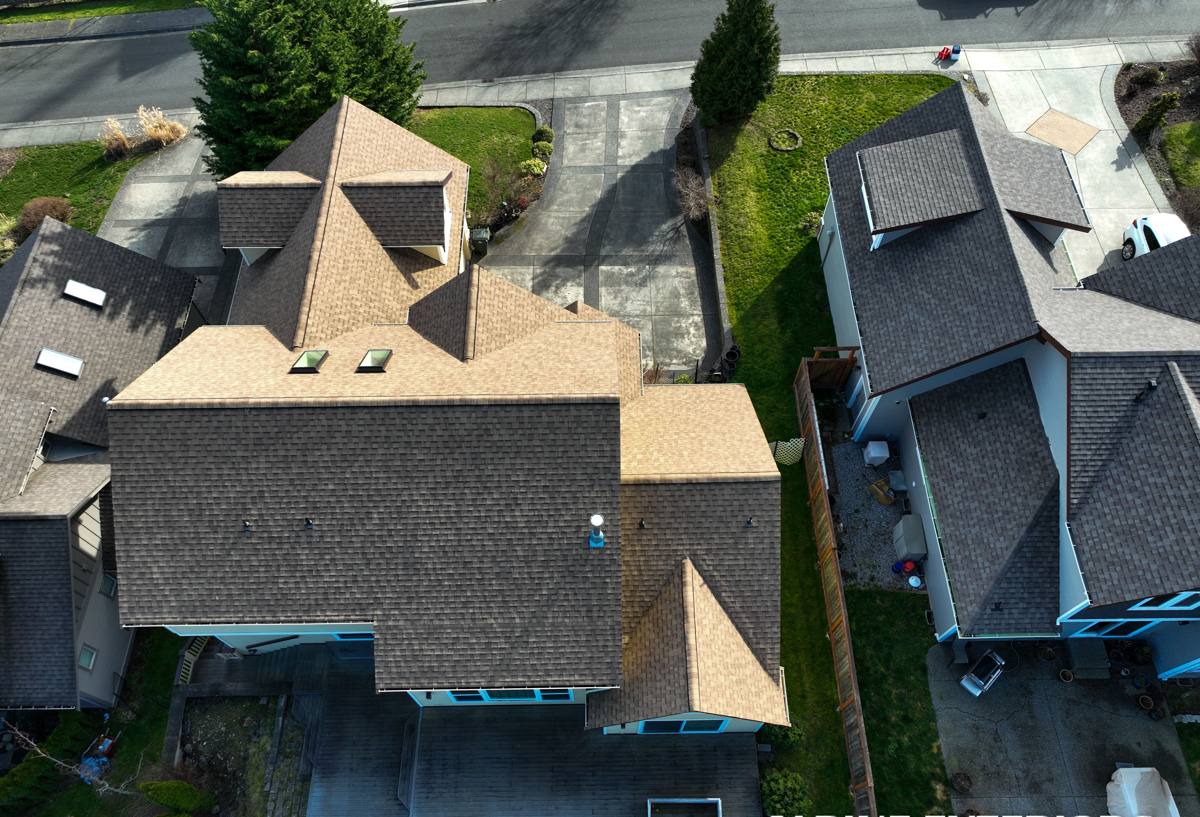
Why Dakota Creek Homes Wear Differently
Salt Air with Nowhere to Go
Blaine's proximity to the water means salt-laden air reaches most of the town, but the low ground around Dakota Creek doesn't get the steady wind that helps dry things out on more exposed lots. Salt air corrodes exposed fasteners, trim, and flashing faster than it corrodes bare wood or fiber cement, and once a fastener starts to rust, the hole around it opens up just enough to let moisture start working its way behind the siding. On a repair call, checking fastener condition is one of the first things we look at, because a house with otherwise sound siding can still have a moisture problem that traces straight back to a handful of failing nails.
Driving Rain and a Low, Wooded Lot
Storms moving in off the water don't drop straight down — wind pushes rain sideways into wall assemblies, trim joints, and anywhere flashing wasn't lapped correctly the first time. On a low-lying lot near the creek, that water also has less chance to run off and evaporate quickly, since surrounding tree cover and the terrain itself keep the area damper longer after a storm passes. That combination is a big part of why we see more soft, saturated siding at the lower courses of a wall in this part of Blaine than we do on more open, higher ground.
A Moss Season That Barely Breaks
Shade from mature trees along the creek, plus the ambient moisture the waterway holds in the air, gives moss and mildew an easier foothold here than almost anywhere else in the Blaine area. Once moss or algae gets established on a wall, it holds moisture against the surface even between rain events, and it can work into small gaps, seams, or caulk failures that would otherwise dry out on their own. A lot of the repair work we do near Dakota Creek starts with cleaning and clearing growth just so we can actually see the extent of the damage underneath.
Signs a Dakota Creek Home Needs Siding Repair
Because tree cover and shade make a lot of Dakota Creek homes harder to inspect casually from the ground, siding problems here often go a little further before anyone notices. These are the signs worth walking the property and looking for directly, board by board, rather than just glancing at the house from the driveway:
- Soft or spongy siding when pressed, especially along the bottom two or three courses near grade
- Moss or dark staining that returns quickly after cleaning, particularly on shaded, north-facing walls
- Cracked, chipped, or missing caulk at butt joints, trim transitions, and window and door casings
- Visible gaps or separation where siding meets trim, corner boards, or flashing
- Rust streaking below fasteners or exposed metal trim pieces
- Bubbling, peeling, or chalky paint on older wood or engineered wood siding
- A musty smell or visible staining on interior walls that back up to an exterior wall
- Warping, cupping, or bowing boards, most common on walls that stay shaded and damp the longest
None of these on their own necessarily means a full re-side is coming. But left alone, most of them get worse quickly in this climate, because the same shade and moisture that caused the problem also slow down any natural drying between storms.
Repair or Replace: How We Make the Call
Homeowners near Dakota Creek often assume that any sign of siding trouble means a full replacement, and sometimes that's the honest answer. But a lot of what we find on repair calls is isolated damage that a full tear-off would be overkill for. We look at the whole wall system, not just the spot that prompted the call, before recommending either direction.
| Situation | Repair Is Usually Right | Replacement Is Usually Right |
|---|---|---|
| Damage extent | Isolated to one wall section, a few boards, or a specific detail like a trim joint | Widespread across multiple walls or found in several unrelated locations |
| Underlying sheathing | Dry or only lightly affected once old siding is pulled back | Soft, delaminated, or visibly rotted sheathing found behind the siding |
| Age and material of existing siding | Relatively recent installation in generally sound condition | Original siding is decades old, discontinued, or a product prone to recurring failure |
| Cause of the damage | A single identifiable cause — impact damage, one failed caulk joint, a few bad fasteners | A systemic issue like missing rain screen, poor original flashing, or a house-wide moisture pattern |
| Cost over time | Lower upfront cost, but only worthwhile if the underlying wall is sound | Higher upfront cost, but resets the whole wall system and warranty clock at once |
The honest answer for a lot of Dakota Creek homes lands somewhere in the middle — repair the areas that are salvageable now, and flag the sections that are trending toward needing full replacement in the next several years, so a homeowner can plan for it instead of being surprised by it.
Getting the Cause Right, Not Just the Symptom
The most common mistake we correct on repair calls isn't a bad patch — it's a patch that was done without figuring out why the damage happened in the first place. Replacing a soft board without fixing the flashing detail or fastener issue that let water in behind it just buys a little time before the same spot fails again. Every repair we do starts with tracing the damage back to its actual cause, which usually means pulling back more of the wall than the visible problem alone would suggest.
What a Correct Siding Repair Actually Involves
A siding repair sounds simple from the outside — pull off the bad board, put on a new one — but doing it in a way that actually holds up in a climate like Dakota Creek's takes more care than that. A few of the details we won't skip:
- Full removal of affected material: Cutting a patch that stops right at the visible damage often leaves compromised material behind it; we remove back to sound, dry substrate.
- Sheathing and framing inspection: Every repair is a chance to check what's behind the siding. If the sheathing or framing shows moisture damage, that gets addressed before new siding goes back on, not covered over.
- House wrap and flashing correction: If the original installation had a flashing or house wrap lapping error — a common root cause of localized rot — we correct it as part of the repair, not just around it.
- Rain screen consideration: Where the wall assembly allows it, we build in or preserve a drainage gap behind the new material so moisture that does get past the surface can drain and dry instead of sitting against the sheathing.
- Matched fastening: New boards go on with corrosion-resistant fasteners at the manufacturer's specified spacing, not just whatever matches what was already there.
- Sealant at the right joints only: Caulk has a role at specific transitions, but it's not a substitute for correct flashing and lap sequencing — over-reliance on sealant is a common shortcut that fails within a few seasons.
Color and Profile Matching
On repairs to existing James Hardie siding, matching the new boards to the weathered color of the existing wall is one of the trickier parts of the job. Hardie's ColorPlus finish is factory-applied and extremely consistent when it's new, but siding that's been on a wall for several years — especially in a damp, shaded environment like Dakota Creek — will have weathered slightly differently than a brand-new board straight from the factory. We account for this when ordering repair material and are upfront with homeowners about what a seamless match looks like versus what's realistic on an older wall.
Our Siding Repair Process
- On-site inspection: We walk the property, examine the reported problem area, and check the rest of the exterior for related or unrelated issues that might not have been noticed yet.
- Diagnosis: We identify the actual cause of the damage — moisture path, fastener failure, flashing gap, impact damage — rather than just describing the visible symptom.
- Honest scope recommendation: We tell you plainly whether the situation calls for a targeted repair, a larger repair, or whether it's trending toward a full replacement conversation.
- Material matching and ordering: For Hardie repairs, we source matching profile, plank width, and as close a color match as the existing weathered siding allows.
- Removal and substrate correction: Damaged material comes off, sheathing and framing get inspected and repaired if needed, and any flashing or house wrap issues get corrected.
- Reinstallation to spec: New siding goes on following manufacturer fastening, spacing, and sealing requirements — the same standard we'd hold to on a full installation.
- Final walkthrough: We review the completed repair with the homeowner and point out anything else on the exterior worth keeping an eye on going forward.
Why We Repair With James Hardie Fiber Cement
Our company installs and repairs exclusively with James Hardie fiber cement siding. We don't install or patch with LP SmartSide, vinyl, Cemplank, Allura, primed spruce, or cedar, and that standard applies to repair work just as much as full installations. In a damp, shaded environment like the Dakota Creek corridor, the reasons matter more than they would in a drier climate:
- Non-combustible core: Fiber cement doesn't feed a fire the way wood-based products can.
- Dimensional stability: It doesn't swell, cup, or warp the way engineered wood or wood siding can after repeated wet-dry cycling, which matters on a lot that rarely fully dries out between storms.
- Climate-engineered HZ formulation: Hardie's HZ5 product line is built for regions with sustained moisture exposure, which describes the Dakota Creek area about as well as anywhere in Whatcom County.
- Factory-applied ColorPlus finish: It holds color and resists chalking and fading better than field-applied paint, which matters when a wall spends much of the year damp and shaded.
- Strong transferable warranty: Hardie's warranty structure is one of the stronger ones in the industry when the product is installed to spec, which is part of why we hold repair work to that same spec.
When we repair a home that currently has a different siding product, we'll say so plainly and explain what we found. Sometimes the right call is a targeted repair in the existing material to buy time. Other times, especially when the underlying product has a pattern of recurring failure in this climate, we'll recommend transitioning the affected section — or eventually the whole house — to Hardie, and explain exactly why.
Why a Crew That Already Works Dakota Creek Matters
Dakota Creek isn't identical to downtown Blaine or the more open, higher ground further from the water. The shade, the ambient moisture off the creek, and the lower drainage all change how a wall dries out after a storm, which changes how fast damage develops and where it tends to show up first. A crew that works this specific stretch of the county regularly knows to check the lower courses on shaded walls first, knows which flashing details tend to fail on homes built in a particular era, and doesn't need to relearn the local conditions on every job. That local pattern recognition is a big part of what makes a repair diagnosis accurate instead of a guess.
It also matters for honesty about scope. A contractor unfamiliar with how Dakota Creek homes actually age might either over-sell a full replacement when a repair would genuinely hold, or under-scope a repair that's really covering for a bigger moisture problem. We'd rather tell a homeowner the straightforward answer, even when that answer is "this section needs more than a patch," than sell a quick fix we know won't last through the next wet season.
Questions to Ask Before You Hire a Repair Contractor
Siding repair is easy to do poorly and hard to verify after the fact, since a lot of the important work ends up hidden behind the new boards. A few questions worth asking any contractor bidding on repair work near Dakota Creek:
- Will you inspect the sheathing and framing behind the damaged area, or just replace what's visible?
- What's your plan if you find rot or moisture damage once the old siding comes off?
- Are you licensed and insured to do exterior work in Washington state?
- Will the repair follow the manufacturer's fastening and flashing specifications, or a faster, off-spec shortcut?
- Can you explain, in plain terms, what caused the damage in the first place?
A contractor who answers those questions clearly, without hedging, is generally the one who's actually going to fix the cause rather than just cover the symptom.
Get a Free, No-Pressure Estimate
If you own a home near Dakota Creek and you're seeing soft siding, recurring moss, cracked caulk, or any of the other warning signs, we're happy to come take a direct look and give you a straightforward assessment of whether the fix is a targeted repair or something larger. Reach out using the form below to schedule a free, no-pressure estimate.