 Blaine Siding
 Siding Repair Built for Sumas Weather
Sumas sits right up against the Canadian border in Whatcom County, and homes here take a specific kind of beating. Weather systems roll in off the water and stack up against the foothills, dumping driving rain that hits siding sideways rather than falling straight down. Add a long, damp shoulder season on either side of winter and you get months where siding rarely gets a chance to fully dry out. That combination — wind-driven moisture plus extended dampness — is exactly what breaks down siding that wasn't built for it, and it's why repair calls in this area tend to follow a predictable pattern.
Salt-tinged marine air moves inland across Whatcom County more than people expect, and it accelerates corrosion on fasteners, flashing, and trim long before most homeowners notice a problem with the siding panels themselves. By the time paint is visibly failing or a board is visibly swollen, the damage underneath has usually been building for a season or two. Repair work here isn't just patching what's visible — it's figuring out how water got in and stopping it from happening again.
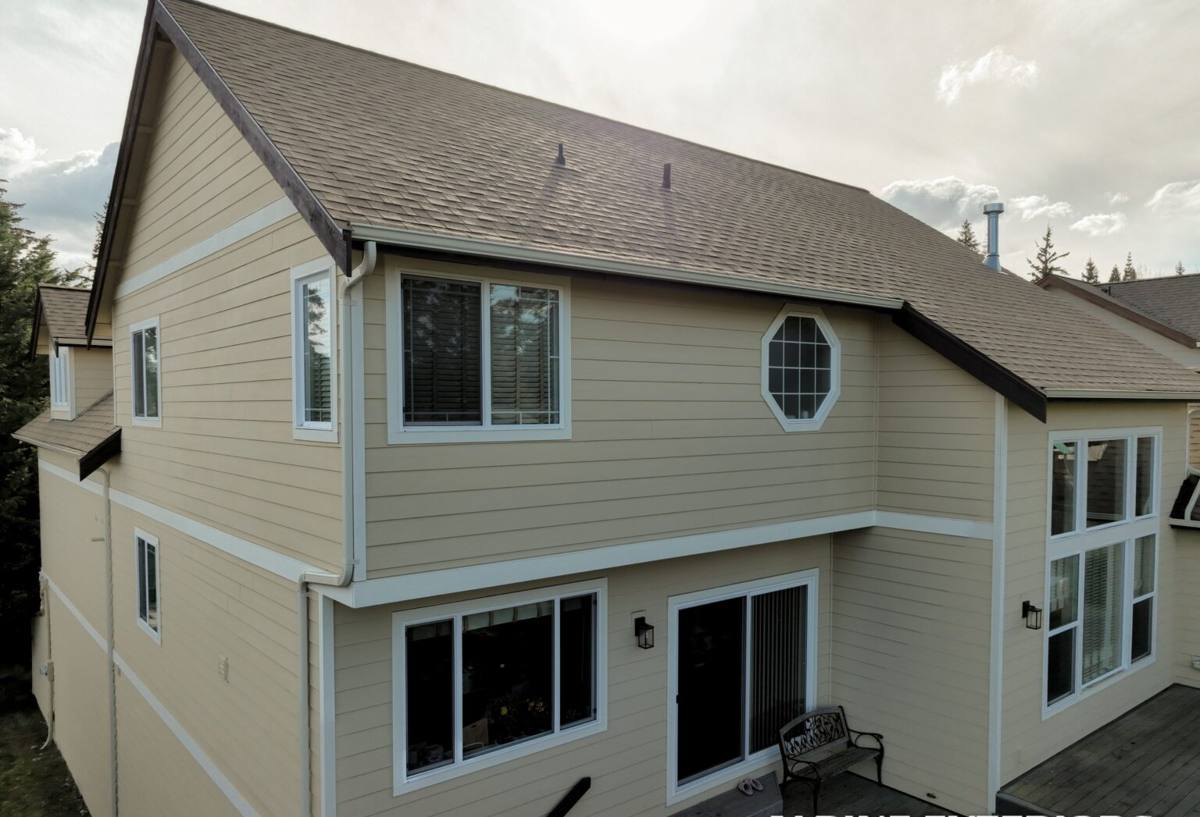
What We See Most Often on Sumas Siding Calls
Every siding material fails differently, but a few patterns show up again and again on repair visits in and around Sumas:
- Moss and algae staining at north-facing walls, under eaves, and anywhere shade keeps a wall from drying — cosmetic at first, but a sign the surface is staying wet longer than it should.
- Swelling, delamination, or soft spots on engineered wood or OSB-based siding products, usually starting at butt joints, corners, and anywhere caulk has failed.
- Cracked or peeling paint that lets bare wood or substrate absorb moisture directly, speeding up rot underneath an intact-looking surface.
- Warped or buckled panels from repeated wet-dry cycling, especially on walls that catch the most wind-driven rain.
- Rusted or failing fasteners and flashing that stain the siding and, more importantly, stop doing their job of keeping water out.
- Gaps at trim, corners, and penetrations — around vents, hose bibs, and light fixtures — where caulk has shrunk, cracked, or never sealed properly to begin with.
The common thread is moisture that had somewhere to go and nowhere to dry. A repair that just replaces the damaged board without addressing why it got wet is a repair that fails again in a year or two.
Repair or Replace? How We Actually Decide
Not every damaged section needs a full re-side, and we don't push a bigger job than a home needs. But we also won't patch something that's structurally compromised just to make a quote smaller. Here's how we think about it:
| Situation | Usually a Repair | Usually a Replacement |
|---|---|---|
| Damage scope | Isolated to a few boards, one wall section, or one corner | Spread across multiple walls or recurring in the same spots year after year |
| Underlying structure | Sheathing and framing are still sound | Rot has reached the sheathing, framing, or window/door framing |
| Material condition | Rest of the siding is holding its finish and shape | Siding elsewhere is showing the same failure pattern (age catching up to the whole house) |
| Cause | A localized failure point — a bad joint, missing flashing, a failed seal | A systemic issue — wrong product for the exposure, or original installation errors repeated house-wide |
| Age of siding | Well within expected service life | Nearing or past the material's realistic lifespan |
We'll walk the exterior with you, open up a damaged section if needed to see what's happening behind it, and give you a straight answer — including telling you when a repair is genuinely the right call and a full re-side isn't necessary.
What a Correct Repair Involves
A siding repair that actually holds up in this climate isn't just swapping a board for a matching one. A correct repair addresses three layers:
1. The water-resistive barrier and flashing
Any time siding comes off, we check the house wrap or building paper underneath and the flashing at windows, doors, and horizontal joints. If that layer is torn, missing, or was never installed correctly, replacing the siding without fixing it just resets the clock on the same failure.
2. The substrate
Sheathing that's stayed wet needs to be assessed, not just covered back up. Soft, delaminating, or rotted sheathing gets cut out and replaced before new siding goes on — otherwise you're fastening new material to something that can't hold a nail.
3. The siding and details
New boards need to match the existing profile and reveal, be properly primed or factory-finished on all cut edges, fastened per manufacturer spec, and caulked or flashed at every joint and penetration — not just where it's visible. Skipping the caulk and flashing details is the single most common reason a "repair" fails again within a couple of seasons.
Why We Repair Homes With James Hardie — and Nothing Else
We install and repair one siding system: James Hardie fiber cement. That's not a marketing position, it's a practical one built from what actually holds up against Whatcom County's wind-driven rain and long damp stretches.
Fiber cement doesn't absorb and swell the way wood-based or engineered wood products can when a seal fails and water gets behind a joint. It's non-combustible, it holds paint and factory finish far longer than wood substrates, and Hardie's HZ5 product line is engineered specifically for climates with heavy moisture exposure — which describes this part of Washington well. When we do repair work on a home that already has Hardie siding, we're usually dealing with an installation detail that needs correcting — a missing kick-out flashing, a caulk joint that failed, a fastener that backed out — not the siding material itself failing.
If your home currently has vinyl, LP SmartSide, primed wood, cedar, or another fiber cement brand, we'll still give you an honest repair assessment. But if the damage points to a bigger project down the road, we'll tell you why we'd recommend transitioning to Hardie rather than replacing like-for-like, and explain the real trade-offs involved so you can decide with full information — not pressure.
Our Repair Process for Sumas Homes
- On-site assessment. We walk the full exterior, not just the spot you called about — damage in one area often means we should check similar exposures elsewhere on the house.
- Open it up if needed. If we suspect moisture behind the siding, we'll open a section to check the barrier and sheathing before quoting anything.
- Straight scope and price. You get a written explanation of what's damaged, why, and what fixing it correctly requires — repair or replacement, whichever actually fits.
- The fix. Barrier and flashing corrected first, substrate replaced where needed, then matching Hardie material installed and sealed to spec.
- Finish check. Caulk lines, fastener pattern, and paint/finish match get a final look before we call it done.
Between Repairs: A Homeowner's Maintenance Checklist
A little seasonal attention catches problems while they're still small and cheap to fix. In this climate, that's worth doing twice a year:
- Walk the exterior and look for cracked, peeling, or bubbling paint — especially on north- and west-facing walls.
- Check for soft spots by pressing gently on siding near the bottom of walls and around window trim.
- Look at caulk joints around windows, doors, and corner trim for cracking, shrinkage, or gaps.
- Keep gutters clear so overflow isn't running down the siding face during heavy rain.
- Trim back shrubs and trees that keep a wall shaded and slow to dry.
- Rinse off moss and algae buildup before it spreads, especially in shaded, low-airflow spots.
- Note any spot that shows the same staining or damage two seasons in a row — that's a flashing or barrier issue, not just cosmetics.
Why a Crew That Already Works Sumas Matters
Siding repair done right depends on understanding how water actually moves on a house in this specific setting — which walls take the worst of the wind-driven rain, where moss builds up fastest, how the border-area weather pattern differs from a typical Puget Sound suburb. A crew that regularly works homes in and around Sumas has already seen how the local exposure plays out on real houses, which means less guesswork diagnosing your damage and a repair that's built to handle the next few winters, not just to look fixed today.
We also stand behind repair work with the same installation standards we use on full re-sides — correct flashing, correct fastening, correct sealing — because a repair that isn't done to spec just becomes next year's callback.
Get a Straight Answer on Your Siding
If you're seeing damage, staining, or soft spots on your siding, don't wait for it to spread. We'll come take a look, tell you honestly whether it's a repair or something bigger, and give you a free, no-pressure estimate — use the form below to get started.