 Blaine Siding
 A Different Kind of Wet
Ask anyone who's spent time in the Nooksack area of Whatcom County and they'll tell you the weather doesn't feel quite like it does out on the water side of Blaine. You're a bit further from the direct salt spray off Semiahmoo Bay and Drayton Harbor, but you trade that for something just as hard on siding: heavier tree cover, more shade, and the kind of lingering humidity that settles into the river corridors running through this part of the county. Shaded lots dry out slower after a storm. Moss and algae get a longer head start in spring and fall. And when driving rain rolls through on a Pacific storm track, it still finds every lap, seam, and fastener a coastal home would face — just with less wind afterward to dry things back out.
That combination of humidity, shade, and rain that lingers rather than blows through is why we treat siding replacement in the Nooksack area as its own job, not a copy-paste of what we'd do a few miles away near the water. The underlying moisture problem is the same. It just shows up on the wall in a different way.
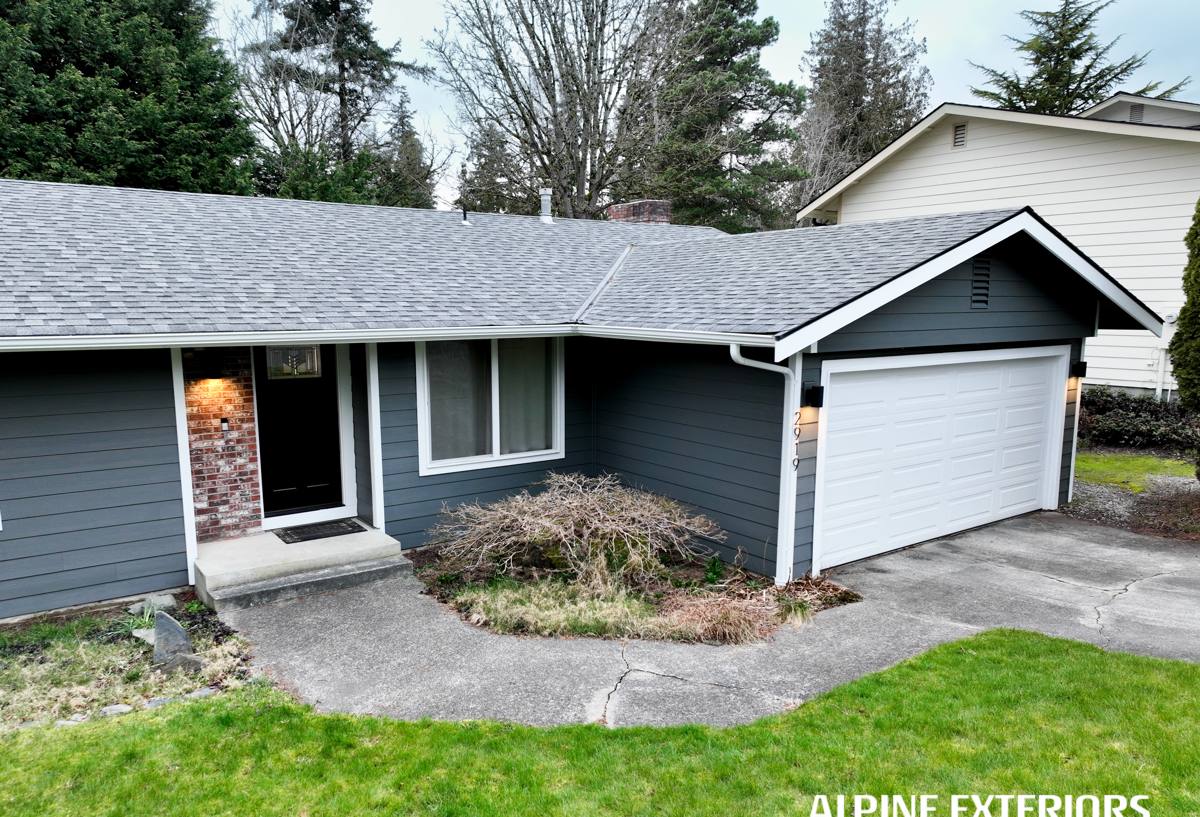
What This Climate Actually Does to Siding
Moss and Algae Aren't Just Cosmetic
On a wooded, shaded lot, moss doesn't stay on the roof. It creeps down onto north-facing walls, into corner trim, and along the bottom courses of siding where splash-back and standing debris keep the surface damp longer than the rest of the house. Left alone, that moss holds moisture directly against whatever is underneath it. On some materials that's a slow cosmetic problem. On others — particularly wood-based products — it's a slow rot problem, because the moss is doing exactly what a wet towel left against a wall would do: keeping that section damp for weeks instead of hours.
Driving Rain Still Finds a Way In
Whatcom County gets its share of wind-driven rain off the Pacific, and even homes set back from the water take a direct hit during a real system. Water doesn't need a big gap to get behind siding — a poorly lapped joint, a nailed-through flashing, or a caulk-only seam around a window is enough. Once it's behind the cladding, whether that moisture becomes a real problem depends almost entirely on what's underneath: the water-resistive barrier, the flashing details, and how much drying capacity the wall assembly has. In a shaded, humid microclimate like Nooksack's, that drying capacity matters even more, because the sun isn't going to bail out a mistake the way it might on an open, south-facing lot.
Signs a Nooksack Home Needs Replacement, Not Just Repair
Repair makes sense when the problem is isolated — a cracked board, a damaged corner, storm impact in one spot. Replacement is the right call when the damage is systemic, meaning it traces back to the material or the original installation rather than a single event. Here's what tends to point toward replacement on homes in this area:
- Soft or spongy spots when you press on the siding, especially near the bottom courses and around window trim
- Persistent black or green staining that comes back within weeks of being cleaned
- Paint that's failing evenly across large sections rather than in one weather-exposed spot
- Visible gaps, warping, or buckling in lap siding, particularly on shaded north and east walls
- A musty smell near exterior walls inside the house, which often means moisture has already worked its way through
- Siding that's original to a home built before modern water-resistive barrier and flashing standards were common practice
If you're only seeing one of these in one location, a repair can buy you time. If you're seeing several, or the same issue keeps reappearing after repairs, the material or the original installation is the actual problem, and replacement is the more honest answer.
What a Correct Siding Replacement Actually Involves
Tear-Off and What's Underneath
A proper replacement starts with a full tear-off, not an install over the old siding. That's the only way to actually see the sheathing underneath — whether it's still sound, whether there's hidden rot around windows or at the base of the wall, and whether previous flashing was done correctly. On homes in humid, shaded settings, this step matters more than usual, because damage that never got the chance to dry out can sit hidden behind the old siding for years.
Water-Resistive Barrier and Flashing
Once the sheathing is exposed and repaired where needed, a continuous water-resistive barrier goes on, with flashing integrated at every penetration — windows, doors, hose bibs, vents, and the base of the wall. This is the layer that actually keeps water out if it gets past the siding itself, and it's also the layer that's easiest to shortcut, because none of it is visible once the siding goes back on. In a climate that stays damp longer than it stays dry, a gap in this layer isn't a someday problem. It's a next-winter problem.
Fastening, Clearances, and Trim
James Hardie fiber cement has specific fastening patterns, minimum clearances from grade, decks, and roofing, and gap requirements at butt joints and trim — all spelled out by the manufacturer for a reason. Fastened too tight, spaced wrong, or installed with insufficient clearance from the ground or a lower roofline, and you create the exact moisture traps that make shaded, humid lots harder on siding in the first place. Getting these details right is what separates a siding job that holds up for decades from one that starts showing problems again in five or six years.
Material Choice Matters More in This Kind of Climate
On a shaded, humid lot, the material itself does a lot of the work of managing moisture — more than it would on an open, sunny site where things dry out fast on their own. Here's how the common options actually perform under those conditions:
| Material | Behavior in shade and humidity | Long-term maintenance |
|---|---|---|
| James Hardie fiber cement | Non-combustible, dimensionally stable, does not swell or rot when damp; factory ColorPlus finish resists moss staining better than field-applied paint | Occasional wash; repaint cycle measured in decades, not years |
| Vinyl siding | Won't rot, but traps moisture behind it if seams or laps fail, and can warp or fade under sustained damp/shade cycling | Low upkeep until failure, then panel replacement is often visually mismatched |
| Primed wood or engineered wood (e.g. LP SmartSide) | Wood-based core is vulnerable to moisture wicking at cut edges and joints; moss holding damp against the surface accelerates this | Regular repainting and edge sealing required to keep warranty intact |
| Cedar | Natural material that will absorb and release moisture repeatedly; shade slows drying and extends the time cedar stays wet after rain | Frequent refinishing, sealing, and moss treatment to prevent decay |
Why We Install Only James Hardie Fiber Cement
We standardized on James Hardie because it's the product that holds up to this exact climate problem without asking a homeowner to stay on top of a maintenance schedule to keep it that way. It's fiber cement, not wood-based, so it doesn't swell, wick, or rot when a shaded wall stays damp longer than it should. It's non-combustible, which matters anywhere in Washington given wildfire smoke and ember exposure in dry summer stretches. The factory-applied ColorPlus finish is baked on under controlled conditions, which holds color and resists the kind of moss and algae staining that shows up fastest on field-painted materials. Hardie's HZ5 product line is engineered specifically for climates like this one — freeze-thaw cycling, sustained moisture, and coastal-adjacent exposure. And the warranty is a real, transferable manufacturer warranty, not a pro-rated one that shrinks the day you move.
We don't say this to knock every other product on the market. Vinyl, engineered wood, and cedar all have legitimate uses and honest advocates. We simply won't put our name behind an install on a wall assembly that we know is working against the climate it's sitting in — and after years of replacing siding that failed early in exactly these conditions, Hardie is the material we trust to do the job right the first time.
Our Process for Nooksack Projects
- On-site assessment. We look at sun exposure, tree cover, drainage, and the current siding's actual condition — not just from the ground, but up close at trim, corners, and the base of the wall.
- Tear-off and sheathing inspection. Old siding comes off completely so we can check for hidden moisture damage before anything new goes on.
- Water-resistive barrier and flashing. Continuous barrier with properly integrated flashing at every window, door, and penetration.
- Hardie installation to manufacturer spec. Correct fastening pattern, gapping, and clearances from grade, roofline, and decks.
- Trim, caulking, and final detailing. The small transitions — corners, butt joints, and terminations — are where most siding failures actually start, so we don't rush them.
- Walkthrough. We go over the finished work with you before calling the job done.
A Quick Checklist Before You Hire
Whether you go with us or someone else, these are worth confirming before any contract gets signed:
- Ask whether the crew does a full tear-off or installs over existing siding
- Ask specifically how they'll handle water-resistive barrier and flashing at windows and doors
- Ask for the manufacturer's fastening and clearance specs, and whether the crew follows them
- Confirm licensing and insurance, and ask how long they've worked in Whatcom County specifically
- Ask what warranty applies to both the material and the labor, and get it in writing
- Ask how they'll address existing moss, staining, or shaded areas of the home during the estimate
Why a Crew That Already Works This Area Matters
A shaded, humid, tree-covered lot near Nooksack asks different questions of a siding job than an open lot closer to the water in Blaine — and a crew that only sees a house once doesn't always know to ask them. Working this area regularly means we've already seen where moss tends to establish first, which walls stay wet longest after a storm, and what a rushed water-resistive barrier looks like five years later when it fails. That's the kind of judgment that doesn't show up in a brochure, only in the details of the install.
If you're weighing a siding replacement on a home in the Nooksack area, we're happy to take a look and walk you through what we're seeing — no pressure, no obligation. A free estimate is the easiest way to find out whether repair still makes sense or whether it's time to do the job right, once.