 Blaine Siding
 Siding Repair in Nooksack Isn't the Same Job Everywhere Else
Nooksack sits inland from Blaine, in a stretch of Whatcom County shaped by the river valley it's named for and by tree cover that shades a lot of the lots out here. That combination matters more than most homeowners realize. You're not dealing with the dry, wide-open exposure of an inland desert town, and you're not right on the water either — but you're close enough to the coastal air moving in off the Strait and the bay country near Blaine that salt-tinged moisture still reaches your siding. Add in the shade from mature trees and damp ground that's common on properties in this part of the county, and you get a specific pattern of wear that a generic repair approach tends to miss.
A lot of siding repair calls we get in this area aren't really about one bad board. They're a symptom. Water has been getting in somewhere — behind a seam, under a window, at a spot where two materials meet — for months or years before anyone noticed the panel start to soften or the paint start to bubble. Repairing the visible damage without figuring out why it happened just buys you a few more years before the same failure shows up again, usually worse.
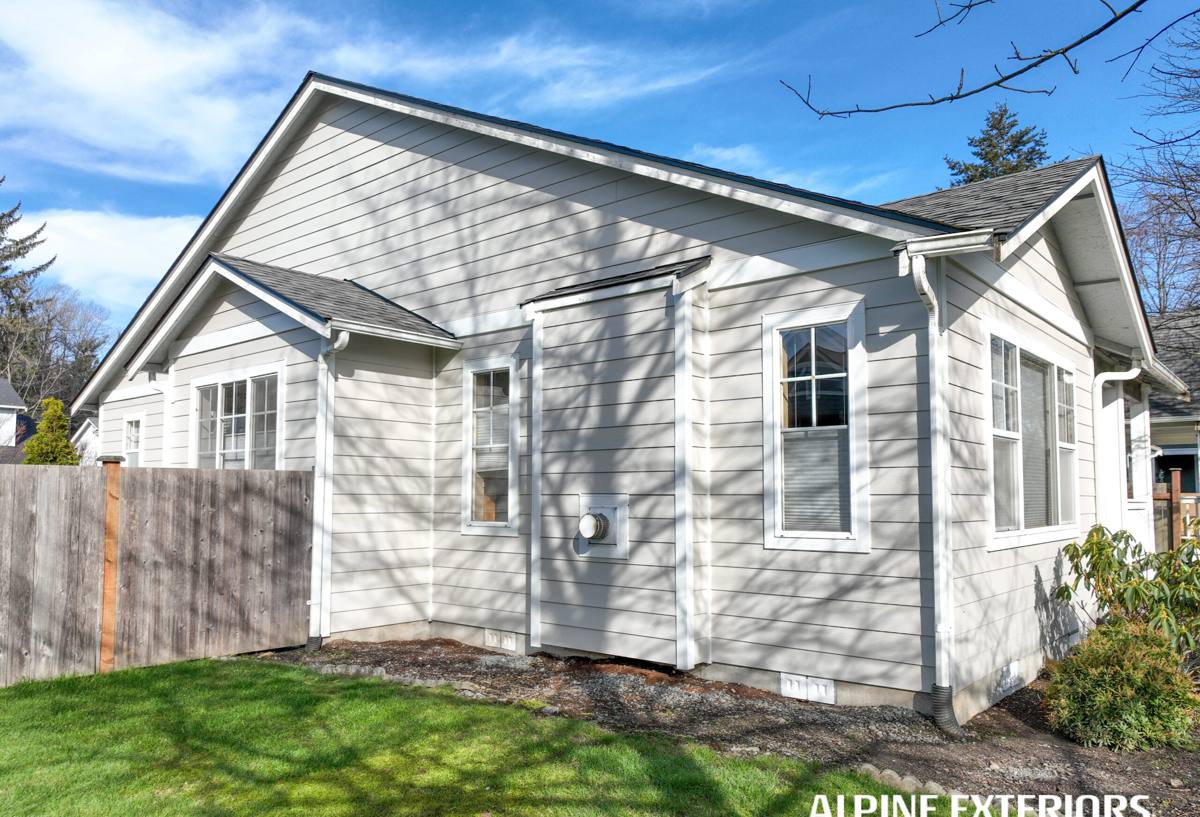
What Local Climate Does to Siding Over Time
Salt Air and Slow Corrosion
Whatcom County's proximity to the coast means airborne salt makes its way inland more than people expect, especially during windier stretches of fall and winter. Salt-laden moisture is hard on exposed fasteners, metal flashing, and trim pieces. It accelerates corrosion at the small metal points that hold siding together, and once a fastener starts to rust and lose its grip, the panel around it starts to move, which opens gaps for water to follow.
Driving Rain and Wind-Driven Moisture
This part of Washington gets rain that doesn't just fall straight down — storms push it sideways, testing every lap joint, corner, and seam on a house. A siding system that's caulked and flashed correctly sheds that water without issue. One with a gap, a failed bead of caulk, or a lap that wasn't installed to the right overlap will let water track behind the panels, where it can sit against sheathing and framing for weeks between dry spells.
Moss, Shade, and a Long Damp Season
Tree-covered lots, which are common around Nooksack, keep siding shaded and slow to dry out after rain. That's exactly the environment moss and algae need to take hold. Once moss establishes on a wall, roofline, or the base of your siding, it holds moisture against the surface long after the rest of the house has dried. Over a long damp season, that constant contact moisture is enough to start softening fiber cement backer, rotting wood trim, or breaking down the protective coating on other siding materials.
Signs Your Siding Needs Repair, Not Just a Wash
Some damage is obvious. Some hides in plain sight until it's expensive. Here's what we tell Nooksack-area homeowners to check for:
- Siding that feels soft, spongy, or gives slightly when you press on it
- Paint that's peeling, bubbling, or flaking in a localized area rather than evenly across the wall
- Dark staining, streaking, or discoloration that doesn't wash off
- Visible gaps opening up at seams, corners, or where siding meets trim
- Moss or algae buildup that keeps coming back after cleaning
- Panels that look warped, buckled, or slightly bowed away from the wall
- Crumbling or rotted material near the bottom courses, close to grade
- A noticeable jump in heating costs, which can point to moisture-damaged insulation behind the siding
Any one of these on its own might be minor. Two or three showing up in the same area of the house usually means water has been getting behind the siding for a while.
What a Correct Repair Actually Involves
Swapping a damaged board for a new one is the easy part. Doing it right takes more steps, and skipping them is how a "repaired" wall ends up failing again in a year or two.
- Remove the damaged section carefully, without cracking adjacent panels that are still sound
- Inspect the sheathing and house wrap or weather-resistive barrier underneath for rot, staining, or moisture damage
- Check flashing at nearby windows, doors, or penetrations — a repair is a good chance to catch a flashing problem before it causes the next failure
- Confirm proper clearance from grade, decks, or hardscaping, since siding installed too close to the ground stays wet longer
- Install matching material with correct fastener spacing and pattern, not just whatever gets it to hold
- Seal and caulk to spec at seams and transitions, using products rated for the material
- Match coating or touch-up paint as closely as possible so the repair doesn't stand out
Miss the inspection step and you can install a brand-new piece of siding over sheathing that's already rotting. It'll look fine for a while. It won't stay that way.
Repair or Replace? How We Help You Decide
Not every damaged section needs a full re-side, and not every "small patch" request should stay small. The honest answer depends on a few factors:
| Situation | Repair Is Often Right | Replacement Is Worth Discussing |
|---|---|---|
| Extent of damage | Isolated to one or two areas | Showing up in multiple spots across the house |
| Cause | Single identifiable failure point (one flashing gap, one bad seam) | Systemic issue — original install quality, wrong material for the climate |
| Siding age | Still well within expected service life | Approaching or past the material's realistic lifespan |
| Moisture behind the wall | Sheathing tests dry once damaged panel is removed | Sheathing shows rot, staining, or soft spots |
| Material match | Original product still available or close match exists | Original product discontinued or was never right for this climate |
We'll tell you straight if a repair is genuinely the right call — we're not trying to upsell a full re-side when a targeted fix will hold. We'll also tell you when patching is throwing money at a problem that's going to keep coming back.
When the Underlying Material Is Working Against You
Part of an honest repair assessment is looking at what's actually on the wall. We install only James Hardie fiber cement siding, and that standard shapes how we approach repairs, too. If a Nooksack home is currently sided in vinyl, LP SmartSide, primed spruce, cedar, or another fiber cement brand, we can often still make a sound repair — but we'll tell you plainly if that material is a poor match for this climate's salt air, driving rain, and long damp season, and whether repeated repairs are a sign the siding itself, not the workmanship, is the problem.
James Hardie fiber cement holds up differently in these conditions. It's non-combustible, dimensionally stable in wet-dry cycles, and finished at the factory with ColorPlus technology, which resists the fading and peeling that painted or primed products are prone to out here. When a repair calls for replacing more than a small section, or when a homeowner is looking at their second or third repair on the same wall in a few years, that's usually the point where switching that section — or eventually the whole house — to Hardie starts to make more sense than continuing to patch a material that's fighting the local climate.
Our Process for a Nooksack Siding Repair
We keep the process straightforward because most homeowners just want the problem fixed correctly and explained clearly along the way.
- Inspection: We look at the damaged area and the surrounding wall, not just the spot you called about, since related issues often show up nearby
- Diagnosis: We identify the actual cause — flashing, caulk failure, grade clearance, material breakdown — before quoting anything
- Straight assessment: You get a clear repair-versus-replace recommendation with the reasoning behind it
- The work: Repairs are done to the same fastening, flashing, and sealing standards we use on full installs, not shortcuts because it's "just a patch"
- Cleanup and check: We leave the site clean and walk the repair with you before we consider the job done
Why a Crew That Already Works in Nooksack Matters
A contractor who regularly works this part of Whatcom County has already seen how salt air, driving rain, and shade-driven moss affect siding on homes with lot conditions similar to yours. That local pattern recognition speeds up diagnosis — we're not guessing at what's causing a failure, we're checking against what we've already seen fail the same way nearby. It also means a faster, more direct response when a repair needs attention, rather than waiting on a crew that has to travel a long distance out of a different service area for a small job.
Just as important is what local experience does for honesty. A crew that's built a reputation working Blaine and the surrounding communities, including Nooksack, has more reason to give you a straight repair-or-replace answer than to push unnecessary work. Reputation in a smaller community travels fast, in both directions.
Keeping a Repair Performing After We Leave
A correct repair should last, but a little upkeep from the homeowner's side goes a long way in this climate:
- Rinse siding periodically to clear salt film and general grime buildup before it accumulates
- Trim back branches and vegetation near the house to improve airflow and sun exposure, which slows moss and algae regrowth
- Check caulking at seams and trim annually, especially after a hard winter
- Keep gutters and downspouts clear so water isn't overflowing onto siding below
- Watch previously repaired areas for any return of staining, softness, or gaps, and address it early rather than waiting
If you're seeing signs of trouble on your siding, or you've already had a repair fail once and don't want to go through that again, we're happy to take a look and give you a straight answer. Reach out for a free, no-pressure estimate — we'll tell you what we actually see, not just what's easiest to quote.