 Blaine Siding
 New-Construction Windows in Custer: What the Term Actually Means
"New-construction windows" isn't just a marketing phrase — it describes a specific installation method used when a house is being framed and dried in, not a window swapped into an existing wall years later. On a new build in Custer, the window arrives with a nailing flange (sometimes called a nail fin) that gets integrated directly into the wall's weather-resistive barrier before siding ever goes up. Get that sequencing right and the window becomes part of a continuous drainage system. Get it wrong, and you've built a leak path into the wall that won't show up until years down the road, usually as rot, staining, or a musty smell nobody can locate.
This matters more in Custer than in a lot of places, because the homes going up here — whether on acreage off the county roads or in newer infill lots closer to Blaine — are sitting in one of the wetter, saltier corners of Whatcom County. A window installation that would hold up fine in a dry inland climate doesn't automatically hold up here.
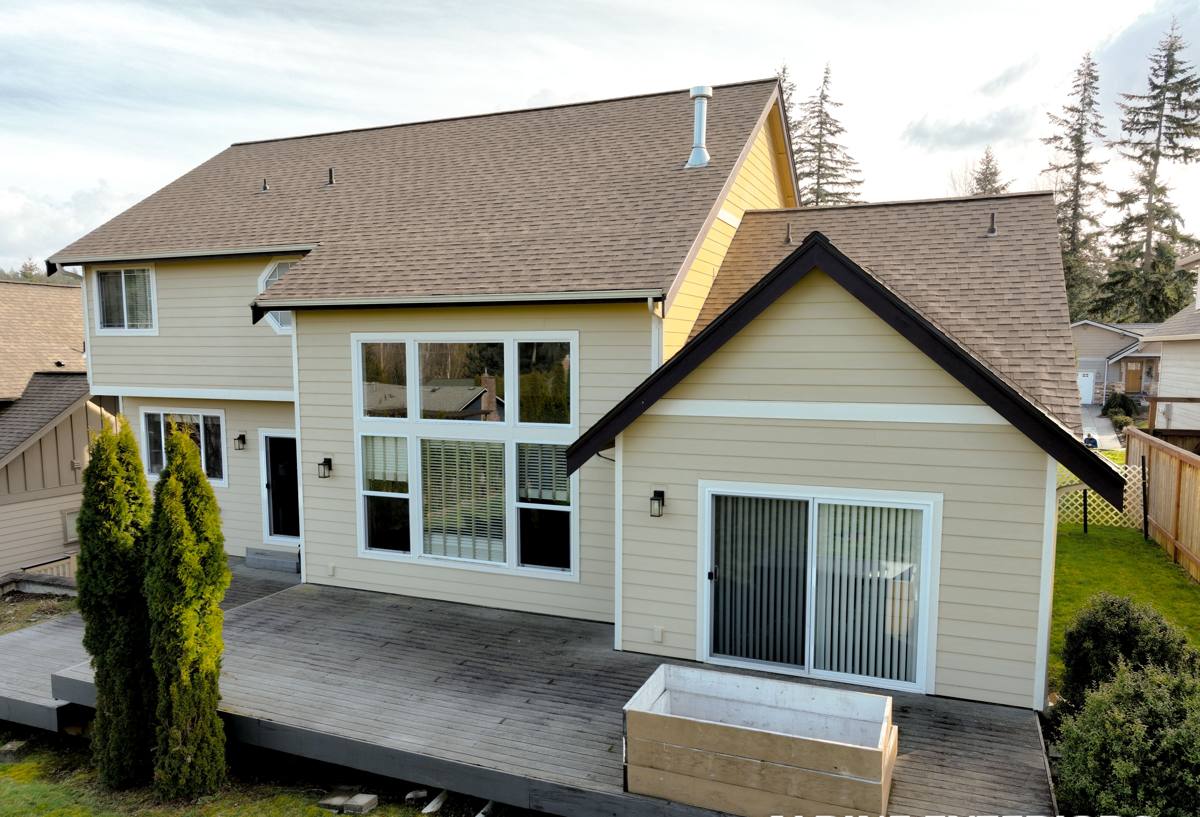
Why Custer's Climate Puts Extra Load on Windows
Custer sits close enough to the Strait of Georgia and the Blaine shoreline that salt-laden air is a regular visitor, even on days when you can't smell or see it. Salt air accelerates corrosion on fasteners, hardware, and any metal flashing components that aren't rated for coastal exposure. Over years, that shows up as pitted screws, stuck locks, and streaking below the frame.
Wind-driven rain is the bigger day-to-day concern. Storms coming off the water don't just fall straight down — they hit window walls at an angle, under pressure, and probe every gap in flashing and sealant. A window that's watertight in a still rain can still leak in a 40 mph gust because the water is being pushed uphill against the frame, not just running off it.
Then there's moss season, which in this part of Whatcom County runs long — often eight or nine months of the year with enough moisture and shade to keep organic growth active. Moss and algae don't just grow on roofs. They colonize window sills, trim, and any horizontal surface that stays damp, and they hold moisture against wood and composite materials far longer than a dry surface would. A sill detail that sheds water quickly is a bigger deal here than in a drier climate, because anything that pools becomes a growth medium.
What a Correct New-Construction Window Installation Involves
There's a right order of operations for installing a window during a new build, and skipping a step is the single most common cause of early window failures we get called out to diagnose. The sequence matters as much as the window itself.
- Rough opening is checked for square, level, and correct dimensions — before the window ever shows up on site.
- A sloped sill pan flashing is installed at the bottom of the opening, so any water that gets past the window has somewhere to drain besides into the wall framing.
- Self-adhered flashing tape is applied at the jambs first, then the head, in a shingle-lap sequence so each layer overlaps the one below it — never the reverse.
- The window is set, shimmed level and plumb, and fastened through the nailing flange per the manufacturer's schedule.
- Flashing tape is run over the top flange and integrated with the weather-resistive barrier so water sheds down and over the window, not behind it.
- Sealant is applied at specific points only — never a full bead around the entire perimeter, which can trap water instead of letting it escape.
- Interior air sealing (backer rod and low-expansion foam, not just caulk) closes the gap between the frame and rough opening for both energy performance and moisture control.
Every one of those steps is hidden behind siding and trim within days of being completed. That's exactly why the installation crew's habits matter more than almost anything visible on the finished house.
Why Sequencing Matters More in Salt Air and Driving Rain
In a milder climate, a small sequencing mistake might never surface — there just isn't enough wind-driven water pressure to find it. In Custer's conditions, water is actively being pushed at the building envelope for a good chunk of the year. A reversed flashing lap or a bead of sealant in the wrong place is far more likely to turn into an active leak, and salt air accelerates any corrosion once moisture does get behind the cladding.
Choosing the Right Frame and Glass for This Location
Frame material and glass package both affect how a window performs against salt air, driving rain, and a long wet season. There's no single "best" option for every project — it depends on budget, exposure, and how the rest of the home is finished — but the trade-offs are worth understanding before you commit.
| Frame Material | Coastal/Salt-Air Behavior | Moss & Moisture Resistance | Best Fit For |
|---|---|---|---|
| Vinyl | Won't corrode; hardware quality varies by manufacturer | Good — non-porous, sheds water cleanly | Budget-conscious builds, most exposures |
| Fiberglass | Excellent — dimensionally stable, minimal expansion/contraction | Very good — dense, low water absorption | High-exposure sites, long-term ownership |
| Aluminum | Requires marine-grade or coastal-rated finish to avoid pitting | Good if properly finished; can show corrosion without it | Modern architectural styles, larger openings |
| Wood-clad | Cladding protects wood, but any breach exposes it to rot risk | Weakest — exposed wood or breached cladding invites growth | Interior wood aesthetic where exterior is fully protected |
On glass, a dual-pane low-E unit with argon fill is the baseline we'd recommend for this area — it manages both energy performance and condensation control through our wet winters. On walls with heavy wind exposure or west/southwest orientation, a triple-pane or upgraded glass package can reduce condensation and improve comfort near the glass, though it's a cost adder that makes more sense on some elevations than others.
Our Installation Process, Start to Finish
For a new-construction project in Custer, our process starts before the windows ever arrive on site. We verify rough openings against the window schedule and manufacturer specs, flag any framing issues to the builder early, and confirm flashing tape and sealant products are compatible with the weather-resistive barrier already specified for the house — mixing incompatible sealants and membranes is a real cause of premature failure that has nothing to do with the window itself.
During installation, each opening gets sill pan flashing, shingle-lapped tape at the jambs and head, and the window set plumb, level, and square before fastening. We check operation — opening, closing, locking — before the opening is closed in with siding, because that's the last easy chance to fix anything. Interior air sealing is completed once the window is set, and we document flashing details as we go so there's a clear record of how each opening was built, not just a finished wall with no way to verify what's behind it.
Coordinating with Builders and General Contractors
New-construction window work almost never happens in isolation — it has to fit into a builder's schedule between framing, WRB installation, and siding. We work directly with GCs and framers on timing so windows go in at the right point in the sequence, not rushed in early before the wall is ready or delayed until it's holding up other trades. Clear communication here avoids the two most common scheduling problems: windows installed before the weather barrier is properly lapped around the opening, and windows sitting exposed to weather for weeks without flashing completed.
Why Local Experience in Custer Matters
A crew that only occasionally works this far north in Whatcom County doesn't have the same working knowledge of how exposure plays out here — which elevations of a house take the worst of the wind-driven rain, how much slower things dry out under tree cover during moss season, and which flashing and sealant combinations hold up under sustained salt exposure versus which ones look fine on day one and fail in year three.
We also know the practical side: what Whatcom County inspectors are looking for at framing and insulation stages, how to sequence work around the region's wet stretches so flashing details aren't compromised by installing in active rain, and how local wind patterns off the water affect exposure differently from one side of a Custer lot to the other. That's knowledge you build by working here repeatedly, not by reading a manufacturer's install guide once.
Maintenance Checklist for New Windows in This Climate
A correctly installed window still benefits from basic upkeep, especially given how long moss season runs here. A few habits go a long way:
- Clear debris and moss buildup from sills and tracks at least twice a year, more often under tree cover.
- Check exterior sealant joints annually for cracking or separation — small gaps are easy to address before they become active leaks.
- Test locks and hardware for smooth operation; salt air can stiffen mechanisms faster than in drier climates.
- Rinse accumulated salt residue off exterior glass and frames periodically, particularly after storms.
- Watch for staining or soft spots on interior trim near windows — an early sign worth investigating, not ignoring.
Common Mistakes We See on New-Construction Projects
Most window problems on new builds trace back to a handful of recurring issues: sealant used as the primary water barrier instead of proper flashing, flashing tape lapped in the wrong order so water runs behind rather than over it, missing or flat (non-sloped) sill pans that let water pool instead of drain, and window openings closed in with siding before flashing details were fully verified. None of these are exotic mistakes — they're the result of rushing a sequence that has to happen in the right order, on a house type where the mistakes get covered up fast.
If you're planning a new build in Custer or anywhere around Blaine and want windows installed the way they should be for this climate, we're happy to walk the plans or the framed opening with you and put together a straightforward, no-pressure estimate.