 Blaine Siding
 Grandview Siding Has to Work Harder Than Siding Inland
Grandview homes sit in one of the tougher microclimates a siding product will ever face in Whatcom County. You're close enough to the water to get salt-laden air working on every fastener, seam, and finish year-round. You're far enough north and west to catch the full brunt of Pacific storm systems, which means driving, wind-blown rain that hits siding sideways rather than straight down. And you're in a part of Washington where shade, moisture, and mild temperatures combine to give moss and algae a long growing season — sometimes close to year-round on north-facing walls and anything tucked under trees or eaves.
Any one of those conditions is manageable for a well-built exterior. Together, they're exactly the combination that exposes weak siding products and sloppy installation fast. We install James Hardie fiber cement siding exclusively, and Grandview is a neighborhood where that decision matters — not as a sales pitch, but as a practical response to what the climate actually does to a house.
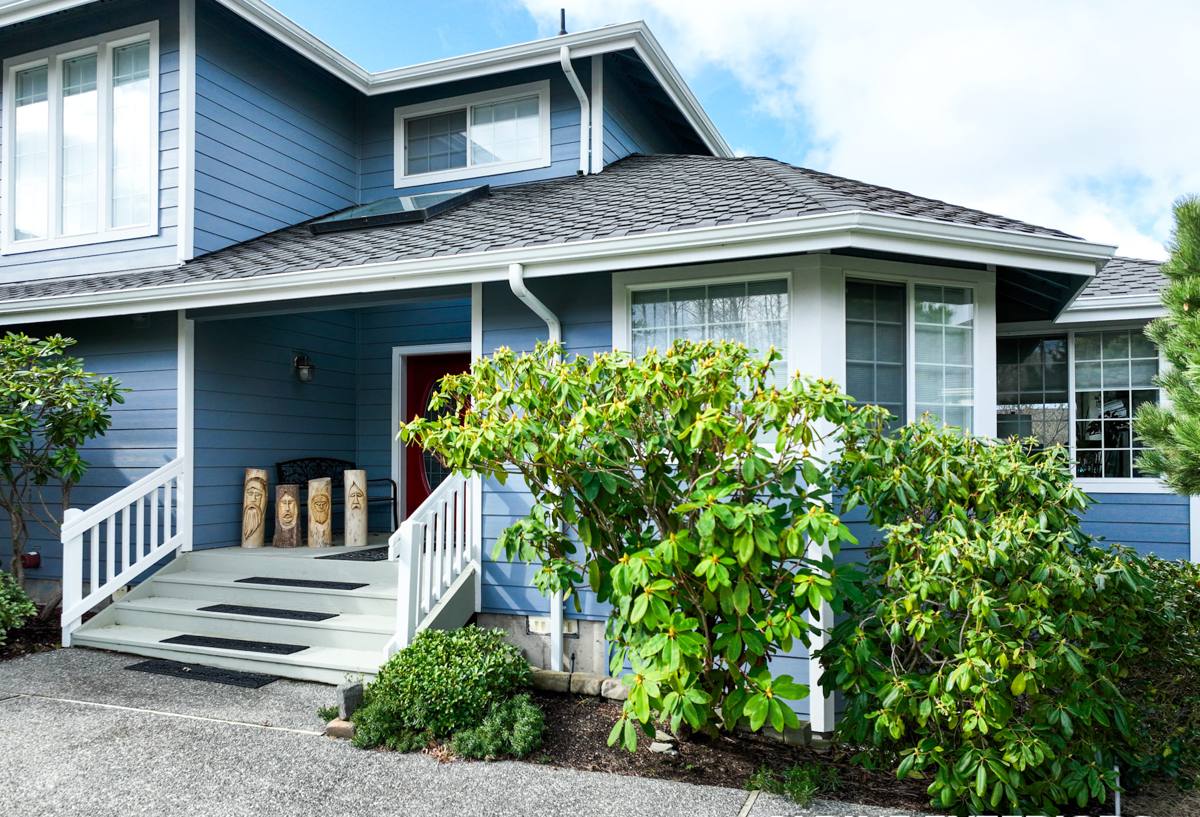
What Salt Air, Rain, and Moss Actually Do to Siding
Salt Air
Airborne salt is corrosive and hygroscopic — it pulls moisture out of the air and holds it against whatever surface it lands on. On siding, that means fasteners, trim edges, and any exposed cut ends stay damp longer than they would a few miles inland. Products that rely on paint film alone for protection, or that swell and soften when saturated, lose ground faster near the water. Over years, that shows up as fastener corrosion, edge swelling, and paint that chalks and fails earlier than it should.
Driving Rain
Wind-driven rain doesn't just wet the face of the siding — it pushes water sideways and upward into laps, seams, and butt joints that were only ever designed to shed water moving straight down. A siding system that isn't dimensionally stable, or that wasn't installed with the right lap, clearance, and flashing details, will take on moisture at exactly those joints. Once water gets behind the cladding, the siding material itself matters less than what happens next — how fast it dries out, and whether it's rigid enough to keep doing its job while damp.
Moss and Algae
A long moss season means prolonged surface moisture on shaded and north-facing walls. That's a maintenance issue for any siding, but it's a structural issue for products that absorb water into the substrate rather than shedding it off a stable surface. Constant damp-dry cycling is what accelerates rot, delamination, and coating failure in moisture-sensitive materials.
Why We Only Install James Hardie Here
We don't install LP SmartSide, vinyl, Cemplank, Allura, primed spruce, or cedar. That's not a marketing position — it's a standard we hold because we've seen what Grandview's climate does to siding that wasn't engineered for it. Each of those alternatives gets something right (cost, appearance, ease of install), but each also has a real-world trade-off — moisture sensitivity, maintenance burden, or a coating system that wasn't built for this much sustained dampness — that we're not willing to put our name behind on a coastal Whatcom County job.
James Hardie fiber cement is non-combustible, dimensionally stable when wet or dry, and finished at the factory with ColorPlus Technology — a baked-on finish that's substantially more consistent and durable than field-applied paint. It's also engineered in climate-specific formulations, which matters a great deal in a place like Grandview.
HZ5 Engineering: Built for This Exact Climate
James Hardie makes region-specific product formulations under its HardieZone system, and the Pacific Northwest falls under the HZ5 engineering profile — designed for high-moisture, high-humidity climates like ours. That's a meaningful distinction from a one-size-fits-all fiber cement product. HZ5 siding is formulated to resist moisture-related damage in exactly the conditions Grandview sees most: sustained dampness, freeze-thaw cycling in winter, and prolonged shade on parts of the home that rarely get direct sun to dry out.
For Grandview homes specifically, that means:
- Stronger resistance to moisture absorption on shaded, moss-prone elevations
- A factory finish (ColorPlus) that holds color and resists chalking better near salt air than field-applied paint
- Dimensional stability that keeps laps and joints tight through wet Whatcom County winters
- Non-combustible core material, which also matters for insurance considerations in many coastal WA communities
The Right Product Lines for a Grandview Home
Most Grandview homes are well served by one of two James Hardie plank profiles, sometimes combined with an accent product for gables or feature walls:
| Product | Best Use | Why It Fits Grandview |
|---|---|---|
| HardiePlank Lap Siding | Primary wall cladding, most home styles | Widest color and texture range; proven long-term performance in wet coastal climates |
| HardieShingle | Accent walls, gables, Craftsman-style detailing | Adds texture without sacrificing the moisture performance of the plank field |
| HardieTrim | Corners, window and door surrounds, fascia | Matches the plank's stability so trim doesn't move independently and open gaps |
| HardiePanel | Modern vertical siding, accent sections | Clean lines for contemporary Grandview builds; same HZ5 moisture engineering |
The right combination depends on your home's existing style, roofline, and how much sun versus shade different elevations get — which is exactly the kind of thing that's worth walking through in person rather than guessing at from a brochure.
What Correct Installation Actually Involves
James Hardie siding is only as good as the installation behind it. In a climate like Grandview's, the details that get skipped on a rushed job are the same details that determine whether water stays out for 30 years or finds its way in within five.
| Detail | Done Right | Common Shortcut |
|---|---|---|
| Weather-resistive barrier | Continuous, properly lapped house wrap with all penetrations sealed | Reused or torn existing wrap, gaps left at penetrations |
| Flashing at windows/doors | Full head, jamb, and sill flashing integrated with the WRB | Caulk used in place of proper flashing |
| Butt joint treatment | Joints flashed or sealed per Hardie's published details, staggered across the wall | Joints simply butted and caulked, stacked in a visible pattern |
| Fastening | Corrosion-resistant fasteners at manufacturer-specified spacing and depth | Standard fasteners driven too deep, blowing through the board's face |
| Clearance | Minimum 6" clearance from grade, 1"–2" from roofline, decks, and patios | Siding installed tight to grade or hardscape, wicking moisture |
| Caulking | Used only where Hardie specifies it, with the right sealant | Over-relied on to cover gaps in flashing work |
None of this is exotic — it's published in James Hardie's own installation instructions. But it takes longer to do correctly than it does to fake, and on a coastal Whatcom County home, the gap between the two shows up as water damage within a handful of winters rather than decades of service.
How We Approach a Grandview Job
1. On-Site Assessment
We walk the home in person, looking at exposure on each elevation, existing moisture damage, roofline and deck intersections, and how much shade each wall gets — since that drives where moss and prolonged dampness will be worst.
2. Tear-Off and Substrate Check
We remove the existing siding and inspect the sheathing underneath for rot or hidden damage before anything new goes up. This is where problems from years of trapped moisture behind the old siding usually surface, and it's not a step we skip to save time.
3. Weather Barrier and Flashing
A new, continuous weather-resistive barrier goes on with all windows, doors, and penetrations properly flashed before a single piece of siding is hung.
4. Hardie Installation to Spec
Siding, trim, and accent products go up following James Hardie's published fastening, clearance, and joint details — not shortcuts that happen to look fine until the first real storm season.
5. Final Walkthrough
We review the finished work with you, including care and cleaning guidance specific to a moss-prone, salt-air environment.
What This Costs — and What Drives the Price
Every home is different, but the main factors that move the price on a Grandview siding job are consistent:
| Factor | Impact |
|---|---|
| Extent of substrate repair | Rotted sheathing found during tear-off adds material and labor before new siding even starts |
| Home size and wall complexity | More corners, gables, and roof intersections mean more flashing and trim detail work |
| Product mix | Combining plank, shingle accents, and trim costs more than a single flat profile but often suits the home's style better |
| Color and finish | Factory ColorPlus finishes vary in cost by color; some premium colors carry a modest upcharge |
| Site access | Tight lots, fencing, or landscaping near the home can add setup and protection time |
We'll only be able to give you real numbers after seeing the home, but broad ranges and the reasoning behind them are something we're always upfront about during the estimate.
Living With Hardie Siding in a Moss-Prone Climate
James Hardie siding is low-maintenance, not no-maintenance. In a place with Grandview's moss season, a little routine care goes a long way toward keeping the finish looking right for decades:
- Rinse siding annually with a garden hose and soft brush — avoid pressure washers, which can force water behind laps and joints
- Trim back vegetation and tree limbs that keep any wall shaded and damp longer than necessary
- Check gutters and downspouts each fall so overflow doesn't run down the siding face
- Address any moss or algae growth early with a gentle, siding-safe cleaner rather than letting it establish
- Inspect caulking at trim and penetrations every couple of years and touch up as needed
- Watch for any hairline cracking or chalking, which can signal it's time for a maintenance coat under ColorPlus's transferable warranty terms
Why Hiring a Crew That Already Works This Neighborhood Matters
Siding installation isn't uniform across Whatcom County. A crew that mostly works drier, inland jobs may not default to the flashing and clearance details that a salt-air, high-rainfall neighborhood like Grandview actually requires — not because they're careless, but because it's simply not what they run into every week. A crew that already works this area knows which elevations tend to hold moss longest, how local wind patterns drive rain into specific wall assemblies, and where the previous generation of siding on homes like yours typically failed first.
That local pattern recognition is hard to replace with a generic install checklist. It's the difference between siding that's technically up to code and siding that's actually built for the specific conditions on your street.
If you're weighing a siding replacement or new build in Grandview, we're happy to walk the property with you, point out what your home's exposure actually calls for, and give you a straightforward, no-pressure estimate — use the form below to get started.