 Blaine Siding
 Board & Batten Siding Built for the Dakota Creek Corridor
Homes along the Dakota Creek corridor in Blaine sit close to moving water, low tree cover in places, and a straight shot of wind off Semiahmoo Bay and Drayton Harbor. That combination means more sustained moisture contact on exterior walls than a house sees a few miles inland, and it shows up first on siding — softened wood grain, chalky paint, and moss creeping up from the bottom courses. Board and batten is a strong style choice for this area's farmhouse and modern-craftsman homes, but the style only holds up if the material underneath it is chosen and installed for exactly this kind of exposure.
This page covers board and batten siding specifically for Dakota Creek properties in Blaine — what the climate demands, what a correct installation looks like, and why we install only one material for it.
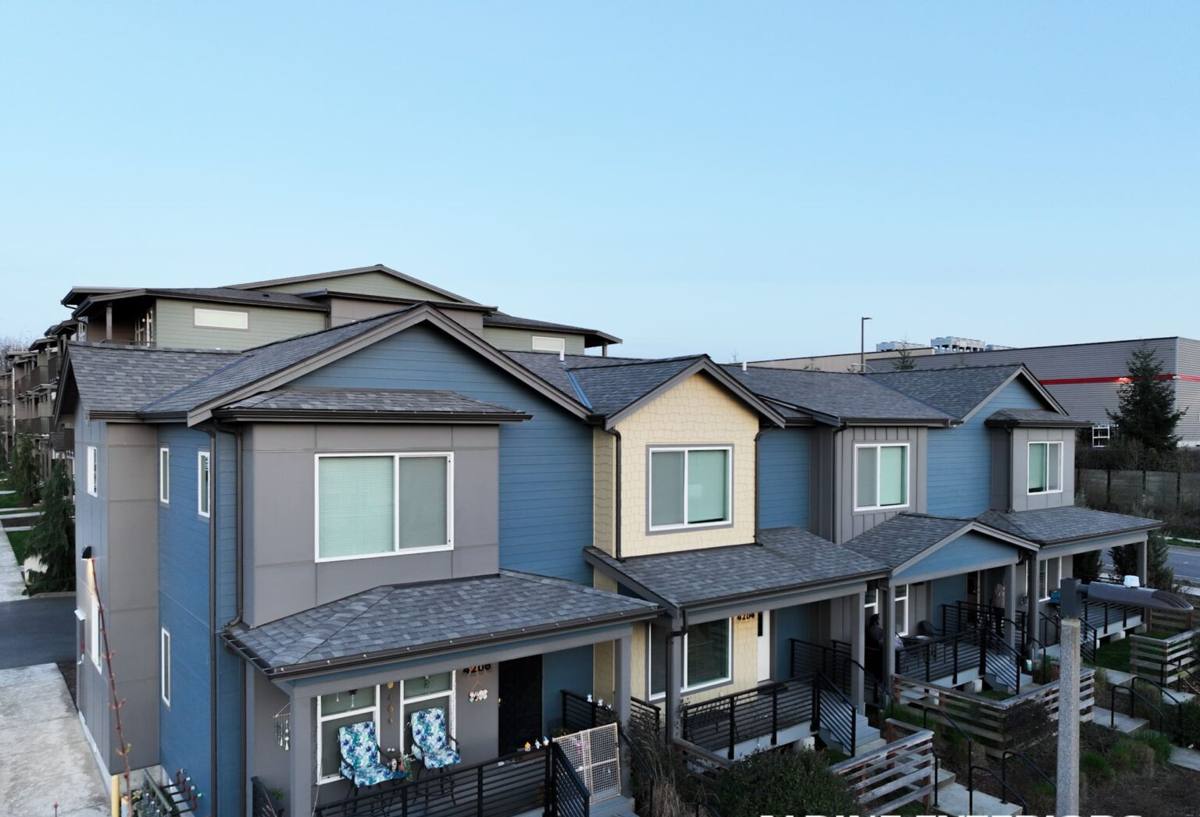
What Board & Batten Siding Actually Is
Board and batten is a vertical siding pattern: wide flat boards installed side by side, with a narrower strip — the batten — covering each seam. The result is a strong vertical shadow line that reads as clean and traditional from a distance, whether it's used on a full house, a gable end, or an accent section like a porch or entry wall. It's one of the oldest siding patterns in American building, originally developed for barns and farmhouses because the batten-over-seam design sheds water better than a plain butt joint.
That water-shedding logic is still the whole point of the style. A board and batten wall is only as good as the seams underneath the battens, the gap behind the boards, and the material's ability to take repeated wetting and drying without swelling, cupping, or losing paint adhesion. On a corridor like Dakota Creek, that's not a cosmetic detail — it's the difference between siding that looks the same in year fifteen and siding that needs battens re-caulked and boards replaced by year seven.
Why the Pattern Matters More Here Than Elsewhere
Vertical boards create more seams per square foot of wall than horizontal lap siding does, and every seam is a place water can find its way behind the cladding if it isn't detailed correctly. In a marine climate with sustained rain and salt-laden air, that raises the bar for the installer, not just the material. We treat every batten line on a Dakota Creek job as a place that needs to be right the first time, because callbacks for water intrusion behind board and batten are almost always an installation problem, not a design problem.
Why We Only Install This in James Hardie Fiber Cement
Board and batten is commonly sold in primed wood, engineered wood, vinyl panel systems, and fiber cement. We install James Hardie fiber cement exclusively, and this style is a good example of why.
Primed wood and engineered wood board and batten depend entirely on the paint film and caulk joints staying intact. Once water gets past either one — through a hairline crack, a nail pop, or a batten seam that opens up as the wood moves — the boards absorb moisture and start to swell, delaminate at the edges, or rot from the inside out. In a wet, salt-exposed climate like Blaine's, that failure clock runs faster than it does in a dry inland region. Vinyl board and batten avoids rot but flexes with temperature and wind, which telegraphs waviness along those long vertical panels, and it's not a material that holds paint if a homeowner ever wants to change the color.
James Hardie fiber cement is cement, sand, and cellulose fiber — it doesn't absorb water the way wood does, it isn't combustible, and it's manufactured in an HZ5 formulation engineered for climates with sustained moisture and freeze-thaw exposure, which describes Whatcom County's winters accurately. The factory-applied ColorPlus finish is baked on rather than field-painted, which matters specifically for board and batten because it means every board and every batten arrives with uniform, weather-resistant color instead of relying on a painter's coverage over dozens of individual seams. That's a meaningful advantage on a pattern with this much surface detail.
What a Correct Board & Batten Job Involves
Board and batten looks simple from the ground, which is exactly why it gets rushed on some jobs. Done correctly, it involves several steps that don't show up in the finished look but determine whether the wall performs for the next several decades.
- Rainscreen gap: A furring strip or drainage mat behind the panels so any moisture that reaches the wall plane can drain and dry instead of sitting against the sheathing.
- Correct fastening: Hardie panels and battens fastened per manufacturer spec into framing, not just sheathing, with the right fastener spacing for wind exposure this close to open water.
- Batten spacing and seam backing: Battens sized and spaced to fully cover panel joints with solid backing underneath, not just cosmetic overlay.
- Flashing at every transition: Windows, doors, roof lines, and the base of the wall all need proper flashing details — this is where the majority of real-world water intrusion actually starts, regardless of siding material.
- Clearance at grade: Bottom of siding held above finished grade, decks, and hardscape so splash-back and standing moisture don't sit against the material.
- Caulk only where it belongs: Sealant at true butt joints and terminations, never used as a substitute for proper flashing or gaps.
Material Comparison for a Board & Batten Project
| Material | Behavior in Sustained Moisture | Salt Air / Coastal Exposure | Long-Term Upkeep |
|---|---|---|---|
| James Hardie fiber cement | Does not absorb and swell; dimensionally stable when installed to spec | Non-combustible, holds ColorPlus finish well in salt-exposed settings | Occasional wash-down; no repainting cycle for the finish itself |
| Primed wood / engineered wood | Absorbs moisture at seams and edges; prone to swelling and rot over time | Salt air accelerates paint film breakdown and edge exposure | Repainting cycle, caulk maintenance, edge sealing |
| Vinyl board and batten panel | Doesn't rot, but seams and panel edges can allow moisture behind the wall plane | Can fade and become brittle faster under UV and salt exposure over years | Low upkeep but limited repair options if a panel is damaged |
How We Handle a Dakota Creek Board & Batten Project
The process for a Dakota Creek property starts with an on-site look at how that specific home sits relative to wind, water, and shade — a low-lying lot near the creek behaves differently than a lot with more elevation and clearance, even within the same neighborhood. From there:
- Walk the exterior and flag existing moisture, trim, and flashing issues before any siding goes up — covering a hidden problem is worse than not covering it at all.
- Confirm the board and batten layout — full-wall, gable accent, or mixed with a lap siding field — and lock in reveal width and batten spacing before ordering material.
- Install or verify the rainscreen gap and weather-resistive barrier across the wall before panels go on.
- Hang HardiePanel vertical siding and HardieTrim battens per manufacturer fastening and clearance specs, with flashing detailed at every window, door, and roof transition.
- Final walk-through covering seam lines, grade clearance, and touch-up needs before calling the job finished.
Living With Board & Batten Siding in This Climate
Correct material and correct installation take care of the structural side. Homeowners still get better long-term results with a small amount of seasonal attention, especially with a wall pattern that has this many vertical seams and battens for moss and debris to catch on.
- Rinse siding annually, focusing on north-facing walls and anywhere shaded by trees or fences where moss gets a foothold first.
- Keep gutters and downspouts clear so water isn't sheeting down the wall face during heavy rain.
- Trim back vegetation and shrubs so battens and the base of the wall get airflow and sunlight.
- Check caulk at butt joints and trim terminations every couple of years — this is the one maintenance item board and batten needs slightly more than plain lap siding, simply because there are more seams.
- Address any moss growth on siding promptly rather than letting it establish, since it holds moisture against the surface.
Why the Local Crew Matters
Board and batten installed to spec in a dry inland climate can tolerate some installation shortcuts and still look fine for years. On a corridor with this much sustained moisture and salt exposure, those same shortcuts show up faster — often within the first few wet seasons. A crew that already works Blaine and Whatcom County properties knows what wind-driven rain does to vertical seams here, how close to grade is actually safe on a low lot, and where flashing details need extra attention on homes near the water. That local pattern recognition is worth more than a generic installation crew working from a national playbook, especially on a siding style where the seams are the whole ballgame.
If you're weighing board and batten for a home in the Dakota Creek area, we're glad to walk the property, talk through layout options, and give you a straightforward, no-pressure estimate using the form below.