 Blaine Siding
 Why Cherry Point's Shoreline Climate Is Especially Hard on Siding
Cherry Point sits right on the water north of Blaine, and that location changes how siding ages compared to homes even a few miles inland in Whatcom County. Homes here take on salt-laden air coming off the Strait, long stretches of wind-driven rain in fall and winter, and a moss season that can run the better part of the year in this part of Western Washington. None of that damage happens overnight. It shows up gradually, in places most homeowners don't check until a problem is already sitting behind the siding rather than on top of it.
Salt air is corrosive to metal, which matters more than most people realize because siding depends on metal in ways you don't see from the ground: nail and screw heads, flashing, and fastener systems at seams and trim. Wind-driven rain matters because it doesn't fall straight down — it gets pushed sideways and upward under laps, into trim joints, and behind poorly sealed penetrations that would stay dry in a calmer inland setting. And moss doesn't just look bad on a north-facing wall; it holds moisture against the siding surface for days at a time, which is exactly the condition that causes rot, paint failure, and fastener corrosion to accelerate.
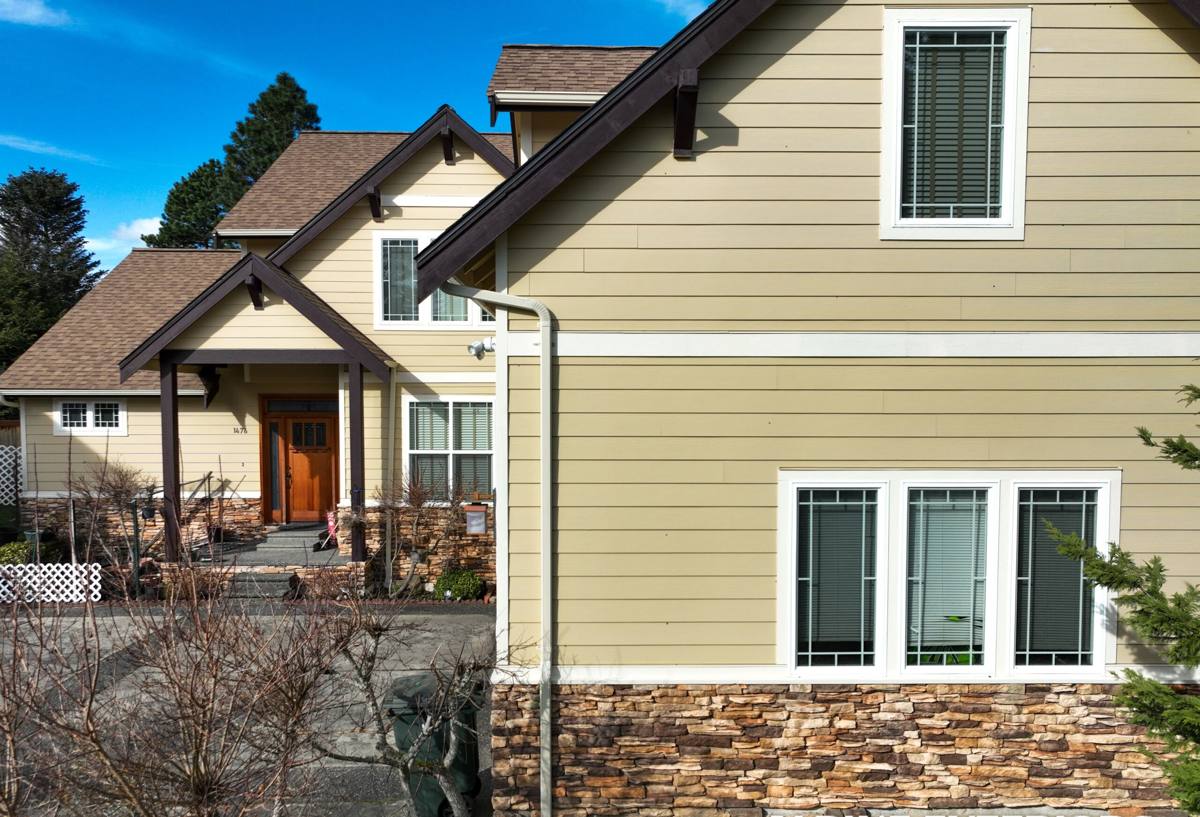
Common Siding Failure Points We Find in Cherry Point Homes
When we inspect siding on a Cherry Point property, damage tends to cluster in a handful of predictable spots. Knowing where to look — rather than just patching whatever is visible — is most of what separates a repair that actually holds from one that fails again in a year or two.
- Rust-streaked or popped fastener heads, especially on walls that face the water directly
- Caulk failure and gaps at window and door trim, where wind-driven rain finds the smallest opening
- Moss and algae buildup on shaded or north-facing walls, trapping moisture against the surface long after the rest of the house has dried out
- Swelling, delamination, or soft spots at butt joints and bottom edges on non-fiber-cement products, particularly primed wood and LP-style panel siding
- Gaps or missing kick-out flashing where a roofline meets a wall, letting wind-pushed rain track behind the siding instead of off it
- Hairline cracking or buckling in vinyl siding from repeated wind and temperature cycling
Repair or Replace? How We Make the Call
Not every damaged section needs to come off the house. But in a shoreline climate like Cherry Point's, it's also easy to under-scope a repair and end up fixing the same spot twice. We walk every job with both possibilities in mind and look at the evidence, not just the homeowner's guess about what's wrong.
| Signs a Repair Makes Sense | Signs Replacement Is the Better Call |
|---|---|
| Damage is isolated to one section or elevation | Fastener corrosion or moisture damage shows up in multiple areas |
| Sheathing behind the damaged area is still sound and dry | Sheathing is soft, spongy, or shows staining when probed |
| The rest of the siding field is holding up well | The same failure has already been patched once or twice before |
| The cause (a flashing gap, a caulk joint) is a fixable detail | The siding material itself is at the end of its realistic service life |
| Moss staining is surface-level and recent | Moss staining is heavy and long-standing, pointing to chronic moisture |
What a Correct Siding Repair Actually Involves
A repair that only addresses what's visible from the ground usually doesn't last in this climate. A repair that holds starts with figuring out why that section failed in the first place.
Diagnosis Before Demolition
We start with a visual inspection and, where damage suggests hidden moisture, a moisture meter reading on the siding and surrounding trim. This tells us whether we're dealing with a surface issue or something that's already reached the sheathing.
Opening It Up
Once damaged siding is removed, we check the house wrap or building paper and the sheathing underneath for rot, staining, or softness — especially around window and door openings, roof-to-wall transitions, and any penetrations like vents or hose bibs. This is the step that gets skipped by a quick patch job, and it's the step that determines whether the repair will actually last.
Fixing the Cause, Not Just the Symptom
If the underlying issue is a flashing detail, a missing kick-out, or a drainage gap, we correct that before any new siding goes back on. Replacing a damaged plank without fixing why it got damaged just buys a few more years before the same repair is needed again.
Putting It Back Together Right
New fasteners go in with corrosion resistance appropriate for a marine environment, not whatever was on hand. We re-establish proper clearance from grade, roof surfaces, and decks — clearance gaps that are often undersized in older installations and become a chronic moisture entry point over time. Sealants are chosen for the joint they're going into, not applied as a blanket fix everywhere.
Matching James Hardie ColorPlus Finish During a Repair
We install James Hardie fiber cement siding exclusively, and that has a practical upside when it comes time to repair rather than replace. Hardie's factory-applied ColorPlus finish ages more evenly and predictably than field-applied paint, which makes matching a repaired section to the surrounding wall more reliable — though even then, a section that's been exposed to years of Cherry Point sun, salt, and rain won't match a brand-new piece exactly. On smaller, more visible repairs we'll talk through whether a like-for-like patch or a full section replacement gives the better long-term result and appearance.
We do inspect and repair siding that isn't James Hardie, since that's what's already on plenty of Cherry Point homes. But when we're looking at primed wood, vinyl, or LP-style panel siding that's failing in the same spots repeatedly, we'll say so plainly. Our standard for new siding and larger sections is James Hardie fiber cement, because it's what we've found holds up to salt air, driving rain, and moss without the recurring maintenance calls those other products tend to generate in this exact climate.
Our Cherry Point Siding Repair Process
- On-site inspection. We look at the damaged area plus anything nearby that shares the same exposure, since problems in a marine climate rarely show up in isolation.
- Written scope. You get an explanation of what caused the damage, not just what we're replacing, so you know whether it's a one-time fix or a sign to watch elsewhere on the house.
- Material matching. We source the closest match in profile and color, and we're upfront if an exact match isn't realistic given the age and fade of the surrounding siding.
- Removal and structural check. Damaged material comes off carefully so we can inspect what's underneath before anything new goes up.
- Repair with the right hardware. Corrosion-resistant fasteners, correctly detailed flashing, and sealants rated for the exposure the wall actually sees.
- Final walk-through. We show you what was found, what was fixed, and what — if anything — is worth keeping an eye on going forward.
Cost Factors for a Cherry Point Siding Repair
Every repair is different, so we don't quote from a distance. But these are the factors that most often move a repair estimate up or down.
| Factor | Typical Impact on Cost |
|---|---|
| Size of the damaged area | Low to Moderate — small, isolated repairs cost less than multi-section work |
| Hidden sheathing or framing damage | Moderate to High — the biggest cost driver once walls are opened up |
| Wall accessibility (height, waterfront exposure, staging needs) | Moderate — harder-to-reach elevations take more time and equipment |
| Material match availability | Low to Moderate — discontinued colors or profiles can mean a larger match area |
| Existing siding type (fiber cement vs. wood, vinyl, or LP-style panel) | Varies — some materials are more labor-intensive to remove and match safely |
Why Hiring a Crew That Already Works Cherry Point Matters
A siding repair in a shoreline neighborhood like Cherry Point isn't quite the same job as the same repair a few miles inland. A crew that already works this area knows which elevations typically take the brunt of the wind and salt, understands how the local moss cycle affects both diagnosis and repair timing, and has already worked through the access and staging considerations that come with waterfront and semi-rural properties in this part of Whatcom County. That familiarity shows up in fewer surprises once a wall is opened up, and in repairs that are scoped around how this specific stretch of coastline actually treats siding — not a generic checklist built for a drier, calmer location.
Keeping Repaired Siding Sound Afterward
A good repair is also easier to protect once it's done. A little seasonal attention goes a long way in a climate like this one.
- Rinse accumulated salt residue off siding periodically, especially on walls facing the water directly
- Keep gutters and downspouts clear so water is directed away from siding and foundation, not run down the wall
- Trim back vegetation and address shaded, damp areas where moss tends to establish first
- Check caulking at trim, windows, and doors annually and touch up before gaps widen
- Watch for new moss or algae growth and address it early, before it holds moisture against the surface for months at a stretch
- Deal with small issues — a loose panel, a cracked caulk joint — before the next round of fall and winter storms
If you're seeing signs of trouble on a Cherry Point home — corroded fasteners, gaps at trim, moss that keeps coming back, or siding that's been patched before without holding — we're happy to take a look and give you a straight answer about what it actually needs. Reach out for a free, no-pressure estimate using the form below.