 Blaine Siding
 Roof Repair Built for the Sumas Climate
Sumas sits inland from Blaine but shares the same weather pattern that wears down roofs across Whatcom County: long, wet winters, a moss season that can stretch from October into May, and enough wind off the surrounding lowlands to drive rain sideways under loose or aging shingles. A roof that would hold up fine in a drier climate often fails early here simply because it was installed, flashed, or maintained without accounting for how much water this region actually sees in a given year.
We repair roofs for homeowners throughout the area, and Sumas jobs tend to share a few recurring problems: moss working into shingle laps and holding moisture against the deck, flashing that was never properly step-lapped around chimneys and dormers, and gutters that back up in a hard rain and push water up under the first course of shingles. None of these are exotic problems. They're predictable, and they're fixable — but only if the repair addresses the actual cause instead of just patching the spot where water showed up inside the house.
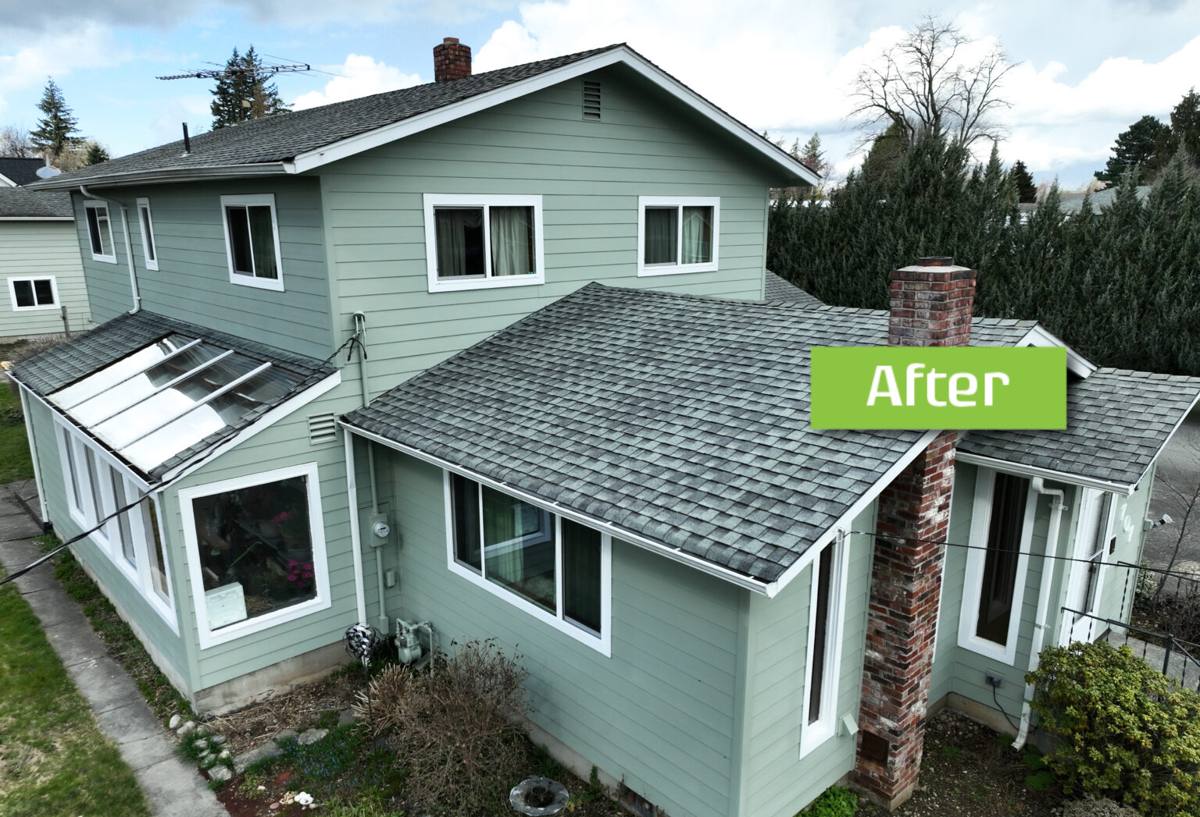
What Local Homes Actually Need From a Roof Repair
A roof leak almost never starts where it shows up on your ceiling. Water travels along the underside of the sheathing or down a rafter before it finds a gap in drywall or insulation to drip through, which means a repair that only addresses the interior stain will leave the real problem in place. A proper roof repair in this climate starts with tracing the water back to its source, which usually falls into one of a few categories:
- Moss and organic buildup: Moss doesn't just sit on top of shingles — it lifts the edges, holds water against the granule surface, and accelerates the shingle's breakdown, especially on north-facing slopes that stay shaded and damp most of the year.
- Flashing failure: Chimneys, skylights, dormers, and roof-to-wall transitions rely on metal flashing, not shingles alone, to shed water. Flashing that's rusted through, poorly lapped, or sealed with caulk instead of properly integrated is one of the most common leak sources we find.
- Nail pops and wind lift: Repeated wind-driven rain works shingle tabs loose over time, and improperly nailed shingles (nails set too high, or not enough per shingle) fail faster under that kind of repeated stress.
- Underlayment gaps: Older roofs, or roofs installed without adequate ice-and-water shield at eaves and valleys, have less backup protection when the primary shingle layer starts to fail.
- Clogged or undersized gutters: When gutters can't keep up with heavy rain, water backs up under the roof edge instead of running off it — a slow, quiet way to rot a fascia board and soak the deck below without anyone noticing until there's a stain inside.
Our Repair Process
1. Inspection and Diagnosis
We start on the roof, not the ceiling. That means checking the suspect area plus everything upslope from it — flashing, valleys, penetrations, and shingle condition — because a leak's entry point is often several feet from where it becomes visible indoors. We'll also check attic ventilation and insulation where accessible, since poor ventilation traps moisture and can mimic or worsen a roof leak from the inside.
2. Honest Scope
Once we know the cause, we tell you what it actually needs: a targeted flashing repair, a shingle section replacement, a moss treatment and preventive cleaning, or in some cases an honest conversation about whether repair still makes sense versus a section or full re-roof. We're not going to talk you into more work than the roof needs, and we're not going to undersell a repair that's really a symptom of a bigger problem.
3. The Repair Itself
Repairs are done to match the existing roof system as closely as possible — same shingle profile and comparable material where available, proper step and counter-flashing (not just sealant), and correct fastening. Where moss has been an issue, we address the growth and, where it makes sense, talk through options for slowing regrowth rather than just cleaning it off once.
4. Cleanup and Walkthrough
We clear debris, check gutters near the repair area for blockage, and walk you through exactly what we found and what we did — no vague summary, no upsell pitch tacked on at the end.
Repair vs. Replace: How We Think About It
Not every roof problem needs a full replacement, and not every leak can be permanently fixed with a patch. The table below covers the general factors that push a decision one way or the other — every roof is different, so this is a starting point for the conversation, not a substitute for an actual inspection.
| Factor | Repair usually makes sense | Replacement worth discussing |
|---|---|---|
| Roof age | Under roughly 15 years, or well-maintained | Approaching or past typical shingle lifespan |
| Leak pattern | Isolated to one flashing point or section | Multiple leaks in different areas |
| Shingle condition nearby | Granules intact, tabs flat | Widespread curling, cracking, or bald spots |
| Moss/moisture history | Recent or first-time issue | Long-term moss damage to the deck itself |
| Decking underneath | Solid, no soft spots | Soft, spongy, or visibly rotted sheathing |
Flashing, Moss, and Ventilation: The Three Things Homeowners Underestimate
If we had to name the three issues that most often turn a small roof problem into an expensive one in this climate, it would be flashing, moss, and ventilation — and all three are quiet by nature. Flashing failures often don't leak every time it rains; they leak during wind-driven storms when water is pushed sideways instead of just running downhill, which means a homeowner might go months between noticeable leaks and assume the problem resolved itself. Moss works even more slowly, lifting shingles a fraction of an inch at a time over a season or two before it becomes obvious from the ground. And poor attic ventilation traps humid air against the underside of the roof deck year-round, which can cause sheathing damage and premature shingle aging even without a single active leak — it just shows up later as a shorter roof lifespan.
The practical takeaway: a roof that "seems fine" from the driveway can still have real problems developing, which is exactly why periodic inspection matters more here than in drier parts of the country.
Signs You Should Get a Roof Looked At
- Water stains on ceilings or upper walls, especially ones that appear or worsen during wind storms rather than steady rain
- Visible moss growth, particularly on shaded or north-facing slopes
- Granules collecting in gutters or at downspout outlets
- Shingles that look curled, cracked, or are missing entirely after a windstorm
- Daylight visible through the roof deck from inside the attic
- Rusted, lifted, or gapped flashing around chimneys, vents, or skylights
- Gutters that overflow during moderate rain rather than just downpours
- A musty smell in the attic, which can indicate trapped moisture even without an obvious leak
Why It Matters That We Work This Area Regularly
Roofing crews that mostly work drier climates or come through on a one-off job don't always account for how aggressively moss and wind-driven rain behave here. We work Whatcom County roofs through multiple wet seasons every year, which means we know what actually fails first on local homes and what holds up — not from a manufacturer's spec sheet, but from what we see when we're up on the roof. That matters when it comes to sequencing a repair correctly (get the flashing and underlayment right before the shingles go back down, not after) and knowing which shortcuts cause problems two winters down the line even if they look fine on install day.
Maintenance That Extends the Life of a Repair
A good repair only stays good if the rest of the roof is kept up. A few habits go a long way in this climate:
- Clear gutters at least twice a year, more often if you're under conifers
- Have moss treated before it establishes heavily rather than after
- Trim back overhanging branches that keep sections of roof shaded and damp
- Get flashing checked whenever gutters or siding work is done nearby, since it's easy to disturb
- Schedule a walk-through inspection every few years even without an active leak
What to Expect When You Call Us
We'll ask a few questions about what you're seeing — where the stain or leak shows up, whether it's tied to wind direction or just heavy rain, how old the roof is if you know. From there we'll schedule a time to get up on the roof and look directly at the problem area and the sections around it. You'll get a straight answer about what's actually wrong, what it'll take to fix it, and a written estimate before any work starts. There's no pressure to sign on the spot, and no inflated scope to pad the job.
If you're dealing with a leak, active moss damage, or just want a roof looked at before winter, we're glad to come take a look. Fill out the form below for a free, no-pressure estimate — we'll tell you honestly what we find.