 Blaine Siding
 Sandy Point sits right on the water in Whatcom County, just outside Blaine, and that shoreline location changes what a house needs from its siding compared to a home a few miles inland. Homes here take a steady dose of salt-laden marine air, driving rain that comes in sideways more often than straight down, and a moss and mildew season that can run most of the year on shaded walls. Siding installation in a spot like this isn't just a smaller version of the same job done anywhere else in Whatcom County — the details that get skipped on an easy inland install are exactly the details that fail first this close to the water. This page covers what a Sandy Point home actually needs from new siding, what a correct installation involves, and how our process works from first look to final walk-through.
Why Sandy Point Siding Wears Differently
Three conditions drive most of the siding problems we see in Sandy Point, and they don't act alone — they compound each other over the course of a wet Whatcom County winter.
Salt Air
Being this close to the water means Sandy Point homes deal with more direct salt exposure than most properties even a short drive inland toward Blaine. Salt in the air accelerates corrosion on fasteners, flashing, and trim, and it breaks down lower-grade finishes faster than a drier climate ever would. Any siding material or piece of hardware on a Sandy Point exterior needs to be chosen with that corrosion risk in mind, not just picked for how it looks in a showroom.
Driving Rain
Waterfront exposure also means more wind, and wind-driven rain doesn't fall straight down — it gets pushed sideways into seams, joints, and every gap in a wall assembly. That's a heavier moisture load than an annual rainfall number would suggest. Siding and installation details that hold up fine in a sheltered, inland spot can fail here specifically because water is finding its way in sideways, not from above.
A Long Moss Season
Mild temperatures, shade, and near-constant moisture add up to a moss and mildew season that runs long in this part of Whatcom County. Shaded and north-facing walls are usually the first to show it, and any siding material that's even slightly porous or that traps moisture against the substrate becomes a growth surface over time. On a lot of Sandy Point homes, the walls facing away from the sun or shaded by trees or neighboring structures need more attention than the sun-facing sides.
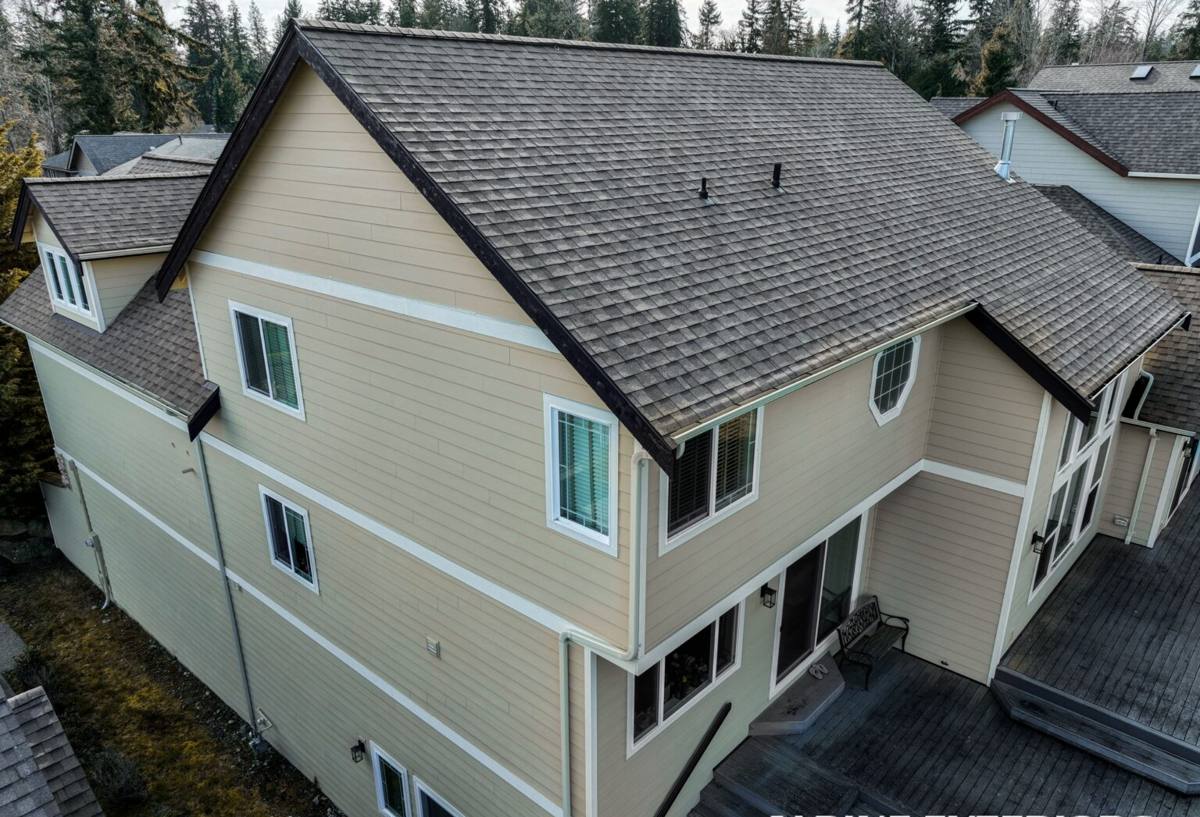
Signs a Sandy Point Home Needs New Siding
Not every siding issue means a full replacement, but these are the signals that usually point toward it rather than a spot repair:
- Panels that are cupping, buckling, or visibly separating from the wall
- Soft or spongy spots when pressed, especially near the bottom courses or trim
- Paint or finish that's chalking, peeling, or fading unevenly across a wall
- Moss or mildew that returns within a season of cleaning, especially on shaded sides
- Visible rot at corners, butt joints, or anywhere siding meets trim
- Rust staining below fasteners or metal flashing
- Interior signs like peeling paint, soft drywall, or musty smells near exterior walls
- Siding that's past its expected service life for the material and this exposure
Why We Install Only James Hardie Fiber Cement Here
We install one siding system: James Hardie fiber cement. We don't offer LP SmartSide, vinyl siding, Cemplank, Allura, primed spruce, or cedar, and that's a deliberate professional standard, not a limited product line we happen to carry. Each of those materials has a legitimate place in the market and homeowners elsewhere who are satisfied with them. But on an exposure like Sandy Point's — sustained salt air, wind-driven rain, and a long moss season — we've made the call that we'd rather install one system we fully stand behind than offer a cheaper option that shifts more long-term maintenance risk onto the homeowner.
- Non-combustible core: fiber cement doesn't feed a fire the way wood-based siding can, which matters for safety and can matter for insurance.
- Factory-applied ColorPlus finish: color is baked on under controlled factory conditions instead of brushed on in the field, and it holds up longer against fading and chalking in salt air than site-applied paint.
- Climate-engineered HZ product lines: Hardie's HZ5 formulation is built for regions with heavy moisture exposure and freeze-thaw cycling, which fits waterfront Whatcom County well.
- Dimensional stability: fiber cement doesn't swell, warp, or cup the way engineered wood products can when they take on repeated moisture over a wet season.
- Strong transferable warranty: Hardie backs the product with one of the more robust warranty structures in the industry, provided installation follows their spec.
That last point matters as much as the material itself. Fiber cement only performs the way it's supposed to when it's installed to Hardie's published specifications — correct fastener type and spacing, proper clearance from grade, and correctly detailed joints and trim. A Hardie product installed loosely will still develop moisture problems in a climate like this one; the material is only as good as the installation behind it.
| Material | Moisture Behavior | Upkeep in Salt Air | Typical Longevity Here |
|---|---|---|---|
| James Hardie fiber cement | Dimensionally stable, resists swelling and warping | Low; factory finish resists fading and chalking | 30+ years with correct installation |
| Vinyl siding | Can distort or warp with heat, brittle in cold | Low upfront cost, but seams and fasteners are exposure points | Variable; shorter in high-wind waterfront spots |
| LP SmartSide / engineered wood | Wood-based core is moisture-sensitive at cut edges and joints | Moderate; edge sealing and caulk maintenance matter | Depends heavily on installation and upkeep |
| Cedar / primed wood | Absorbs and releases moisture readily | High; regular refinishing needed in wet, salty air | Shorter without consistent maintenance |
What Correct Siding Installation Actually Involves
The siding panel itself is the smallest part of what determines whether an installation holds up in Sandy Point. Most of the failures we get called out to inspect trace back to what's underneath or around the visible surface, not the panel itself.
Water-Resistive Barrier and Drainage
Behind every panel needs to be a continuous water-resistive barrier, properly lapped and sealed at every penetration. Given how much wind-driven rain gets pushed into wall assemblies out here, we pay close attention to drainage planning — giving any moisture that gets past the siding a way to drain back out rather than sitting against the sheathing.
Flashing at Every Transition
Windows, doors, roof-to-wall transitions, and any penetration through the siding are where the majority of leaks actually start. Flashing needs to be correctly lapped with the water-resistive barrier and siding, not patched together with caulk as the primary line of defense. This is one of the most common places corners get cut on a fast, budget install, and it's exactly the detail that fails first in a driving-rain climate.
Fastening and Clearances
Hardie's spec calls for specific fastener types, spacing, and penetration depth, along with minimum clearance from grade, roof lines, and decks. Getting clearance wrong traps moisture against the bottom of the siding and is one of the more common causes of early rot and finish failure we see on homes near the water.
Joints, Trim, and Caulking
Butt joints, corners, and trim transitions need to be detailed correctly — factory-mitered where possible, properly caulked where field joints are necessary, and painted with a product rated for the exposure. Loose joint work is a small detail that becomes a big problem once salt air and repeated wetting start working on it.
Our Installation Process
- On-site assessment. We look at the existing siding, sheathing condition, and any trouble spots, and take measurements for an accurate estimate.
- Material and color selection. We go over Hardie's plank, panel, and trim options and ColorPlus color choices that fit the home.
- Tear-off and sheathing inspection. Old siding comes off, and any water-damaged sheathing found underneath gets replaced before anything new goes up.
- Water-resistive barrier installation. The moisture barrier goes on first, since this layer determines whether the wall assembly stays dry behind the siding.
- Flashing at all penetrations. Windows, doors, and other penetrations get flashed and integrated with the barrier before siding installation begins.
- Siding installation to spec. Panels are fastened, spaced, and cleared from grade according to James Hardie's published installation requirements.
- Trim, joints, and caulking. Corners, butt joints, and trim are detailed and sealed with attention to this climate's exposure.
- Final walk-through. We review the completed work with the homeowner and go over warranty and care details.
Cost Factors for a Sandy Point Siding Project
Every siding job prices out differently, but these are the main variables that move the number up or down. We don't quote figures without seeing the home, since access and existing wall condition alone can shift a bid.
| Factor | Why It Matters Here |
|---|---|
| Home size and wall complexity | More corners, dormers, and trim detail mean more labor and material cutting |
| Existing sheathing condition | Rot found during tear-off adds repair cost that isn't visible before the old siding comes off |
| Siding profile chosen | Lap, shingle-style, and panel profiles carry different material and labor costs |
| Trim and detail work | Corner boards, window trim, and fascia detailing add labor beyond flat wall coverage |
| Access and site conditions | Tight lots, fencing, or landscaping near the water can slow staging and setup |
| Water-resistive barrier upgrade | Enhanced drainage detailing costs more up front but reduces wind-driven rain risk |
Why Hire a Crew That Already Works Sandy Point
A siding installer who mostly works inland jobs isn't wrong about siding in general — they're just working from a different set of defaults. Fastener specs, flashing choices, and clearance details that are perfectly adequate on a typical inland Whatcom County home are often undersized for what a Sandy Point exterior deals with year-round. A crew that's already worked in this community has seen which details actually fail out here, not just which ones fail in a manual.
There's also a practical side to it. Waterfront properties can have tighter lot access, wind considerations during installation, and staging challenges that a crew unfamiliar with the area hasn't planned for. Local experience means the schedule and the install plan already account for that, instead of running into it mid-project.
Maintaining New Siding in This Climate
- Rinse salt residue off siding periodically, especially on walls facing the water
- Keep gutters and downspouts clear so water isn't running down and pooling against siding
- Address moss or mildew on shaded walls before it spreads across a full elevation
- Trim back vegetation that keeps a section of wall shaded and slow to dry
- Have caulking and trim joints checked periodically, especially after major storms
- Address any small signs of moisture intrusion immediately rather than waiting for the next dry season
If your Sandy Point home's siding is showing its age, or you're planning ahead for a replacement, we're glad to take a look and give an honest read on what it needs. Reach out for a free, no-pressure estimate using the form below.