 Blaine Siding
 Decks in Dakota Creek Face a Tougher Climate Than Most Builders Plan For
Dakota Creek sits in the part of Whatcom County where marine air off the Salish Sea meets a long, wet Pacific Northwest winter. That combination is harder on an outdoor deck than most manufacturer warranties and generic building guides assume. Salt-laden air moves inland off the water and settles onto exposed metal and end grain. Driving rain comes in sideways during winter storms, not just straight down, which means water finds gaps that a fair-weather build never accounts for. And Blaine's moss season isn't a few weeks in spring — with our cloud cover and rainfall pattern, conditions favor moss and algae growth for a good chunk of the year on any deck surface that doesn't get real sun or airflow.
A deck built without those specifics in mind will usually look fine for the first year or two. The problems show up later: fasteners weeping rust stains into the boards, a ledger board that's been quietly rotting behind the siding, or a deck surface so slick with moss by January that it's a fall hazard. Building correctly for this corner of Blaine costs a little more attention up front. It saves years of problems later.
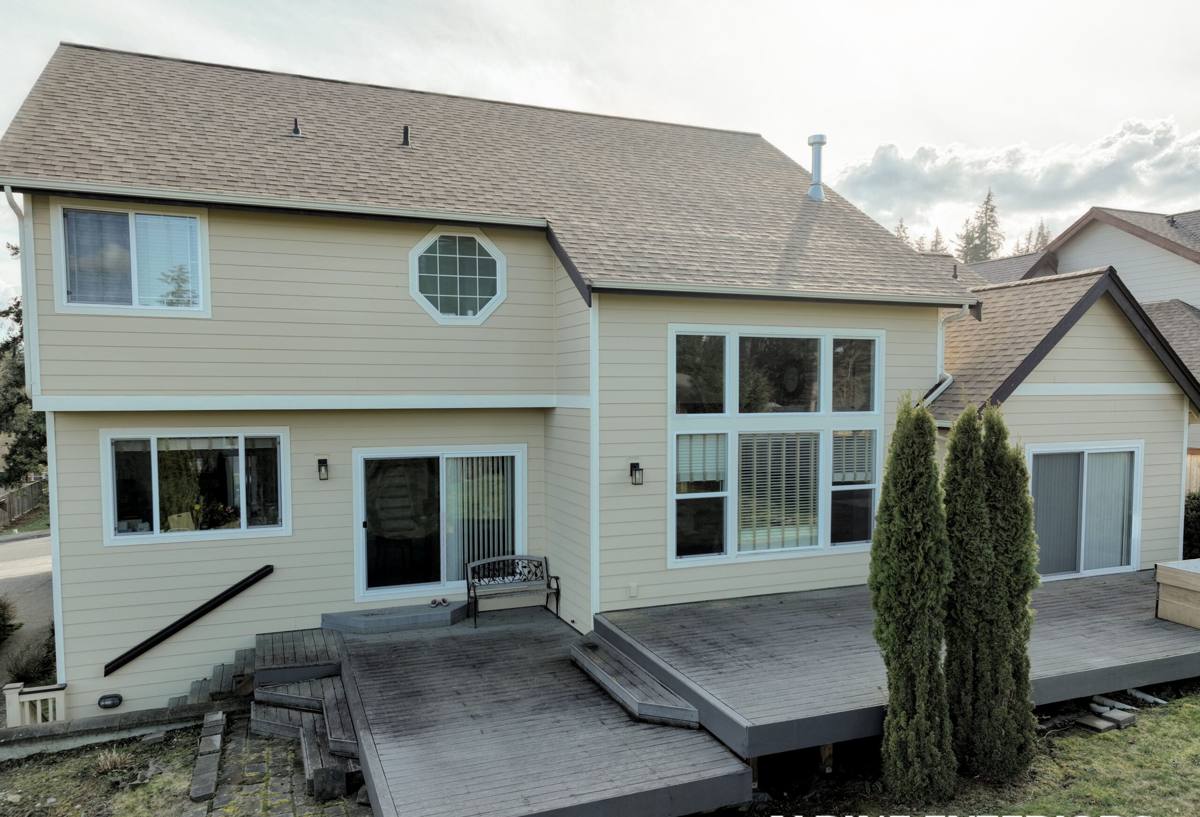
What a Correctly Built Deck Needs to Get Right Here
Framing and Ledger Attachment
Most deck failures don't start at the surface — they start where the deck meets the house. The ledger board, the flashing behind it, and the fasteners holding it all together are the single most important part of the job, and they're also the part a homeowner can't easily inspect once the deck is finished. In a climate that delivers sustained, wind-driven rain, that ledger connection needs proper flashing that sheds water away from the house framing, not just a bead of caulk and a prayer. We treat this as the part of the job that determines whether the deck lasts fifteen years or thirty.
Fasteners and Hardware
Salt air accelerates corrosion on standard fasteners faster than most people expect, even a few miles inland from the water. Structural screws, joist hangers, and post bases all need to be rated for the exposure they'll actually see — not just treated for general outdoor use. Mixing metals matters too: the wrong combination of fastener and connector material can set up galvanic corrosion that eats through hardware from the inside, long before it shows on the surface.
Choosing a Decking Material for Salt Air and a Long Moss Season
There's no single "right" decking material for every home — it depends on budget, how much upkeep you want to do, and how much direct sun the deck actually gets. Here's how the common options hold up under Dakota Creek conditions specifically:
| Material | How it handles salt air and rain | Moss and algae behavior | Maintenance |
|---|---|---|---|
| Pressure-treated wood | Good if fasteners and hardware are matched correctly; end cuts need field treatment | Prone to moss in shaded, low-airflow areas without regular cleaning | Annual cleaning and periodic re-staining or sealing |
| Cedar | Naturally decay-resistant but still needs sealing against driving rain | Can develop surface graying and moss if left unsealed in shade | Sealing every couple of years to hold color and resist moisture |
| Composite decking | Handles moisture and salt exposure well; no rot risk in the boards themselves | Still grows algae/moss film in shaded, damp spots — needs the same cleaning as wood | Occasional washing; no staining or sealing required |
| PVC decking | Fully moisture-resistant, unaffected by salt exposure | Smooth surfaces shed moss more easily but still need periodic cleaning in shade | Lowest maintenance of the group; occasional washing |
One point worth being direct about: no decking material is "moss-proof." Anything installed in a shaded, low-airflow spot near the water will collect organic growth over a wet Whatcom County winter. Material choice affects how much that growth damages the board underneath and how easily it comes off — it doesn't prevent moss from showing up in the first place.
The Moss and Mildew Problem — and How Design Prevents It
Moss doesn't just make a deck look neglected — on a walking surface it's a genuine slip hazard, and left long enough it holds moisture against the board surface and shortens the life of the material underneath, wood or composite. The biggest factor isn't the decking product at all. It's design: how much sun and airflow the deck gets, how tight the board spacing is, and whether the substructure allows air to move underneath instead of trapping damp ground air against the joists.
A deck tucked under heavy tree cover on the shaded side of a Dakota Creek property is always going to need more frequent cleaning than one that gets afternoon sun. We can't change the sun exposure of a lot, but we can control board spacing, ventilation under the deck, and drainage away from the structure — all of which make a real difference in how fast moss takes hold and how easy it is to keep off.
Footings, Drainage, and Grade — Getting the Ground Right First
Whatcom County's wet season saturates ground around a home's foundation for months at a time, and low-lying areas near creeks and wetlands hold water even longer. Footings need to be set below frost depth and sized for the actual soil conditions on the lot, not a generic assumption. Just as important is what happens to water once it's off the deck: grading and drainage around the posts and footings need to direct water away from the structure, not let it pool against posts or under the deck where it accelerates rot and corrosion.
This is another area where a rushed job looks identical to a correct one on installation day — the difference only shows up years later, when a deck on poor footings starts to settle or heave unevenly.
Our Deck Building Process
- On-site assessment. We look at sun exposure, drainage, soil, and how the deck ties into the existing structure before recommending a material or layout.
- Design and material selection. We walk through the honest trade-offs for your budget and how much upkeep you actually want to take on.
- Permitting. Deck permitting requirements vary by jurisdiction in Whatcom County; we handle that process so the finished structure is properly documented.
- Footings and framing. Footings set to depth, ledger flashed correctly, hardware matched to the exposure — the parts that determine whether the deck lasts.
- Decking and finish work. Board installation, railing, and stairs, built to the spacing and detailing the material and site actually call for.
- Final walkthrough. We go over maintenance expectations specific to your deck's material, exposure, and location before we consider the job done.
Cost Factors for a Dakota Creek Deck
Every deck project is different, but the same handful of factors drive most of the cost difference between a basic build and a more involved one:
| Factor | Why it moves the cost |
|---|---|
| Decking material | Pressure-treated wood costs less up front; composite and PVC cost more initially but reduce long-term maintenance |
| Deck height and footing depth | Elevated decks and deeper footings for local frost depth and soil conditions require more structural work |
| Ledger and flashing complexity | Tying into existing siding or a complicated house wall adds labor to do the water management correctly |
| Railing and stair design | Code-required railing height and stair geometry add material and labor depending on deck height |
| Site access and grading | Sloped, low-lying, or hard-to-access lots near the creek or waterfront can add site prep work |
We give straightforward, itemized estimates rather than a single lump number, so you can see exactly what's driving the price and where there's room to adjust the scope.
Maintenance Checklist for Coastal Whatcom County Decks
Whatever material you choose, a few habits go a long way toward getting the full lifespan out of a deck in this climate:
- Sweep debris off the deck regularly through fall and winter so leaves and needles don't trap moisture against the boards
- Clean moss and algae film off the surface at least once a year, more often in shaded areas
- Check fastener heads and hardware periodically for early rust staining, especially near the water side of the property
- Keep gutters and downspouts clear so runoff isn't dumping extra water onto or under the deck
- Re-seal or re-stain wood decking on the schedule the product actually needs, not just when it starts to look worn
- Confirm underdeck airflow isn't blocked by stored items or overgrown landscaping
Why a Crew That Already Works Dakota Creek Matters
A lot of deck problems in this area trace back to a build that would have been perfectly fine somewhere drier — a design or material choice that made sense in a climate without our salt air, our rainfall pattern, or our moss season. A crew that already works Dakota Creek and the surrounding Blaine area has already seen which fastener choices hold up, which ledger details actually keep water out over a wet winter, and which spots on a given lot are going to fight moss no matter what decking goes down. That local track record shows up in fewer callbacks and a deck that's still solid well past the point where a generically built one starts causing trouble.
If you're planning a new deck or replacing one that didn't hold up to a few Whatcom County winters, we're happy to take a look and talk through what makes sense for your property. Use the form below to request a free, no-pressure estimate.