 Blaine Siding
 Point Roberts Decks Face a Different Set of Problems
Point Roberts sits out on its own peninsula, surrounded on three sides by the Salish Sea, which means decks here take on a lot more than the average backyard structure in Whatcom County. Salt-laden air off Boundary Bay and the Strait of Georgia works on fasteners, flashing, and finishes in ways that inland decks never experience. Add in the long stretch of driving rain that defines a Pacific Northwest fall and winter, plus a moss season that can run from October well into spring, and you have a structure that's under constant attack from three directions at once.
None of this means a deck in Point Roberts is doomed — it means it needs to be built and repaired with those conditions in mind from the start. A repair that would hold up fine in a drier, more sheltered part of the county can fail fast out here if it doesn't account for salt exposure and sustained moisture.
Why Salt Air Matters More Than People Expect
Salt air doesn't just look bad when it leaves a white haze on metal — it accelerates corrosion in fasteners, hardware, and any exposed metal connectors far faster than plain moisture alone. Once a screw or joist hanger starts corroding, it loses holding strength long before it looks obviously bad from the surface. On a deck, that's a structural issue, not a cosmetic one.
Why Moss Season Is a Bigger Deal Than It Looks
Moss doesn't just grow on roofs. On a deck, it takes hold in the gaps between boards, along north-facing sections that don't get much sun, and anywhere water sits a little longer than it should. Moss holds moisture against the wood or composite surface for extended periods, which is exactly the condition that leads to rot underneath and slick, unsafe footing on top.
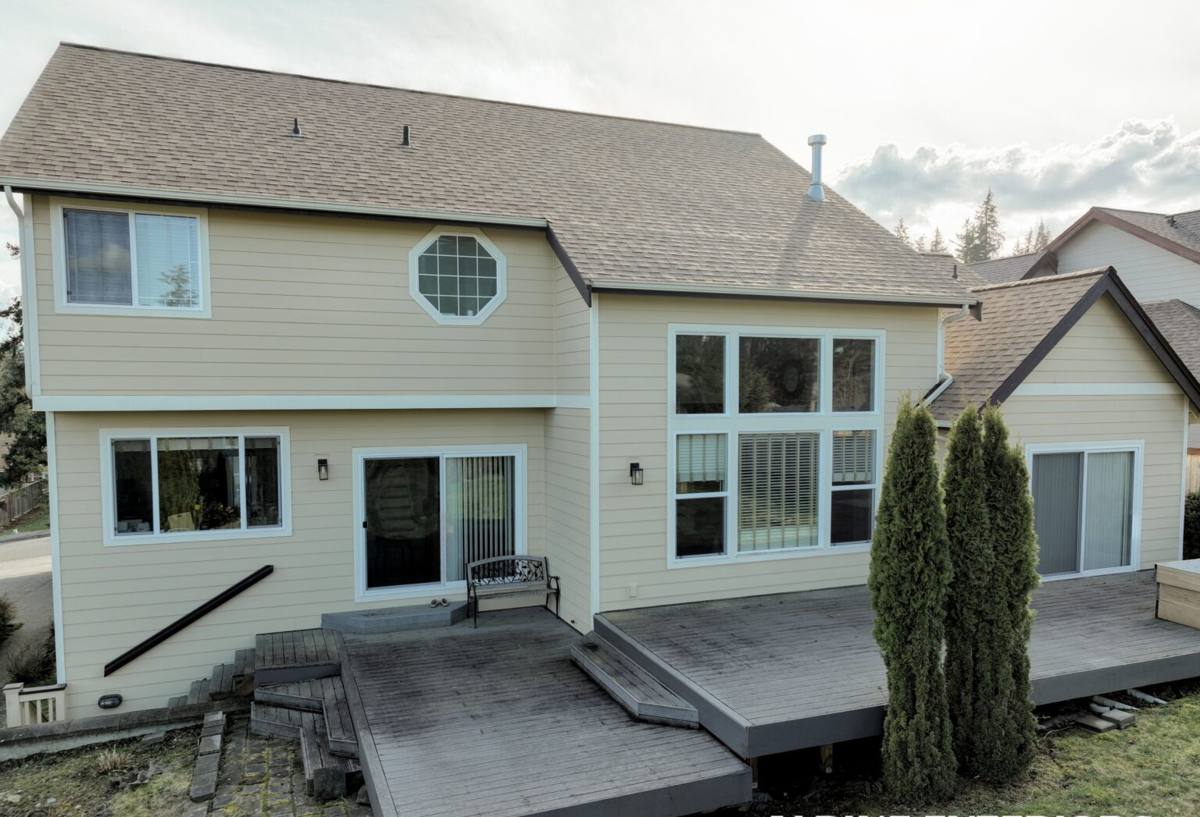
Signs a Point Roberts Deck Needs Repair
Most deck problems don't show up overnight. They build slowly, often hidden underneath the deck boards where you're not looking. Knowing what to check — and how often — makes the difference between a straightforward repair and a full rebuild.
- Soft or spongy spots when you walk across the deck surface
- Boards that have visibly cupped, split, or pulled away from fasteners
- Rust streaks running down from screws, nails, or metal connectors
- A railing that flexes or wiggles when you lean on it
- Green or black growth that keeps coming back even after cleaning
- Gaps or separation where the deck meets the house (the ledger board connection)
- Support posts that feel loose or show soft wood near ground contact
If you're only seeing one or two of these, it's usually a repair situation. If you're seeing several at once, especially anything involving the ledger board or support posts, it's worth a closer structural look before anyone uses the deck.
What a Correct Deck Repair Actually Involves
A repair that's done right isn't just about swapping out the boards you can see. Most of the problems that shorten a deck's life start underneath, and a repair that skips that part just buys a little time before the same issue resurfaces.
The Ledger Board and Framing
The ledger board — where the deck attaches to the house — is the single most important connection on the whole structure, and it's also the part most exposed to water running off the house. A proper repair checks the flashing behind the ledger, confirms the fasteners are still holding at full strength, and looks for any rot working its way into the rim joist behind it. Skipping this step and just replacing surface boards is one of the most common shortcuts we see, and it's the one most likely to cause a bigger failure later.
Joists, Beams, and Support Posts
Anywhere wood meets wood, or wood meets the ground, is a spot to check for rot, especially in a climate that stays damp for months at a time. Support posts near grade and joist ends tucked under the decking are common trouble spots because they dry out slowly and get less airflow than the open deck surface above.
Fasteners and Hardware
In a salt-air environment, the hardware matters as much as the wood. Standard galvanized fasteners can corrode faster here than they would further inland. We use stainless steel or heavy-duty coated fasteners rated for coastal exposure on repair work, because replacing a board with the wrong screws just means doing the job again sooner.
Railings and Guards
Railings take constant stress from people leaning, gripping, and pushing off them, and they're also fully exposed to weather on all sides. A wobbly railing is rarely just a cosmetic annoyance — it usually means a post connection has loosened or the wood around the anchor point has started to soften.
Repair or Replace? What Actually Drives That Decision
Homeowners often assume any deck problem means a full replacement, but that's frequently not the case. The honest answer depends on how much of the structure is affected and where the damage is located.
| Factor | Usually Points to Repair | Usually Points to Replacement |
|---|---|---|
| Location of damage | Isolated to a few boards or one section | Spread across framing, ledger, and multiple posts |
| Age of the deck | Under 15 years, built with sound framing | Original framing near or past its service life |
| Ledger board condition | Solid, flashing intact | Rotted or improperly flashed to begin with |
| Support post condition | Firm, no soft wood at grade | Multiple posts soft or undersized for current code |
| Overall cost | Lower — targeted material and labor | Higher upfront, but resets the clock on the whole structure |
We'll always tell you honestly which side of that line your deck falls on. A repair that's really a stopgap on a failing structure isn't a good use of your money, and a full replacement on a deck that just needs targeted work isn't either.
Materials We Use for Deck Repairs
What goes into a repair matters as much as the labor. For framing and structural work, we use pressure-treated lumber rated for ground contact where it's needed, because anything less doesn't hold up to this region's rain and humidity over time. For visible decking boards, homeowners typically choose between wood and composite, and each comes with real trade-offs worth understanding rather than a one-size-fits-all answer.
Wood decking costs less upfront and can be refinished or spot-repaired board by board, but it needs regular cleaning, sealing, and moss treatment to hold up in this climate. Composite decking costs more initially and resists moisture and moss growth better, but individual boards can be harder to color-match if a repair is needed years down the road, and it still needs proper ventilation underneath to perform well. We'll walk you through what makes sense for your specific deck and how much upkeep you're realistically willing to do, rather than pushing one product as a universal fix.
Why Local Experience in Point Roberts Actually Matters
Point Roberts isn't like the rest of Blaine or the rest of Whatcom County when it comes to scheduling a repair crew. It's a peninsula that's physically cut off from the rest of Washington by land — reaching it by vehicle means crossing into Canada and back through a second border crossing. That's a logistics detail that trips up contractors who don't already build it into their routing and scheduling.
A crew that regularly works Point Roberts plans material deliveries and job scheduling around that reality instead of discovering it the day of the appointment. That means fewer delays, fewer surprise reschedules, and a crew that shows up ready to work rather than figuring out border logistics on the fly. It also means we've seen how decks in this specific pocket of the county actually age — which orientations take the worst of the wind-driven rain, which fastener types hold up and which don't, and where moss tends to establish itself first.
Our Deck Repair Process
We keep the process straightforward because a deck repair shouldn't require guesswork on your end.
- On-site inspection: We check the deck surface, framing, ledger connection, and support posts, not just what's visible from the top.
- Honest assessment: We tell you plainly whether you're looking at a targeted repair, a larger structural fix, or a full replacement, and why.
- Written scope and estimate: You'll know exactly what's being repaired, with what materials, before any work starts.
- The repair itself: Framing and structural issues get addressed first, then decking, then railings and hardware.
- Final walkthrough: We check the repair with you and point out anything worth keeping an eye on going forward.
Keeping Your Repaired Deck in Good Shape
A repair holds up longer with a little regular attention, especially given how much moisture and salt air this deck has to deal with year-round.
- Sweep debris out of board gaps regularly so water doesn't sit and trap moss spores
- Rinse salt residue off the surface and railings a few times a year, especially after storms
- Check for early moss growth in shaded or north-facing sections before it spreads
- Inspect fasteners and hardware annually for rust streaking or looseness
- Keep gutters and downspouts clear so runoff isn't draining directly onto the deck or ledger board
- Reseal or refinish wood decking on the schedule the product actually calls for, not just when it looks faded
If your deck in Point Roberts is showing soft spots, loose railings, or moss that keeps coming back, it's worth having someone look at it before those small issues turn into a bigger structural problem. We're happy to come out, take an honest look, and give you a straightforward, no-pressure estimate — just fill out the form below to get started.