 Blaine Siding
 Peace Arch's Climate Is Harder on Siding Than It Looks
Homes in the Peace Arch area of Blaine sit right where marine air off the water meets the wind and rain patterns of northern Whatcom County. It's a beautiful place to live, but it's not an easy place to be exterior siding. Three things wear on a house here more than almost anywhere else in the region: salt-laden air, wind-driven rain that hits walls at an angle instead of falling straight down, and a moss season that can stretch for most of the year on shaded or north-facing walls.
Salt Air
Being this close to the water means airborne salt settles on exterior surfaces year-round, not just during storms. Salt is corrosive to exposed metal fasteners and trim, and it accelerates the breakdown of paint films that aren't built to handle it. Siding that isn't engineered with this exposure in mind tends to show fading, chalking, or fastener bleed-through years before it should.
Driving Rain
Blaine's weather doesn't just rain down — it rains sideways. Wind off the water pushes moisture into every seam, lap joint, and trim gap on a wall. Any siding system with weak flashing details, poor drainage planes, or joints that aren't sealed correctly will eventually let water behind the cladding, and once that happens, it's the sheathing and framing that pay the price, not just the siding's appearance.
Long Moss Season
Tree cover and persistent damp conditions mean moss and algae get a long head start each year on walls that don't get much direct sun. Materials that hold surface moisture, or that have a finish moss can grip and grow into, stay wet longer and age faster. It's less dramatic than a storm, but it's the slow, constant issue that separates siding that still looks sharp after a decade from siding that doesn't.
Why Fiber Cement Is the Right Answer for This Environment
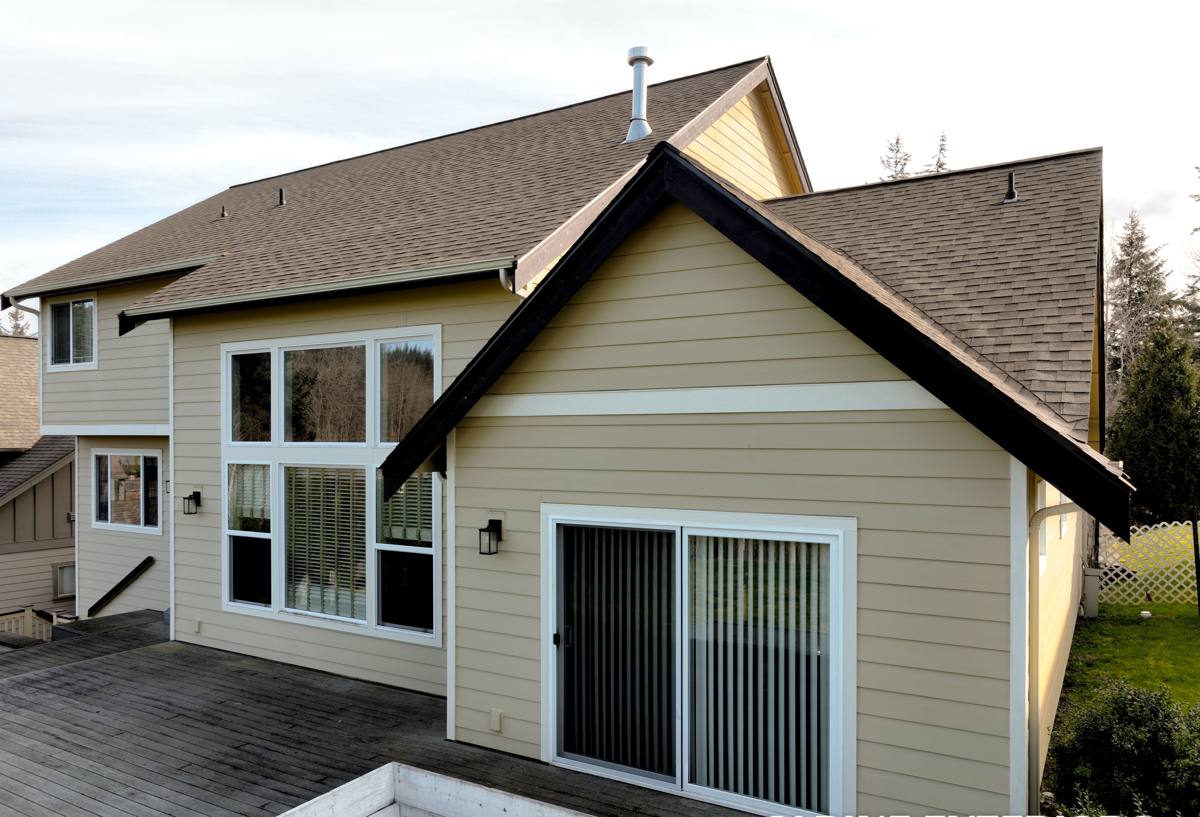
Fiber cement was developed specifically to resist the kind of punishment Peace Arch's climate delivers. It's a dense, cement-based material that doesn't absorb water the way wood does, doesn't corrode the way metal-faced products can, and doesn't get brittle or discolor the way vinyl does under UV and salt exposure. We install James Hardie fiber cement exclusively, and one reason is that Hardie engineers specific product lines — its HZ5 line, in particular — for climates like this one, with formulations built around moisture exposure and temperature swings typical of the Pacific Northwest coast.
That climate-specific engineering matters more in Peace Arch than in a drier inland town. A siding product that performs fine in a mild, dry climate can behave very differently once it's dealing with near-constant humidity, salt air, and driving rain for years on end. Hardie's ColorPlus factory-applied finish also matters here — it's baked on under controlled conditions and backed by its own finish warranty, which holds up better against salt exposure and UV than most field-applied paint jobs.
What a Correct Fiber Cement Installation Involves in This Area
Fiber cement is only as good as its installation. A large share of the siding problems we get called out to inspect in this region aren't material failures — they're installation shortcuts that let water get where it shouldn't.
Moisture Management Behind the Siding
Every correct install starts with a weather-resistive barrier and properly integrated flashing at windows, doors, and any wall penetration. In a driving-rain environment like Peace Arch, this is not optional detail work — it's the difference between siding that sheds water and siding that traps it against the wall sheathing.
Fastening and Clearances
Fasteners need to be corrosion-resistant and set to the manufacturer's specified pattern and depth — over-driven or under-driven nails are a common cause of premature siding failure. Ground clearance and clearance from decks, patios, and roof lines also need to follow Hardie's published specifications; skipping these is one of the fastest ways to invite moisture damage in a wet climate.
Joints, Caulking, and Trim
Butt joints, trim transitions, and any place two pieces of siding meet need to be treated correctly — sealed where Hardie calls for sealant, left to drain where it calls for a gap. Getting this wrong doesn't show up immediately; it shows up two or three winters later as staining, soft trim, or paint failure.
How Siding Materials Hold Up in a Salt Air, High-Moisture Climate
Homeowners comparing materials for a Peace Arch project are usually weighing upfront cost against how the material will actually perform once it's dealing with real Blaine weather for fifteen or twenty years. Here's how the common options stack up on the factors that matter most in this specific climate.
| Material | Moisture Resistance | Salt Air Durability | Moss/Algae Resistance | Long-Term Maintenance |
|---|---|---|---|---|
| James Hardie Fiber Cement | Excellent — non-combustible, dimensionally stable | Strong when installed with corrosion-resistant fasteners | Good — dense surface resists moss anchoring | Low; factory finish holds color for years |
| Vinyl Siding | Fair — seams and laps can allow water intrusion behind panels | Can fade and become brittle over time | Fair — smooth but traps moisture at laps | Low upfront, but limited lifespan in harsh exposure |
| Cedar/Wood Siding | Poor without diligent upkeep — absorbs moisture | Weakens with repeated wet/dry salt cycling | Poor — organic material, prone to moss growth | High; regular sealing/painting required |
| LP SmartSide (Engineered Wood) | Good if edges stay sealed; vulnerable where cuts are exposed | Moderate — coating can wear at exposed edges | Fair — depends on coating integrity | Moderate; edge sealing is critical and ongoing |
This isn't a claim that other materials can't work anywhere — it's a reflection of what tends to hold up best specifically in a coastal, high-rain, moss-prone environment like Peace Arch, which is why we standardized on Hardie fiber cement rather than offering several competing products.
Our Process for Fiber Cement Projects in Peace Arch
Every project starts with an honest look at the specific conditions on that wall — sun exposure, wind direction, tree cover, and existing moisture damage all shape the plan before a single piece of siding goes up.
- Assessment: We inspect the existing siding, sheathing, and trim for hidden moisture damage before quoting the job, not after starting it.
- Prep and repair: Any compromised sheathing or framing gets addressed before new siding goes on — covering up rot with new siding just hides the problem.
- Weather barrier and flashing: A correctly lapped weather-resistive barrier and flashing at every penetration, matched to this climate's rain exposure.
- Installation to spec: Fastening, clearances, and joint treatment follow James Hardie's published installation guidelines — not shortcuts.
- Final walk-through: We review the finished work with the homeowner and confirm everything meets the standard we'd want on our own home.
Keeping Fiber Cement Siding Performing Long-Term in This Climate
Fiber cement is low-maintenance compared to wood, but "low-maintenance" doesn't mean "no maintenance" — especially with a moss season this long. A little seasonal attention goes a long way toward protecting the investment.
- Rinse siding periodically to remove salt residue and organic buildup, especially on shaded or north-facing walls
- Trim back tree branches and shrubs that keep siding shaded and damp for extended periods
- Check caulking at trim and joints annually and have any cracked sealant replaced promptly
- Keep gutters and downspouts clear so water doesn't sheet down over siding it wasn't meant to run over
- Watch ground-level clearance — mulch or landscaping that creeps up against siding traps moisture against it
- Address any soft trim, staining, or discoloration early rather than waiting for it to spread
Why It Matters to Hire a Crew That Already Works in This Area
Siding installation guidelines are written for a wide range of climates, but applying them well means understanding the specific conditions of the wall in front of you. A crew that regularly works Blaine and the Peace Arch area already knows which walls take the worst of the driving rain, which sides of a house fight moss the longest, and where salt exposure tends to hit fasteners and trim hardest. That local pattern recognition doesn't replace following manufacturer specifications — it's what makes sure those specifications get applied correctly to the conditions this specific home actually faces, not to a generic climate zone on a chart.
It also means fewer surprises during the project. A contractor unfamiliar with this stretch of Whatcom County's coastline may not anticipate how much wind-driven rain a particular wall orientation takes, or how quickly moss reestablishes itself on a shaded gable — details that change how flashing, clearances, and even scheduling around wet weather should be handled.
If you're weighing a siding project for a home in the Peace Arch area, we're happy to take a look and give you a straightforward, no-pressure assessment of what your home actually needs. There's no obligation — just use the form below to request a free estimate.