 Blaine Siding
 Metal Roofing Built for Lynden's Weather
Lynden sits inland from the Strait of Georgia, but the same marine air that soaks Whatcom County's coastline pushes through the valley here too. Homeowners deal with a long wet season, low winter sun that keeps shaded roof sections damp for days at a time, and the kind of driving rain that finds every weak seam in a roof system. Add in the moisture-laden air drifting in off the water and you get conditions that are tough on fasteners, flashing, and any roofing material that depends on a perfect seal to keep water out.
Metal roofing holds up well in this climate when it's specified and installed correctly. It sheds water fast off a smooth, continuous surface, gives moss far less to grip onto than a shingle roof, and — with the right coating and fastener selection — resists the corrosion that salt-influenced air can cause over time. The key phrase there is "installed correctly." A metal roof is only as good as the details underneath it, and that's where a lot of installations fall short.
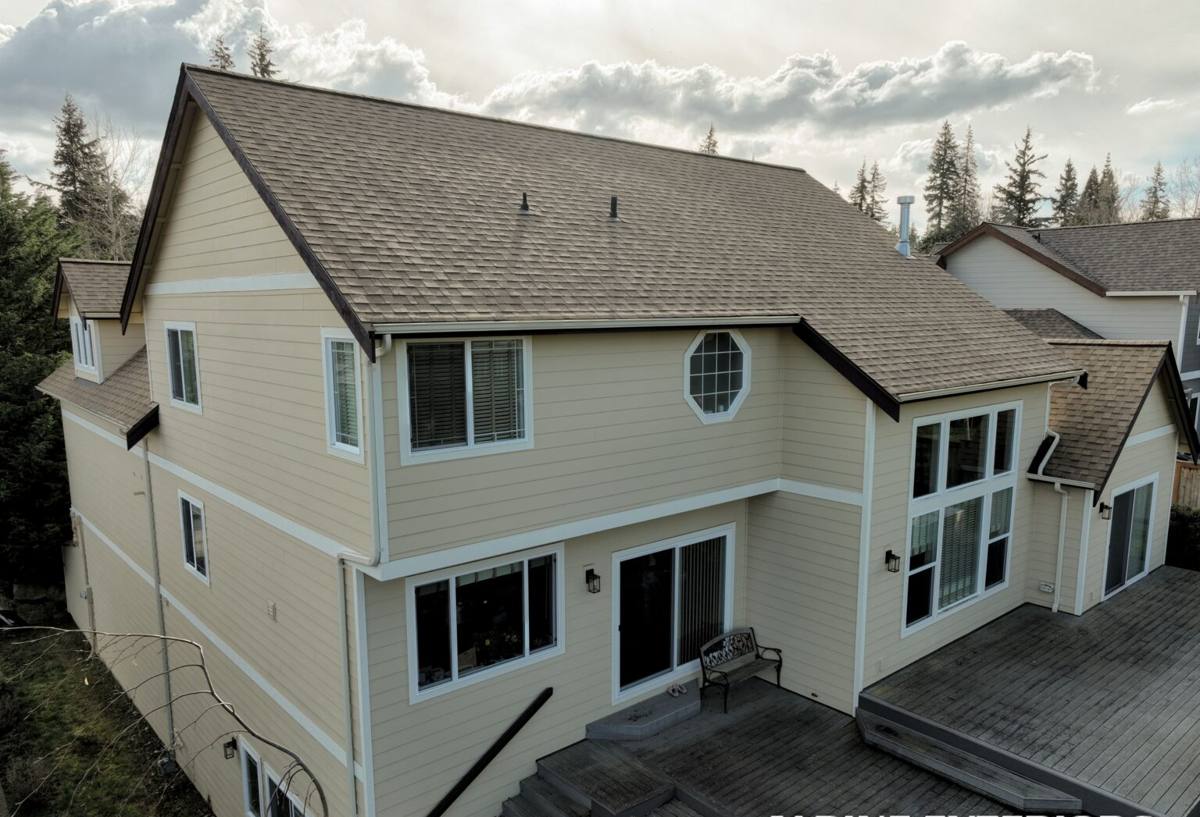
What a Correct Metal Roof Installation Actually Involves
Underlayment and Moisture Protection
Every square foot of decking gets a synthetic or self-adhered underlayment before a single panel goes down. In valleys, eaves, and around penetrations, we use a self-adhering ice-and-water membrane. In a climate where a roof can see weeks of consecutive wet days, this layer is what protects the deck if wind-driven rain ever works its way past a seam or a fastener.
Fastener Selection and Corrosion Resistance
Not all screws and fasteners are rated the same for coastal-influenced climates. We match fastener coatings to the panel material so galvanic reaction isn't slowly eating away at connection points from the inside. This is a detail that's invisible once the roof is finished, but it's the difference between a metal roof that still looks and performs well after two decades and one that develops rust streaks and loosening panels within a handful of years.
Flashing and Penetration Details
Chimneys, vents, skylights, and wall transitions are where metal roofs actually fail — not in the open field of panels. We custom-fabricate flashing to fit each penetration rather than relying on generic trim pieces, and every seam is layered so water is always directed downhill and away from the structure, never trapped against it.
Ventilation
A metal roof installed over a poorly ventilated attic can trap condensation underneath the panels. We check existing intake and exhaust ventilation as part of every assessment and correct it when needed, since trapped moisture is just as damaging from the inside as rain is from the outside.
Panel Types We Install
There's more than one way to do a metal roof, and the right choice depends on the home's roofline, budget, and how the owner wants it to look. Here's how the two most common options compare for a Whatcom County home:
| Factor | Standing Seam | Exposed-Fastener (Ribbed/Corrugated) |
|---|---|---|
| Fasteners | Hidden beneath interlocking seams | Visible, driven through the panel face |
| Long-term maintenance | Lower — no exposed fastener seals to fail | Higher — fastener washers age and need occasional checking |
| Typical lifespan | 40-70 years with proper install | 30-50 years with proper install |
| Appearance | Clean, uninterrupted panel lines | Traditional ribbed look, budget-friendly |
| Upfront cost | Higher | Lower |
Both are legitimate options. Exposed-fastener panels are a solid, economical choice for outbuildings, additions, and homeowners working within a tighter budget. Standing seam is what we recommend when a homeowner wants to minimize long-term maintenance and is planning to stay in the home for decades, since there's no fastener seal that can eventually wear out and start letting water through.
Moss and Rain: Long-Term Maintenance in Whatcom County
Moss doesn't get much traction on a smooth metal panel the way it does on the granular surface of asphalt shingles, but it can still take hold in the debris that collects in valleys, around penetrations, and in gutters if they're not kept clear. Shaded, tree-covered lots — common around Lynden — hold onto moisture longer after a rain, which gives moss and algae more opportunity to establish.
A few habits keep a metal roof performing the way it should through a Whatcom County wet season:
- Keep gutters and downspouts clear so water has somewhere to go instead of backing up under the drip edge
- Trim back overhanging branches to reduce shade and debris buildup on the roof surface
- Rinse off accumulated needles, leaves, and organic debris once or twice a year, especially in valleys
- Have penetration flashing and seams checked periodically rather than waiting for a visible leak
- Avoid pressure washing directly into seams or under panel edges — a soft rinse is enough
None of this is heavy maintenance. It's the same basic upkeep any roof needs, just with the advantage that metal isn't giving moss and algae a surface to root into in the first place.
Our Process for Lynden Metal Roofing Projects
- On-site assessment — we walk the roof, check the decking, ventilation, and existing flashing, and talk through what the home actually needs before recommending anything.
- Tear-off or overlay decision — most metal roof installs go over a fresh deck inspection rather than layering over old shingles, since that's what lets us catch and fix any hidden decking damage before it's covered up.
- Deck repair — any soft, rotted, or water-damaged decking gets replaced before underlayment goes down. Skipping this step is one of the most common shortcuts that leads to early failures.
- Underlayment and ice-and-water membrane — installed across the full deck, with extra protection at eaves, valleys, and penetrations.
- Panel installation — panels are installed to manufacturer spec with the correct fastener pattern and spacing for the panel type and roof pitch.
- Flashing, trim, and penetration detailing — custom-fit around every chimney, vent, and wall transition.
- Final walkthrough — we go over the finished roof with the homeowner and clean the site of debris and old materials.
What Affects the Cost of a Metal Roof
Every home is different, so we don't quote a number without seeing the roof, but these are the factors that move the price up or down:
| Factor | Why It Matters |
|---|---|
| Roof pitch and complexity | Steep roofs and rooflines with lots of valleys, dormers, or hips take more labor and material to flash correctly |
| Panel type | Standing seam costs more upfront than exposed-fastener panels but needs less long-term upkeep |
| Tear-off vs. overlay | Removing old roofing adds labor and disposal cost but allows a full deck inspection |
| Decking condition | Rotted or damaged sheathing found during tear-off needs replacement before installation continues |
| Roof size | Larger roof area means more material and labor regardless of panel choice |
Broadly speaking, metal roofing costs more upfront than asphalt shingles but is a longer-lived system when installed correctly, which changes the math over the life of the roof rather than just at the time of installation.
Signs Your Lynden Roof May Be Ready for a Metal Upgrade
- Shingles are curling, cracking, or losing granules faster than expected for their age
- Moss keeps returning to the same spots no matter how often it's cleaned off
- You're seeing daylight or staining around vent pipes, chimneys, or skylights
- The roof is due for a second or third replacement and you'd rather stop redoing it every 15-20 years
- You want a roof surface that sheds heavy rain and doesn't hold onto moisture during Whatcom County's wet months
Any one of these is worth a look. None of them mean the roof needs to be replaced tomorrow, but they're the kind of signs that are cheaper to address on your own timeline than during an active leak.
Why a Crew That Already Works in Lynden Matters
Roofing details that work in a dry climate don't always hold up here. A crew that regularly works Whatcom County knows how much underlayment coverage this area actually needs, how to detail flashing for a roof that stays wet for extended stretches, and which fastener and coating choices hold up against the moisture this region sees most of the year. That local familiarity shows up in the parts of the roof you don't see — the parts that determine whether it's still performing well in twenty years.
We're also positioned to respond quickly if something needs a second look after installation, rather than a crew that installed the roof and then moved on to a different region entirely.
Get an Estimate
If you're weighing a metal roof for a Lynden home, we're happy to take a look and walk you through what your specific roof needs — no pressure, no pushy sales pitch. Fill out the form below and we'll set up a time to assess your roof and put together a straightforward estimate.