 Blaine Siding
 Lynden Homes Face a Different Kind of Weather Test
Lynden sits inland from Blaine and the saltwater shoreline, but "inland" in Whatcom County still means wet. The same weather systems that push driving rain and salt-tinged marine air off the Strait of Georgia and Boundary Bay carry well into the Nooksack Valley, and Lynden's flat, open farmland does little to slow the wind that pushes moisture into wall assemblies. Add a long, low-sun moss season that runs from fall through spring, and siding here works harder than the calendar suggests.
None of this is dramatic, and it doesn't need to be. It's steady, cumulative exposure — the kind that doesn't show up as a problem in year one or two, but shows up as soft trim, failed caulk joints, and moss-stained siding by year eight or ten if the product and the installation weren't matched to the climate in the first place.
Driving Rain and Wind-Driven Moisture
Winter storms in this part of Whatcom County rarely come straight down. Wind-driven rain hits siding at an angle, working its way behind trim boards, into butt joints, and around penetrations that weren't flashed correctly. On a coastal property that's an obvious risk. On a Lynden property with long, unobstructed sightlines across open fields, wind exposure can be just as significant — there's simply less to block it.
Moss, Shade, and Slow-Drying Walls
North- and east-facing walls, and any wall shaded by mature trees or outbuildings, stay damp longer here than most homeowners expect. Moss and algae need exactly that — shade and moisture — and once they take hold on a wall surface, they hold water against the siding instead of letting it shed. Over time that constant dampness is harder on paint, caulk, and the substrate underneath than any single storm.
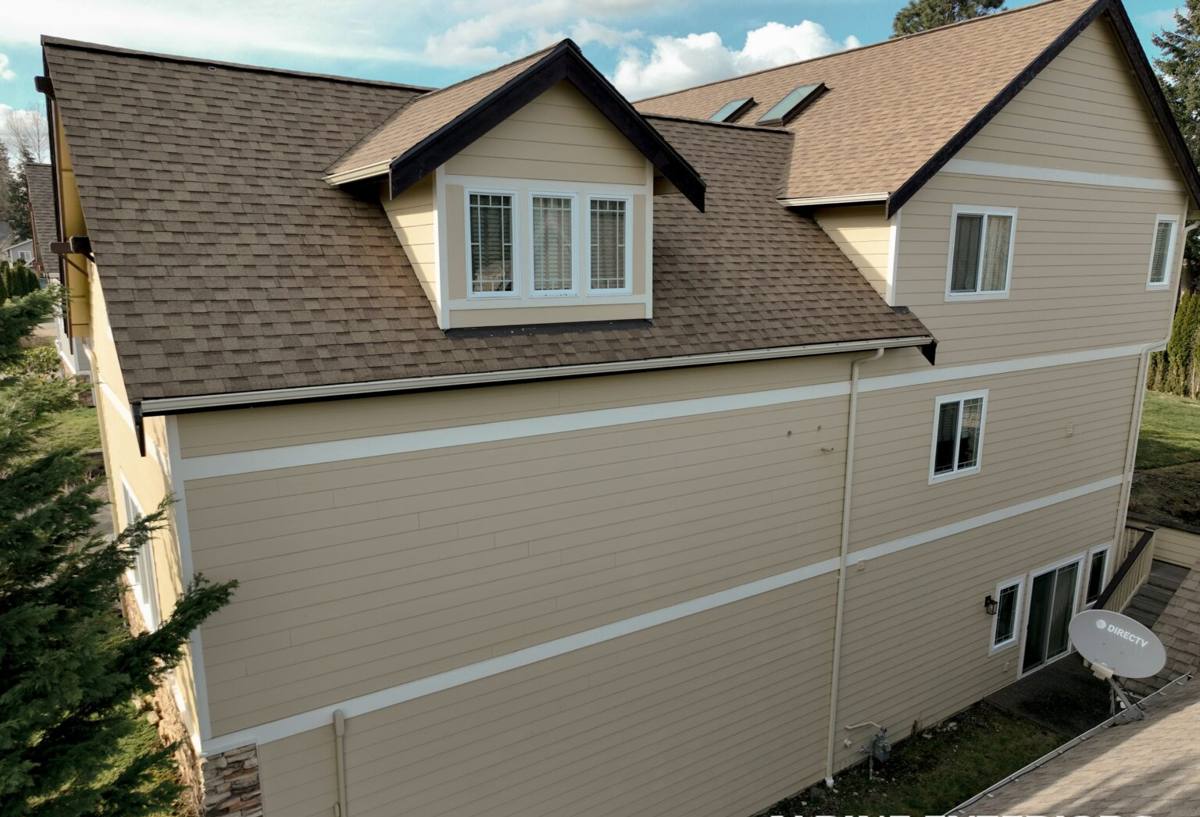
Why We Install Only James Hardie Fiber Cement
We don't install vinyl, LP SmartSide, Cemplank, Allura, or bare wood siding, and it's not a marketing position — it's a standard we hold because of what we see on re-siding jobs across Whatcom County. Vinyl flexes, fades, and can trap moisture behind it if not detailed carefully. Engineered wood products depend heavily on flawless field sealing to keep water out of the wood fiber core, and one missed seam in a climate this wet has consequences. Fiber cement, done right, doesn't have those failure points.
James Hardie's HZ5 product line is engineered specifically for climates like ours — freeze-thaw cycles, extended damp seasons, and high humidity. It's non-combustible, dimensionally stable (it doesn't expand and contract the way wood or vinyl does with temperature swings), and it holds a factory-applied ColorPlus finish that's baked on rather than field-painted, which matters enormously in a region where a fresh paint job barely has time to cure before the rain starts again.
Matching the Right Hardie Product to a Lynden Home
Not every Hardie product is the right fit for every house. Lynden's mix of farmhouse-style homes, newer builds, and outbuildings on larger rural lots means we're regularly specifying different profiles depending on the structure and how it's exposed to weather.
| Product | Typical Use | Why It Fits Here |
|---|---|---|
| HardiePlank lap siding | Primary wall covering on most homes | Classic profile, strong water-shedding lap design, wide color range |
| HardieShingle | Gable accents, dormers, feature walls | Adds texture without the maintenance burden of real cedar shingle |
| HardiePanel | Shops, barns, modern-style builds | Clean vertical lines, common on ag-adjacent outbuildings in this area |
| HardieTrim | Corners, fascia, window and door surrounds | Resists the swelling and rot that plagues wood trim in wet climates |
What a Correct Installation Actually Involves
James Hardie siding is only as good as the installation underneath it. The product is engineered to perform for decades, but a rushed or by-the-book-minimum install shortens that lifespan fast in a climate that gives moisture this many chances to find a way in.
The Rainscreen Question
In a lower-rainfall climate, siding installed directly over house wrap can perform adequately. In Whatcom County's rain and humidity, we lean toward a drainage gap — furring strips or a purpose-built rainscreen product behind the siding — on exposures that see the most wind-driven rain. That gap lets any moisture that does get past the siding surface drain and dry instead of sitting against the sheathing.
Flashing and Penetrations
Every window, door, hose bib, and light fixture is a place water can get behind the cladding. Correct flashing — including kickout flashing where a roofline meets a wall, a detail that's frequently missed or done poorly — is non-negotiable on our jobs, not an upsell.
Fastening, Gaps, and Sealant
Hardie specifies fastener type, spacing, and butt-joint gaps for a reason: get them wrong and you either void the manufacturer's warranty or create points where the board can't move and shed water the way it's designed to. Cut edges get properly sealed, and we use sealant products compatible with the ColorPlus finish rather than whatever's on the truck.
What We Often Find on Existing Lynden Siding
On tear-off jobs around Lynden we regularly see the same handful of issues: moss-stained siding on shaded walls that was never cleaned or was cleaned with pressure washing that drove water into seams instead of out; caulk that's cracked and pulled away from trim boards after a few Whatcom County winters; and, on some rural properties, walls that take regular overspray from irrigation equipment, which adds a source of sustained wall moisture that a lot of siding products simply weren't built to handle. None of these are unusual for the area — they're the reason product choice and installation detail matter more here than in a drier climate.
Our Process for a Lynden Siding Project
- On-site assessment — we look at every elevation, note shaded and wind-exposed walls, and check for existing moisture damage behind current siding where accessible.
- Product and color selection — matching Hardie product lines to the home's style and exposure, with ColorPlus color samples viewed on-site in Whatcom County light.
- Sheathing and structural repair — any rot or damage found during tear-off gets repaired before new siding goes on; siding over a compromised wall just hides the problem.
- Installation to manufacturer spec — including rainscreen detailing where exposure calls for it, correct fastening, and flashing at every penetration.
- Final walk-through — we review the completed job with the homeowner and register the manufacturer warranty.
What Affects the Cost of a Lynden Hardie Project
| Factor | Why It Matters |
|---|---|
| Home size and story count | More wall area and ladder/scaffold work for multi-story homes |
| Tear-off and sheathing condition | Rot repair or full sheathing replacement adds material and labor |
| Product mix | Lap siding alone costs less than lap plus shingle accents and panel sections |
| Trim complexity | Homes with more corners, dormers, and window surrounds take more trim labor |
| Rainscreen detailing | Added drainage-gap installation on high-exposure walls |
| Site access | Long rural driveways, outbuildings, and landscaping can affect staging and material delivery |
Why a Crew That Already Works Lynden Matters
A contractor who works this specific area regularly already knows which elevations on a typical Lynden property take the worst of the weather, understands the local permitting process, and — just as important — is still around locally when a warranty question comes up five or ten years later. Siding is a long-term investment; a crew with no ongoing presence in Whatcom County isn't the one you want to be tracking down if something needs attention down the road.
What to Check Before Hiring
- Are they James Hardie certified, and can they explain why they'd choose one product line over another for your specific home?
- Do they discuss rainscreen or drainage detailing, or only mention the siding product itself?
- Will they inspect and repair sheathing before installing new siding, not just cover what's there?
- Do they register the manufacturer warranty on your behalf and explain what it covers?
- Can they point to other work they've completed in Whatcom County specifically, not just general regional experience?
Protecting the Investment After Installation
Correctly installed James Hardie siding is low-maintenance, not no-maintenance. A rinse to clear moss and debris from shaded walls once a year, prompt attention to any caulk that starts to crack at trim joints, and keeping gutters clear so overflow doesn't run down the siding face will keep a Lynden installation performing the way it's designed to for decades.
If you're weighing a siding replacement or repair on a Lynden home, we're happy to walk the property, look at your specific exposure and existing siding condition, and put together a straightforward estimate — no pressure, no upsell on products we don't stand behind. The form below is the fastest way to get that started.