 Blaine Siding
 Why Nooksack's Climate Is Hard on Siding
Nooksack sits in a part of Whatcom County that stays wet for most of the year. Rain doesn't just fall here — it drives sideways in a stiff wind, it sits in shaded yards under fir and cedar canopy, and it lingers on north-facing walls long after the rest of the property has dried out. Add in the moss season that stretches from fall through spring, and you've got a set of conditions that will find every weak point in a wall assembly: a gap in flashing, a caulk joint that failed, a piece of siding that was never rated for this much sustained moisture.
Whatcom County's proximity to the water also means the broader region deals with salt-laden air moving inland on winter storms, which accelerates corrosion on fasteners, trim, and anything metal that wasn't specified for a coastal-influenced climate. Even inland from the immediate shoreline, that air quality is part of what any exterior product on a Nooksack home has to tolerate over a 30- or 40-year lifespan.
This is the environment we design every Nooksack job around. It's also the reason we stopped installing anything other than James Hardie fiber cement siding — not because other products can't be installed, but because we don't think they hold up to this specific combination of moisture, shade, and moss the way Hardie does.
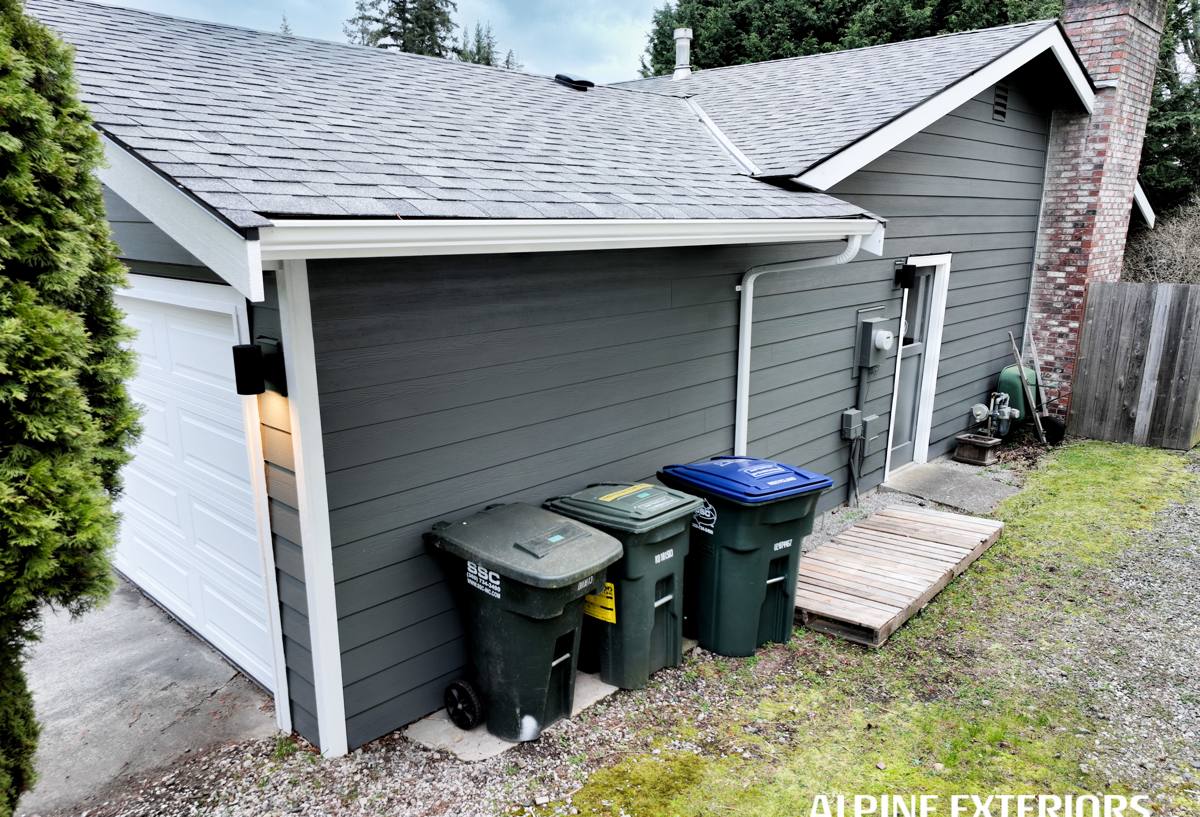
What James Hardie Actually Solves Here
Fiber cement doesn't feed moss and mildew
Moss and mildew need an organic surface to root into. Wood-based siding products — cedar, primed spruce, and engineered wood siding like LP SmartSide — have organic material in their composition that gives moss something to work with over time, especially on shaded walls that don't get enough sun to dry out between rain events. James Hardie fiber cement is made from cement, sand, and cellulose fiber, cured into a dense, non-organic board. Moss and algae can still grow on the surface if a wall stays wet and shaded long enough, but they aren't feeding on the material itself, and a Hardie board isn't softening or delaminating underneath the growth the way an organic substrate can.
ColorPlus finish holds its look through the wet season
James Hardie's ColorPlus Technology is a factory-applied, baked-on finish that's more consistent and more fade- and moisture-resistant than a field-applied paint job. For a Nooksack home under tree cover, that matters — you're not relying on a coat of paint applied in variable weather to keep water out of the substrate for the next decade. It also means touch-up and repainting cycles are longer, which is a real cost consideration in a climate this wet.
Built for the Pacific Northwest specifically
James Hardie engineers its HZ5 product line for climates like ours — freeze-thaw cycling, sustained damp, and wind-driven rain. It's not a generic national product; it's a version of the siding specified for this region's conditions. That's a meaningful difference from vinyl siding, which can warp or crack in temperature swings and relies entirely on lap seams and J-channel to keep water out, or from products not rated for a marine-influenced climate at all.
What a Correct Installation Involves
James Hardie siding performs the way it's designed to only when it's installed correctly. A lot of the moisture problems we get called out to inspect on older homes in this area trace back to installation shortcuts, not the siding itself. A correct install includes:
- A weather-resistive barrier installed and lapped correctly behind the siding, with all penetrations (pipes, vents, hose bibs) properly flashed and sealed
- Rainscreen or furring strips where the wall assembly calls for a drainage gap, so bulk water has somewhere to go besides sitting against the back of the board
- Correct fastener type, spacing, and depth — over-driven or under-driven nails are one of the most common causes of premature siding failure
- Proper clearance from grade, roof lines, decks, and hardscape — Hardie specifies minimum clearances for a reason, and skipping them invites wicking
- Butt joints and trim that are caulked with a product rated for the movement and moisture cycling this climate produces, not whatever was left over from the last job
- Kick-out flashing at every roof-to-wall intersection, which is one of the single most common missed details on older Whatcom County homes we inspect
None of this is exotic. It's James Hardie's published installation guidance, applied consistently. The failures we see are almost always a step that got skipped to save an hour on a Friday, not a flaw in the product.
Mistakes We See on Older Nooksack-Area Homes
When we're bidding a re-side in this area, a few patterns show up often enough to be worth mentioning:
- No rainscreen gap on a wall that clearly needed one, leading to trapped moisture and staining on the sheathing behind the siding
- Missing or undersized kick-out flashing where a roof meets a sidewall, which sends roof runoff straight down behind the siding instead of out and away from the wall
- Caulk used as a substitute for flashing at window and door trim, which fails within a few seasons in this climate and then traps water instead of shedding it
- Siding installed too close to grade or a deck surface, which keeps the bottom courses perpetually damp and accelerates moss growth right at the point most visible from the street
Every one of these is fixable at the time of a full re-side, and catching them early is a big part of why we walk the whole exterior — not just the siding — before we quote a job.
Our Process for a Nooksack Project
- On-site assessment. We walk the exterior, check for existing moisture damage, evaluate roofline intersections, and look at sun/shade exposure on each wall.
- Written estimate. You get a clear scope — product line, color, trim details, and what's included — before anything is scheduled.
- Tear-off and inspection. Once old siding is off, we inspect sheathing for rot or moisture damage and address it before anything new goes up. This step is non-negotiable; covering a compromised wall with new siding just hides the problem.
- Weather barrier and drainage plane. Correctly lapped house wrap and rainscreen furring where the assembly requires it.
- Flashing at every penetration and intersection. Windows, doors, roof-to-wall junctions, and utility penetrations all get flashed before siding goes on.
- Hardie installation to manufacturer spec. Correct fasteners, clearances, and joint treatment throughout.
- Final walkthrough. We go over the finished job with you before calling it done.
James Hardie Product Lines and Colors
| Product | Best Use | Why It Fits This Area |
|---|---|---|
| HardiePlank lap siding | Most common wall application | Available in HZ5, engineered for Pacific Northwest moisture and freeze-thaw cycling |
| HardiePanel vertical siding | Accent walls, gables, modern facades | Clean lines that hold up well against sustained damp exposure |
| HardieTrim boards | Corners, window and door trim, fascia | Matches the moisture resistance of the field siding so trim doesn't become the weak point |
| ColorPlus finishes | Any of the above | Factory-cured finish resists fading and moisture intrusion better than field-applied paint in a shaded, wet climate |
Color and texture choice matters here too. Darker colors and heavier shade cover tend to show moss growth sooner than lighter, more sun-exposed walls — something worth discussing during your estimate if you're deciding between finish options.
Cost Factors for a Nooksack Re-Side
| Factor | Why It Affects Price |
|---|---|
| Existing sheathing condition | Rot or moisture damage found during tear-off adds repair scope before new siding can go on |
| Number of roof-to-wall intersections | Each one needs proper kick-out flashing, which adds labor |
| House size and wall complexity | More corners, gables, and trim details mean more cutting and fitting time |
| Product line and finish | Panel size, texture, and ColorPlus color selection affect material cost |
| Site access | Tree cover, tight side yards, and grade changes common on wooded Whatcom County lots can affect staging and labor |
Why Hire a Crew That Already Works This Area
A siding job in Nooksack isn't the same job as one in a drier climate, and it isn't quite the same job as one right on the water either. It's shaded lots, sustained damp, moss pressure, and a coastal-influenced air quality moving in off Whatcom County's weather patterns. A crew that installs siding here regularly already knows where kick-out flashing gets missed, which walls need a rainscreen gap without being told, and how much clearance to leave at grade given how wet this ground stays for months at a time.
That local pattern recognition is worth more than a lower bid from a crew that doesn't work this area. We install James Hardie exclusively because we believe it's the right product for this climate, and we back that up with an installation process built around the specific ways Whatcom County weather tries to get behind a wall.
If you're planning a re-side or new siding install in Nooksack, we're happy to walk your property, look at your specific exposure and trouble spots, and put together a straightforward estimate — no pressure, no upsell. The form below gets you started.