 Blaine Siding
 Siding Repair for Ferndale-Area Homes Near Blaine
Homes in and around Ferndale sit in a stretch of Whatcom County where marine air, long wet winters, and a moss season that never seems to fully end put real, ongoing stress on exterior siding. Whether your house is sided in vinyl, wood, an older fiber cement product, or engineered wood, the pattern we see on repair calls out here is consistent: moisture finds a weak point, sits there through months of gray weather, and slowly turns a small problem into a bigger one. Siding repair in this area isn't just patching a hole or replacing a cracked panel — it's identifying why that section failed in the first place and making sure the fix doesn't fail the same way again.
This page focuses specifically on siding repair work for Ferndale and the surrounding Blaine service area. We'll cover what the local climate does to different siding types, what a repair job should actually include, and how our process works when you call us out for an assessment.
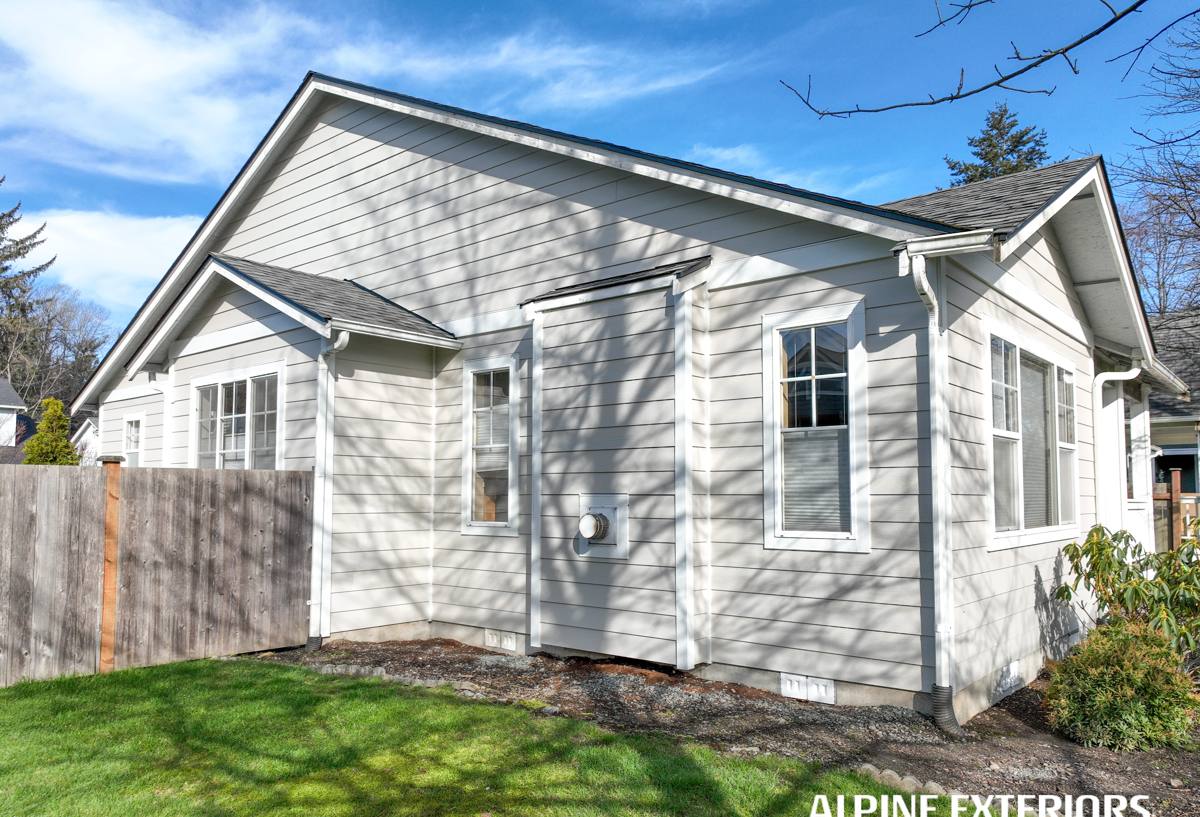
What Ferndale's Climate Does to Siding
Ferndale sits close enough to the coast that salt-laden air is a real factor, not a theoretical one. Combine that with Whatcom County's driving rain events and a moss season that can stretch from fall through spring, and you get three distinct failure patterns we look for on every repair call:
- Salt air corrosion — fasteners, flashing, and any exposed metal trim are more prone to corrosion here than in drier inland areas, which can loosen siding attachment points over time.
- Driving rain intrusion — wind-driven rain doesn't just fall straight down, it gets pushed sideways into laps, joints, and butt seams that were never properly sealed or flashed to begin with.
- Moss and organic growth — moss holds moisture against the siding surface for extended periods, which accelerates rot in wood-based products and can stain or degrade coatings on others.
None of these are dramatic, sudden failures. They're slow ones. A house can look fine from the curb for years while moisture works behind the surface — which is exactly why repair calls out here so often turn up damage that's more extensive than the homeowner expected.
Why Repair Calls Often Reveal More Than Expected
When we pull a damaged section of siding in this area, we're commonly finding soft or discolored sheathing behind it, corroded fasteners nearby, or evidence that water has been tracking down behind the cladding for a while before it ever showed up as a visible problem. This isn't unique to any one brand or material — it's what happens when a marine climate meets an installation detail that wasn't quite right, whether that's a missing kick-out flashing, an unsealed butt joint, or trim that was never designed to shed water in the first place.
Common Siding Problems We Address in Ferndale
| Problem | What Causes It | What a Correct Repair Involves |
|---|---|---|
| Cracked or split panels | Impact damage, freeze-thaw cycling, or material fatigue | Remove and replace the full panel — not a patch — matched to existing coursing |
| Soft or rotting sections | Long-term moisture intrusion behind the cladding | Open the wall, dry and assess sheathing/framing, repair water barrier before re-siding |
| Buckling or warping | Moisture absorption in wood-based or engineered wood products | Replace affected boards; check fastening pattern and clearances |
| Moss and algae staining | Shaded, damp wall sections holding moisture against the surface | Clean, assess coating condition, address surrounding drainage and airflow |
| Failing caulk and sealant joints | UV exposure and thermal movement over time | Remove old sealant fully, re-seal with correct product for the joint type |
| Corroded trim or flashing | Salt air exposure on exposed metal components | Replace with corrosion-resistant flashing detailed to shed water properly |
What a Correct Siding Repair Actually Involves
A quality repair is not just swapping a bad board for a good one. On every job we treat repair as a small-scale version of a proper installation, because a repair done to a lower standard than the surrounding wall just becomes the next failure point.
Our Repair Process
- Assessment — we inspect the damaged area and the surrounding siding field, looking for the underlying cause, not just the visible symptom.
- Investigate behind the surface — where there's evidence of moisture intrusion, we open the affected section to check sheathing, framing, and the water-resistive barrier before closing anything back up.
- Address the root cause — this might mean correcting a flashing detail, adding a missing kick-out at a roof-wall intersection, or fixing a drainage path, not just replacing material.
- Match the repair to the existing siding — profile, exposure, and color need to line up so the repair doesn't stand out or create a new water path.
- Reseal and finish correctly — proper fastener placement, sealant at the right joints (and not over-sealed where it shouldn't be), and finish work that holds up in this climate.
Repair vs. Replacement: How We Make That Call
Not every damaged section needs a full re-side, and not every "repair" job should stay a repair. We give homeowners an honest read on which situation they're in:
- Isolated damage (impact, a single cracked panel, a localized moisture spot) — usually a straightforward repair.
- Repeated failures in the same area — a sign of an underlying detail problem (flashing, drainage, grading) that needs to be fixed, not just re-covered.
- Widespread moisture damage or aging siding nearing the end of its service life — often more cost-effective, and more durable long-term, to replace the affected elevation or the whole exterior rather than keep patching it.
We'll tell you plainly which category your house falls into. There's no benefit to us talking a homeowner into a full re-side when a targeted repair will genuinely hold up — but there's also no benefit to patching a wall that's going to keep failing in the same spot.
Why We Only Repair and Install James Hardie Fiber Cement
When repair work does turn into a conversation about replacing a section or an entire elevation, we install James Hardie fiber cement — and nothing else. It's a deliberate standard, not a default. Fiber cement is non-combustible, dimensionally stable in wet climates, and Hardie's ColorPlus factory-applied finish holds up to UV and moisture exposure better than field-applied paint on wood-based alternatives. Hardie's HZ5 product line in particular is engineered for climates like ours, with moisture and freeze-thaw performance that matters directly in a place where driving rain and long damp seasons are the norm rather than the exception.
That standardization also means every repair matches correctly — we're not trying to blend a discontinued product line or guess at a color match from a material we don't stock. When we repair or extend Hardie siding, we're working within a system we install every day.
What This Means If Your Home Has a Different Siding Type
We still repair vinyl, wood, engineered wood, and other fiber cement siding when that's what's on your house — a homeowner shouldn't have to re-side an entire home just to fix one damaged section. But when a repair reveals that a section, elevation, or the whole exterior has reached the point of diminishing returns, our recommendation is Hardie, and we'll explain exactly why based on what we found on your specific house.
Why a Crew That Already Works Ferndale Matters
Siding repair is detail work, and the right detail depends on knowing how this specific climate behaves. A crew that mostly works drier inland regions may not instinctively flash a joint the way it needs to be flashed here, or may underestimate how much a shaded, moss-prone wall section needs airflow behind the cladding. Working this area regularly means we've seen how salt air treats different fastener types, how moss builds up on north-facing walls, and where driving rain typically finds its way in on homes built to older or less rigorous standards. That local pattern recognition is what separates a repair that lasts from one that reopens in two years.
What to Check Before You Call for a Repair Estimate
- Note where you've seen visible damage — cracking, warping, staining, or soft spots — and on which side of the house.
- Check nearby areas for soft drywall, peeling interior paint, or musty smells, which can indicate moisture has already moved past the siding.
- Look at gutters and downspouts near the damaged area — clogged or misdirected drainage is a common contributor to localized siding failure.
- Take note of any moss or algae buildup and how long it's been there.
- Mention if the damage has appeared before in the same spot — that's a strong signal of an underlying detail issue rather than a one-off.
Get an Honest Assessment
If you're dealing with damaged, warped, or moss-stained siding on a home in Ferndale or elsewhere in the Blaine service area, we'll come take a direct look, tell you what we find, and give you a clear recommendation — repair, targeted replacement, or a full re-side — based on what's actually happening behind your walls, not a one-size-fits-all sales pitch. Reach out for a free, no-pressure estimate using the form below.