 Blaine Siding
 Why Decks Wear Out Faster in Point Roberts
Point Roberts sits out on its own point of land surrounded by the Salish Sea, and that location is exactly what makes deck construction here different from a typical inland Whatcom County build. Salt-laden air off the water accelerates corrosion on anything metal — nails, screws, joist hangers, railing brackets — long before the wood or composite surface shows obvious wear. Add in driving rain that comes sideways during winter storms and a moss season that can stretch from fall through spring, and you have three separate stresses working on a deck at once: corrosion from below, moisture intrusion at every joint, and organic growth on the surface that holds water against the boards.
A deck built to a generic spec, with standard hardware and no real drainage plan, tends to show structural problems in Point Roberts years before it would in a drier climate. That's not a knock on any particular builder — it's just what happens when a design meant for a mild, dry region gets used near saltwater with heavy annual rainfall. We build and replace decks specifically for this exposure, not around it.
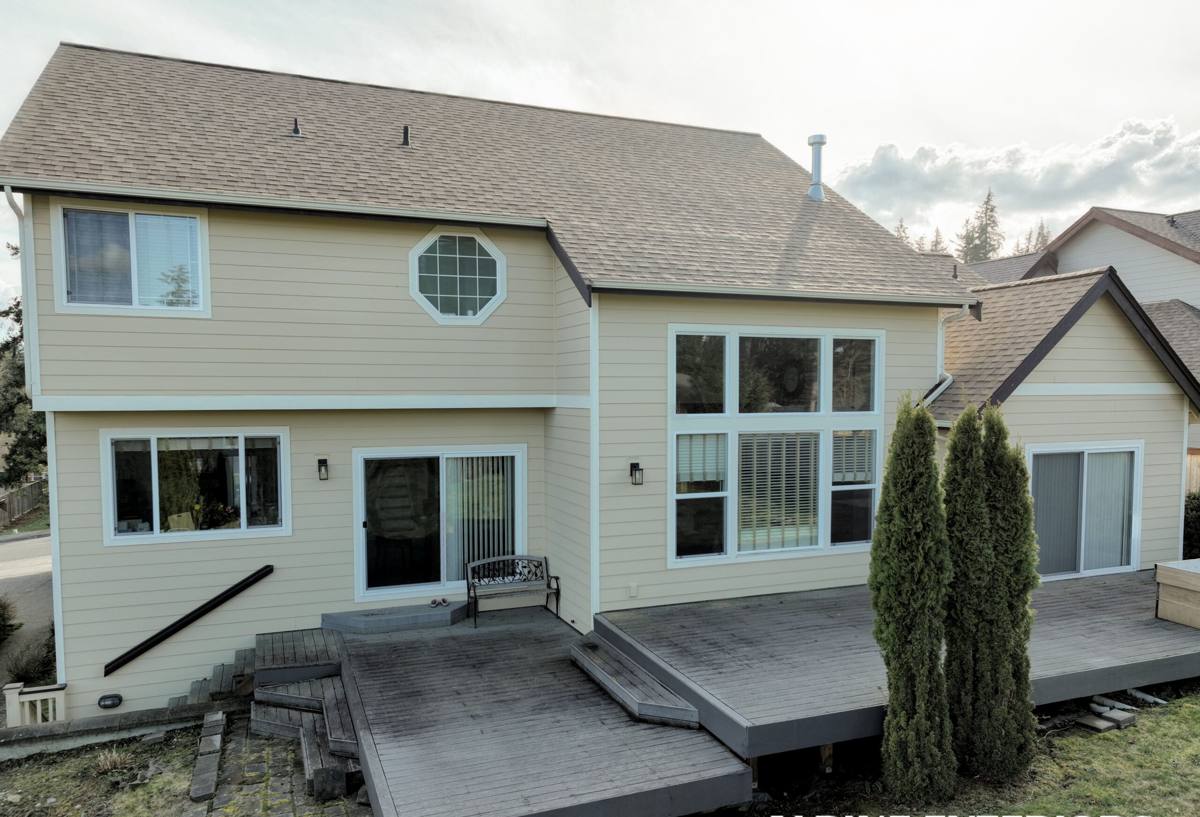
Signs a Deck Needs Replacement, Not Just Repair
Homeowners often call us thinking they need a few boards swapped, and sometimes that's true. But there are signs that point to a structural problem underneath the surface, where a repair would just be cosmetic.
- Soft or spongy spots when you walk across the deck, especially near the house
- Rust streaks running down from screw heads or bolts
- A ledger board (where the deck attaches to the house) that's dark, swollen, or separating from the siding
- Persistent green or black growth on boards that comes back within weeks of cleaning
- Railing posts that wiggle at the base or connections that feel loose
- Visible gaps opening up between boards or at the rim joist
Any one of these can be isolated. Two or more together, especially on a deck more than 12–15 years old, usually means the frame and fasteners have absorbed more moisture damage than the surface boards let on.
What a Correct Deck Replacement Involves
Structure First
Before any decking material goes down, the framing underneath needs to be right for this environment. That means pressure-treated joists and beams rated for ground contact where they're close to grade, proper flashing at the ledger board so water is directed away from the house rather than trapped against it, and footings sized and set below frost depth. We also check that the ledger connection itself — the single most common failure point on any deck — is through-bolted and flashed correctly rather than just lag-screwed and caulked.
Fasteners and Hardware
In a salt-air environment, hardware grade matters as much as the visible decking. We use stainless steel or heavy hot-dip galvanized fasteners and connectors rather than standard coated screws, because standard coatings can start showing rust bleed within a few seasons this close to the water. It costs more up front and it's the right call for a deck meant to last.
Drainage and Airflow
Moss and rot both need standing moisture to take hold. Proper board spacing, a slight slope away from the house, and clear airflow underneath the deck all reduce how long surfaces stay wet after a storm. On lower decks close to grade, we also look at whether the ground underneath needs grading or gravel to stop water from pooling against the posts.
Choosing a Decking Material for This Climate
There's no single "best" decking material for every home — it depends on budget, how much upkeep you want to do, and how close the deck sits to the water. Here's how the common options actually perform under Point Roberts conditions.
| Material | Moisture/Salt Behavior | Moss Resistance | Maintenance |
|---|---|---|---|
| Pressure-treated wood | Good if sealed regularly; untreated end grain is vulnerable | Low — needs regular cleaning | Annual sealing/staining recommended |
| Cedar | Naturally moisture-resistant, but surface still needs protection | Low to moderate | Periodic oil or sealant |
| Composite decking | Very good — won't rot or absorb water into the core | Moderate — can still grow surface algae if shaded and damp | Occasional wash, no sealing |
| PVC/capped composite | Excellent — fully sealed surface, no organic material to feed rot | Highest — least hospitable surface for moss | Lowest — wash as needed |
We don't push one product on every homeowner. If you want the look and feel of real wood and are willing to stay on top of sealing every year or two, a well-built wood deck can last a long time here. If you want to minimize upkeep on a deck that's shaded, close to the water, or just rarely gets attention, composite or capped composite earns its higher upfront cost back in fewer callbacks and less moss scrubbing.
How Our Process Works
We keep the process straightforward because deck replacement shouldn't feel complicated.
- Site visit and assessment — we check the ledger, framing, footings, and drainage, not just the surface boards, and tell you honestly whether repair or full replacement makes sense.
- Material selection — we walk through the tradeoffs above based on your budget and how much maintenance you actually want to do.
- Permitting — most deck replacements in Whatcom County require a permit, particularly when structural framing or footings are being replaced. We handle that paperwork so it doesn't fall on you.
- Demo and framing — old decking, damaged framing, and any compromised hardware come out; new structure goes in with corrosion-resistant fasteners and correct flashing.
- Decking and railing installation — surface material and railing go on to code, with attention to spacing and slope for drainage.
- Final walkthrough — we go over the finished deck with you, including what maintenance it needs and how often.
Why Local Experience in Point Roberts Matters
Point Roberts is a peninsula that's part of Washington State but physically cut off from the rest of Whatcom County by land — reaching it means crossing an international border. That geography changes how a construction project gets staffed and supplied compared to a job in Blaine proper. Crews and material deliveries need to be planned around border crossing realities, and a contractor unfamiliar with that logistics reality can end up with delayed lumber, missed appointments, or surprise costs that get passed on to the homeowner.
A lot of homes here are also seasonal or vacation properties, which means owners aren't always on-site to catch small problems early, or to be present for every stage of a project. We're used to coordinating with owners remotely, scheduling around when they're actually in town, and leaving a deck in a condition that won't need attention again the moment they're away for a few months. Working this area regularly, rather than as an occasional out-of-town job, is what makes that coordination reliable instead of a headache.
Protecting Your New Deck
A correctly built deck still benefits from basic seasonal upkeep, especially given the moss and salt exposure. A short annual routine keeps a new deck looking and performing the way it should for its full lifespan.
- Sweep debris off the surface regularly, especially in fall when leaves and needles accumulate
- Rinse salt residue off railings and hardware a few times a year, particularly after winter storms
- Clean moss or algae as soon as it appears rather than waiting for a heavier buildup
- Check that gutters and downspouts near the deck are directing water away, not onto it
- Re-seal or re-stain wood decking on the schedule recommended for that specific product
- Have the substructure looked at every few years if the deck is more than a decade old
What Affects the Cost
Every deck is different, but a few factors consistently drive the price up or down more than anything else.
| Factor | Effect on Cost |
|---|---|
| Deck size and shape | Larger footprints and multiple levels increase material and labor |
| Decking material chosen | Pressure-treated wood is the lowest upfront cost; capped composite is the highest |
| Framing condition | Full frame and footing replacement costs more than resurfacing over sound framing |
| Railing style | Cable, glass, or custom railing adds cost over standard wood or composite balusters |
| Height and access | Elevated decks or difficult site access add labor time |
| Permitting scope | Structural work typically requires permits, which adds time and a modest fee |
We give you a real number after seeing the deck in person — not a rough guess over the phone — because framing condition especially can only be judged up close.
Get an Honest Look at Your Deck
If your deck is showing rust stains, soft spots, or moss that won't quit, or if it's simply old enough that you're wondering whether it's still safe, we're glad to come take a look. The estimate is free, there's no pressure to move forward, and you'll get a straight answer about whether you're looking at a repair or a full replacement.