 Blaine Siding
 Deck Replacement for Everson Homes
Everson sits inland from Blaine in the Whatcom County lowlands, but the weather that wears down a deck here isn't much different from what the rest of the county deals with. Long stretches of wet fall and winter weather, humidity that never fully clears out, and a growing season for moss and algae that runs most of the year all add up to decks that age faster than homeowners expect. A deck that looks fine from the porch door can be hiding soft joists, corroded fasteners, or a ledger board connection that's no longer doing its job.
We replace decks for homeowners throughout this part of Whatcom County, and the patterns repeat: decks built with untreated or lower-grade lumber twenty-plus years ago, decking boards that were never properly spaced for drainage, and railings that were structurally adequate when installed but haven't been inspected since. Deck replacement done right isn't just swapping old boards for new ones — it's a chance to fix the structural and drainage problems that caused the failure in the first place.
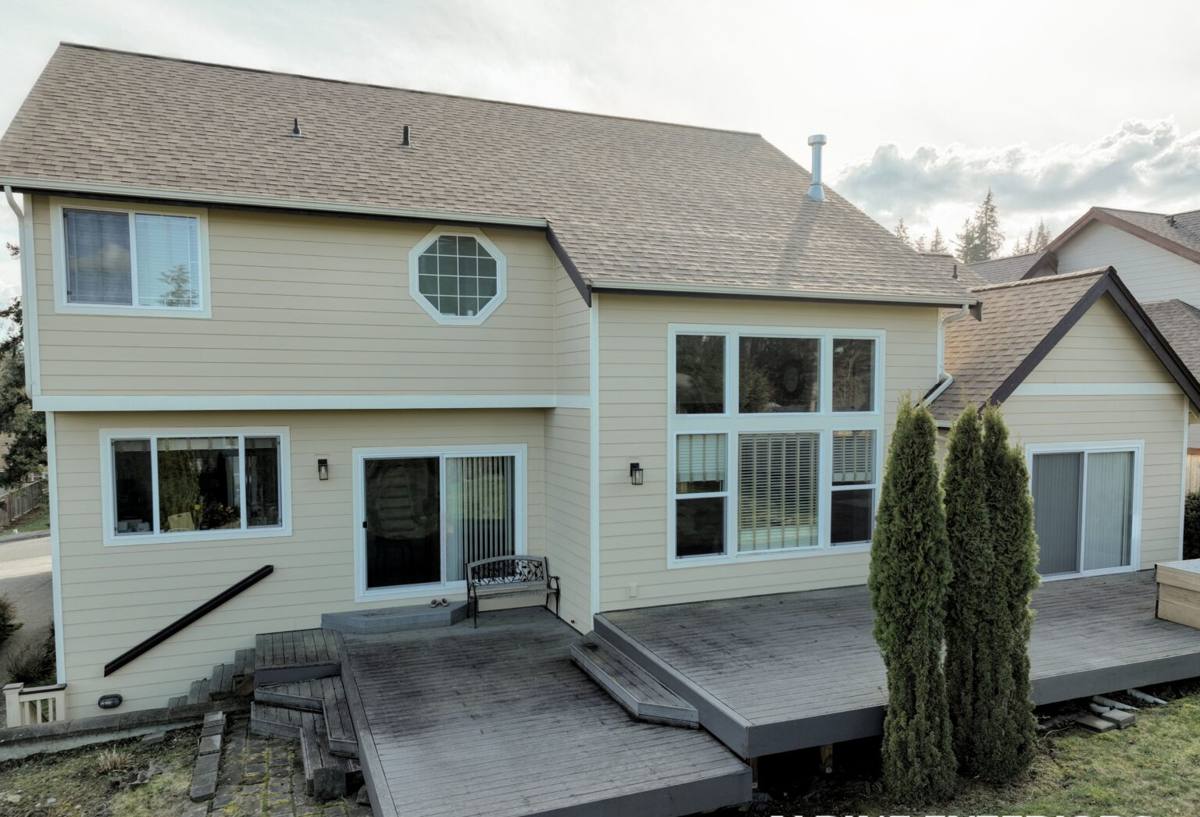
Why Decks Fail Faster in This Climate
Moisture That Doesn't Let Up
Wood decking and framing dry out fastest when there's steady sun and airflow. In Whatcom County, that window is short. Rain events stack on top of each other for weeks at a time, and even on dry days the humidity keeps wood moisture content elevated. That constant damp-dry cycling is what drives rot in ledger boards, joists, and post bases — usually from the inside out, which is why surface boards can look okay while the frame underneath is failing.
Moss and Algae Growth
A long moss season means any deck surface that holds shade or doesn't drain well will grow a slick green film, usually starting on the north side or under overhangs. Beyond the slip hazard, moss and algae hold moisture against the wood fibers, which accelerates rot in untreated or under-maintained decking far beyond what the wood's rated lifespan would suggest.
Salt Air and Metal Fasteners
Homes across this part of Whatcom County, including areas within reach of Puget Sound's salt air, see faster corrosion on exposed metal — nails, screws, joist hangers, and railing hardware. Once fasteners start corroding, they lose holding strength well before they look visibly bad, which is one reason a deck can feel "solid enough" right up until it isn't.
Signs Your Deck Needs Replacement, Not Just Repair
Not every aging deck needs a full teardown. But there's a point where patching boards is just delaying a bigger problem. Here's what tells us a deck has crossed that line:
- Soft or spongy spots in the decking that give underfoot, especially near the house or stair landings
- Visible rot, splitting, or crumbling wood at the ledger board where the deck attaches to the house
- Rust streaks around fasteners or joist hangers, or hardware that's visibly corroded
- Railings or stair stringers that flex or wobble under normal weight
- Persistent moss or algae staining that comes back within weeks of cleaning
- A deck built without proper flashing at the ledger connection — a common gap in older construction
- Posts that show rot or insect damage at the base, where they sit closest to grade and moisture
If it's mostly cosmetic — faded boards, minor surface checking, a few loose screws — repair or refinishing is usually the right call. Once the framing or ledger connection is compromised, replacement is the safer and often more cost-effective path.
What a Correct Deck Replacement Involves
A deck that's built to hold up in this climate needs more attention paid to what's underneath the decking boards than to the decking itself. The parts that fail first are rarely the visible ones.
The Ledger Connection
This is where the deck attaches to the house, and it's the single most common failure point we see. It needs proper flashing to keep water from tracking behind the siding and into the rim joist, along with structural fasteners rated for the load — not just deck screws.
Framing and Joist Spacing
Joist spacing and beam sizing need to match the actual span and load, not just match what was there before. We also make sure joists get proper end protection so they're not sitting in standing moisture every time it rains.
Fasteners and Hardware
Given the corrosion risk from moisture and salt air, we use hot-dip galvanized or stainless connectors and fasteners rated for treated lumber and coastal exposure, not standard interior-grade hardware.
Drainage and Airflow
Proper board spacing, and grading or venting underneath the deck where it's low to the ground, keeps moisture from pooling and gives the structure a chance to dry out between rain events instead of staying wet for weeks.
Decking Material Options for Whatcom County Weather
There's no single "right" material for every home — it depends on budget, how much upkeep the homeowner wants to do, and how the deck is used. Here's how the common options actually perform in this climate:
| Material | Moisture Performance | Moss/Algae Resistance | Maintenance |
|---|---|---|---|
| Pressure-treated wood | Good if properly finished and re-sealed | Needs regular cleaning to prevent buildup | Annual cleaning, re-staining every 2-3 years |
| Cedar | Naturally moisture-resistant, but surface still weathers | Still needs cleaning; grays without upkeep | Regular sealing to maintain appearance and resistance |
| Composite decking | Excellent — doesn't absorb moisture or rot | Resists staining better; still needs washing | Occasional washing, no sealing or staining |
| PVC/vinyl decking | Excellent — fully moisture-proof surface | Very low absorption, easiest to keep clean | Lowest maintenance of the group |
We're honest with homeowners about trade-offs rather than pushing one product. Composite and PVC decking cost more upfront but make sense for homeowners who don't want to keep up with sealing and staining in a climate that's hard on wood finishes. Cedar and pressure-treated wood cost less initially and give a more traditional look, but they only perform well long-term if the maintenance schedule actually gets followed. We won't tell you a low-maintenance product is maintenance-free — even composite decking needs periodic washing to stay ahead of moss and mildew film.
Our Deck Replacement Process
- On-site assessment. We inspect the existing deck, ledger connection, framing, and post footings to identify what's actually failing versus what's still sound.
- Scope and material discussion. We walk through decking material options, layout changes if wanted, and give a straightforward estimate — no pressure, no inflated scope.
- Permitting. Deck replacement in Whatcom County typically requires a building permit, especially for structural work at the ledger or framing level. We handle that process as part of the job.
- Demolition and disposal. Full removal of the old deck, checking framing and ledger areas underneath for hidden rot or water damage before rebuilding.
- Rebuild. Proper flashing, corrosion-resistant fasteners, correctly spaced joists, and code-compliant railings and stairs.
- Final walkthrough. We go over the finished deck with you, including basic care guidance specific to the material you chose.
Permits and Local Code Considerations
Most deck replacements involving structural changes — new footings, a raised or lowered deck, or a rebuilt ledger connection — require a permit through the local jurisdiction. Railing height, guard spacing, and stair rise/run also have to meet current code, which sometimes differs from what was allowed when an older deck was originally built. If your existing deck predates current code, replacement is often the point where those gaps get corrected, since bringing it up to standard as part of a full rebuild is more practical than retrofitting a deck that's staying in place.
What Deck Replacement Typically Costs
Every deck is different, and final cost depends on size, height off grade, material choice, and how much of the substructure needs replacing versus reusing. In general terms, the biggest cost drivers are:
| Factor | Why It Matters |
|---|---|
| Decking material | Composite and PVC cost more per square foot than wood, but reduce long-term upkeep |
| Deck height and footings | Taller decks need more substantial framing, footings, and often guardrails on stairs |
| Ledger and structural repair | Rot found at the house connection adds scope beyond simple board replacement |
| Railing style | Cable, glass, or custom railing systems cost more than standard baluster railing |
| Size and layout | Multi-level decks, built-in benches, or stairs on multiple sides add labor and material |
We give a firm, written estimate after the on-site assessment — not a rough number over the phone — because the condition of the framing underneath makes a real difference in scope.
Keeping a New Deck Healthy in This Climate
A well-built deck still needs some seasonal attention to get its full lifespan out of it. Here's a basic checklist we give homeowners after a replacement:
- Sweep leaves and debris off the surface regularly, especially in fall — trapped organic matter feeds moss growth
- Wash the deck surface at least once or twice a year to remove algae film before it takes hold
- Check that gaps between boards stay clear so water can drain instead of pooling
- Inspect railings and stair connections annually for looseness
- Reseal or restain wood decking on the schedule appropriate to the product — don't wait until it's visibly gray and dry
- Keep an eye on the area where the deck meets the house for any staining or soft spots that could signal a flashing issue
Why Hire a Crew That Already Works in Everson
A deck built to a generic spec sheet doesn't always hold up to the specific conditions here. Fastener choice, ledger flashing detail, and even how a deck is oriented relative to sun and shade all matter more in a climate with this much sustained moisture and moss pressure than they would somewhere drier. Working regularly in Whatcom County means we've seen which shortcuts show up as problems five years down the road — the under-flashed ledger, the standard-grade screws that rust, the deck built without enough slope for drainage — and we build to avoid them from the start, not just to pass inspection.
If your deck is showing its age or you're planning ahead for a replacement, we're happy to take a look and give you a straightforward assessment of what it actually needs. Reach out for a free, no-pressure estimate using the form below.