 Blaine Siding
 Why Dakota Creek Homes Need a Different Approach to Windows
Dakota Creek sits close enough to the water that homes here deal with a combination of stresses most inland Whatcom County properties never see. Salt-laden air moves in off the marine environment near Blaine and settles on everything — window frames, hardware, sealants — accelerating corrosion on the wrong materials and breaking down finishes that would otherwise last decades. Add in driving rain that comes sideways during winter storms and a moss season that stretches for months in our wet, shaded microclimates, and you have a set of conditions that punishes generic, big-box window installs.
A window that performs fine in a dry inland subdivision can fail here in half the time if it wasn't chosen and installed with this specific exposure in mind. That's not a knock on any particular product — it's just physics. Persistent moisture and airborne salt find every weak point in a window system: a poorly sealed nailing flange, a frame material prone to pitting, a sill without proper slope for drainage. Our job on a Dakota Creek project is to make sure none of those weak points exist in the first place.
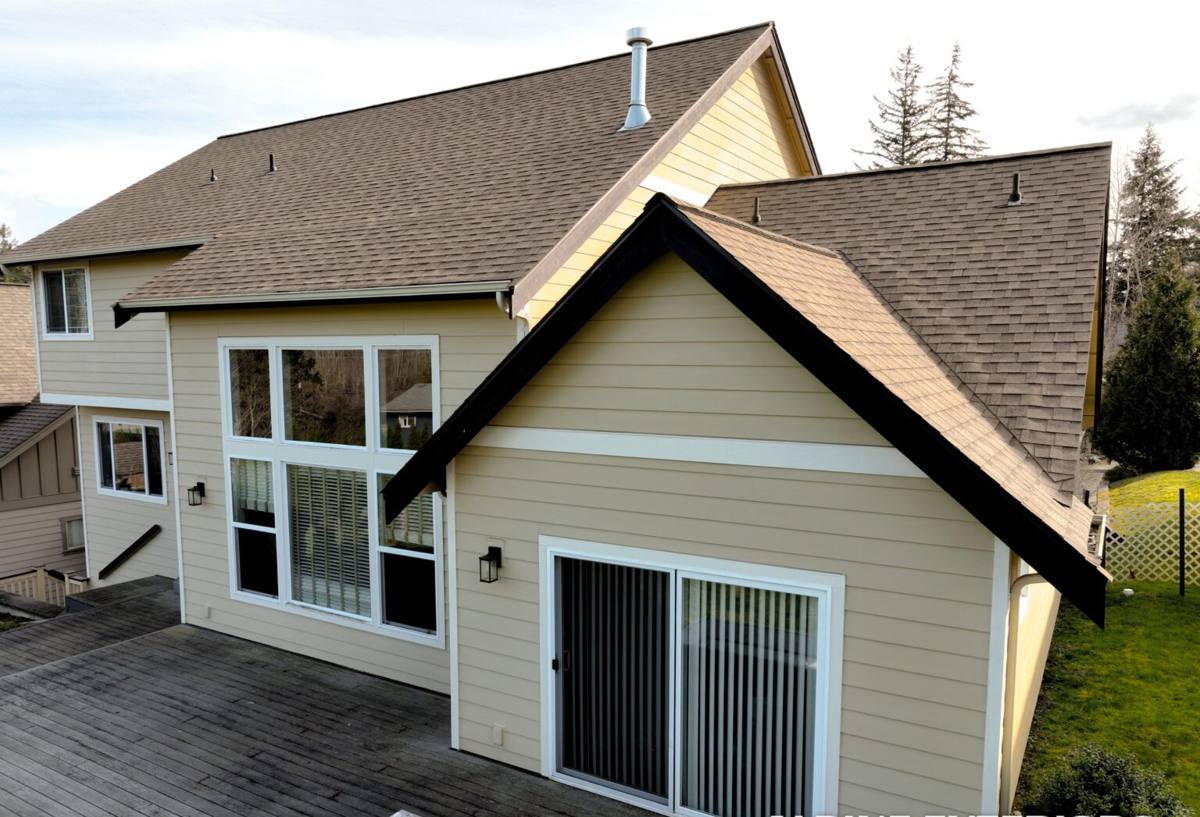
What a Correct Custom Window Job Actually Involves
"Custom windows" doesn't just mean non-standard shapes or sizes — though we do plenty of that for older Dakota Creek homes with openings that don't match modern stock dimensions. It means every window is specified and installed to match the actual conditions of that wall: sun exposure, wind-driven rain load, framing condition behind the old window, and how that specific elevation of the house handles moisture.
The Parts That Matter Most (and Are Easiest to Rush)
- Flashing and weather barrier integration — the window has to tie into the house wrap or building paper correctly, not just get caulked around the edges
- Sill pan drainage — a sloped, sealed pan under the window so any water that gets past the glass has somewhere to go besides your wall framing
- Backer rod and sealant, not just caulk — gaps need proper sealant depth and backing, not a bead smeared over a wide void
- Shimming and squaring — an out-of-square window stresses the frame, the seals, and eventually the glass unit itself
- Insulation of the rough opening — low-expansion foam or batt insulation around the frame, not left hollow
Skip any one of these and you can end up with a window that looks fine for a year or two, then starts showing staining, soft trim, or fogged glass — right when the driving rain and moss season of a Whatcom County winter start testing it.
Material Choices That Actually Hold Up Near the Water
Frame material is where most of the long-term performance difference comes from in a marine-influenced climate like Blaine's. We walk homeowners through the honest trade-offs rather than pushing one product line.
| Frame Material | Salt Air / Moisture Behavior | Maintenance | Best Fit |
|---|---|---|---|
| Vinyl (quality, welded corners) | Doesn't corrode or rot; UV-stable grades hold color | Low — occasional wash | Most Dakota Creek homes, good value |
| Fiberglass | Excellent — very stable dimensionally in wet/dry cycling | Low | Larger openings, high wind-load walls |
| Wood-clad | Good if cladding and seams are intact; interior wood needs protection from condensation | Higher — watch cladding seams and interior finish | Homes prioritizing a traditional wood interior look |
| Aluminum | Prone to pitting and corrosion in salt air unless marine-grade and properly finished | Moderate to high | We use this selectively, not as a default here |
We're not going to tell you one brand is "bad" — most reputable manufacturers make a defensible product. The issue is matching the material and finish grade to Dakota Creek's actual exposure, and being honest when a cheaper option will cost more in callbacks and shortened lifespan than it saves upfront.
Glass and Coatings
Double-pane, argon-filled units with a Low-E coating are the practical baseline for this climate — they cut condensation risk on cold, wet mornings and reduce heat loss during the long stretches of overcast weather we get. Triple-pane is worth discussing for north-facing walls or rooms that run cold, but it's not automatically the right call for every opening; we size the spec to the wall, not the other way around.
Our Process for a Dakota Creek Window Project
- On-site assessment — we check existing framing condition, current flashing/weather barrier, and any signs of past water intrusion before quoting anything
- Measure and spec — exact opening dimensions, frame material and glass package matched to that elevation's exposure
- Removal — old units come out carefully so we can inspect the sill and framing underneath, which is often where the real problems are hiding
- Repair as needed — any soft framing, rot, or failed prior flashing gets fixed before a new window ever goes in; we don't install a good window over a bad opening
- Install with proper sill pan, flashing sequence, and insulation — done in the order that actually sheds water, not just what's fastest
- Seal, trim, and final check — interior and exterior finish work, then a functional check of every operating window
We don't skip step 4 to save a day. An opening with hidden rot or a broken weather barrier will undermine even the best window, and it's far cheaper to address it during replacement than to discover it later as interior damage.
Signs Your Current Windows Are Already Losing the Fight
Homeowners in Dakota Creek often live with early warning signs for years before calling anyone, mostly because they don't look dramatic at first. Watch for:
- Fogging or a hazy film between the panes of a double-pane unit — the seal has failed
- Soft or discolored trim/sill wood, especially on walls facing prevailing wind and rain
- Windows that are harder to open, close, or lock than they used to be — frame movement or swelling
- Visible moss or green staining creeping onto the frame or sill, not just the roof
- Drafts you can feel near the frame edge on a windy day
- Corroded or stiff hardware — latches, cranks, or balances that feel gritty
- Noticeably colder rooms in winter compared to the rest of the house
Any one of these on its own isn't an emergency. Several at once, especially on the same wall, usually means water has been getting past the glass and into the assembly for a while.
Living With Windows in a Salt Air, Rain, and Moss Climate
Even a well-installed window benefits from a little seasonal attention here. Rinsing salt residue off frames and hardware a few times a year — especially after storms — keeps corrosion-prone spots from getting a foothold. Keeping weep holes at the base of the frame clear of moss, dirt, and debris matters more in Whatcom County than in drier parts of the state, since a blocked weep hole turns a window designed to drain water into one that traps it. Checking exterior caulk lines once a year for cracking or separation is a five-minute job that heads off much bigger repairs.
None of this is heavy maintenance, but it's maintenance that's easy to skip when you don't know it matters — and in this climate, skipping it shows up faster than it would in a drier region.
Why It Matters That We Work Dakota Creek Regularly
A crew that only occasionally works this area treats every job as a generic install. A crew that works Dakota Creek and the surrounding Blaine area regularly already knows which elevations catch the worst of the wind-driven rain, which older homes tend to have outdated or missing flashing systems, and how aggressively moss establishes itself on north- and west-facing walls here. That local pattern recognition shows up in fewer surprises during removal, better material choices from the start, and installs that are built for the conditions actually present at your address — not a textbook average.
It also means we're not guessing at permitting or code requirements for Whatcom County jobs, and we're not learning on your house how this specific marine climate treats different products over time. We've already seen it.
Get a Straight Answer for Your Home
If you're dealing with foggy glass, drafty rooms, or windows that just don't feel right anymore, it's worth getting an honest, no-pressure look before deciding what to do. We'll tell you plainly whether you need full replacement, targeted repair, or nothing urgent at all. Reach out for a free estimate using the form below, and we'll take a look at what your Dakota Creek home actually needs.