 Blaine Siding
 Building a Deck That Actually Holds Up in Sumas
A deck in Sumas has to earn its keep every month of the year, not just on the handful of sunny weekends we get. Whatcom County's climate is wet more often than it's dry, and a deck built with the same specs you'd use in a drier part of the state will show it within a few seasons — soft spots at the ledger, black streaks on the boards, moss creeping into every shaded corner, hardware bleeding rust down the face of the joists. We build decks for this specific corner of the state, where driving rain, damp air off the Salish Sea region, and a moss season that can run from October into April are simply part of the design brief, not an afterthought.
That means every deck we build starts with the assumption that water will find its way onto the surface, into the fasteners, and around the ledger connection to the house. The job is to control where that water goes and make sure nothing underneath is left to rot quietly out of sight.
Planning a Deck for Your Property
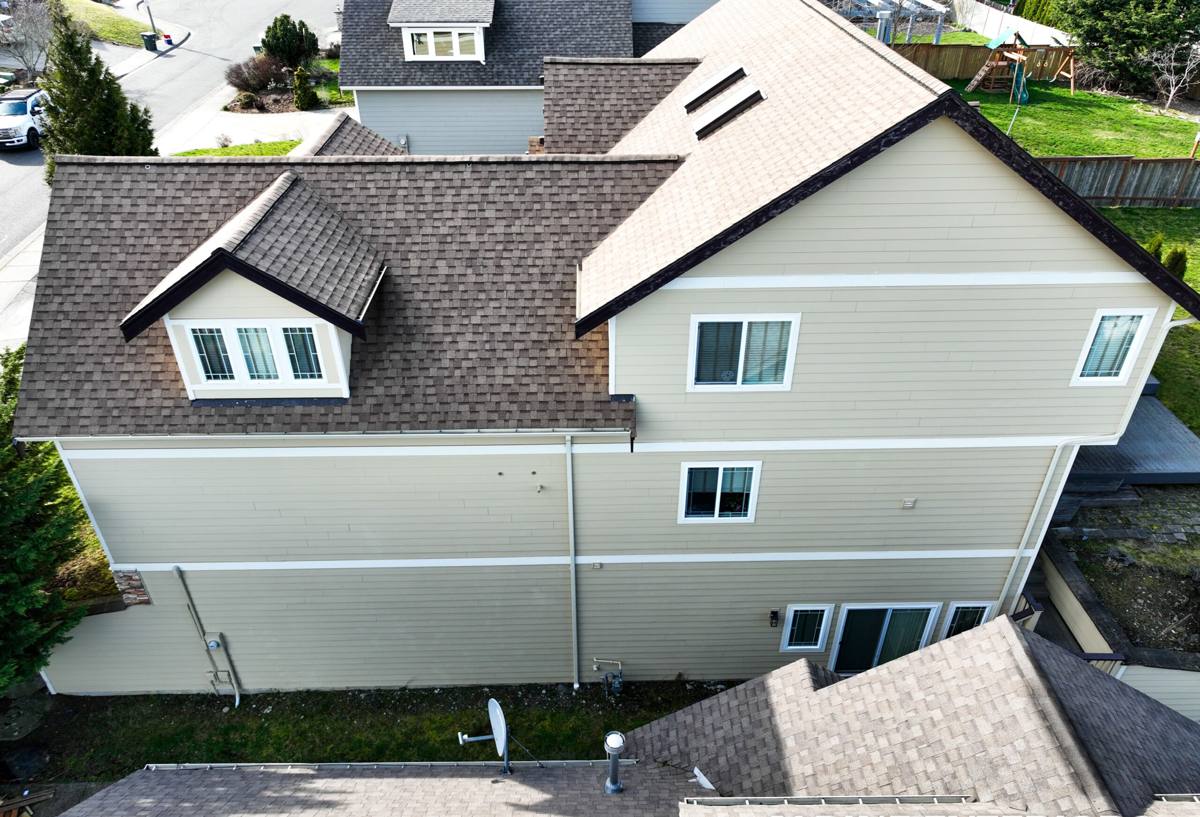
Before we talk about decking material or railing style, we look at how the deck sits on your specific lot. Sumas properties vary — some sit close to the road on flat ground, others back up to sloped yards or tree lines that keep parts of the deck shaded most of the day. Both of those details change the build.
Sun, Shade, and Drainage
A deck that sits in shade for most of the day will hold moisture longer after a rain and is far more prone to moss and algae growth. We factor that into board spacing, material choice, and how aggressively we pitch the surface for drainage. Ground-level grading matters too — if water already pools near the house, we address that before we build over it, not after.
How the Deck Meets the House
The single most important connection on any deck is where it attaches to your home — the ledger board. This is also the most common failure point on decks built without proper flashing, because it's a direct pathway for water to get behind your siding and into the wall structure. We treat ledger flashing as non-negotiable, regardless of decking material or budget.
Permits and Whatcom County Requirements
Most decks attached to a house, and many freestanding decks above a certain height, require a building permit in Whatcom County. Requirements can include engineered footing depth, guardrail height, stair geometry, and setback from property lines. We handle the permit process as part of our estimate rather than leaving it for the homeowner to sort out, and we build to the code that applies to your specific lot and structure height — not a generic minimum.
- Guardrails are generally required once the deck surface is more than 30 inches above grade
- Stair and railing dimensions (rise, run, baluster spacing) follow Washington's adopted residential building code
- Footings must be set below the local frost depth and sized for the load they carry
- Ledger attachment to the house structure has specific fastening and flashing requirements
- Some lots have setback rules that affect how close a deck can sit to a property line
What's Underneath Matters More Than What's On Top
A beautiful deck surface over a poorly built frame is a short-term win. The structure underneath — footings, posts, beams, joists, and the ledger connection — determines whether the deck is still solid in ten or twenty years.
Footings and Framing
Footings need to be sized and set below frost depth so seasonal freeze-thaw cycles don't heave them. We use pressure-treated framing lumber rated for ground contact where it's called for, and we're deliberate about which grade of treated lumber goes where — support posts and anything near grade need a higher level of protection than boards further from soil contact.
Joist Protection and Hardware
Two details separate a deck that lasts from one that doesn't, and neither is visible once the project is finished: joist tape and fastener quality. Joist tape covers the top edge of each joist, which is where standing water sits longest and where rot typically starts first. We use stainless or heavily coated structural hardware throughout — in a climate this damp, standard galvanized fasteners can corrode and stain the wood around them well before the deck itself is due for replacement.
Ledger Flashing
We install proper flashing — typically a combination of metal flashing and a self-adhering waterproof membrane — at every ledger connection, integrated correctly with your home's existing siding and weather barrier. Done right, this keeps water from ever reaching the rim joist or your wall framing. It's not a step we skip to save time, because it's the step that protects the house itself, not just the deck.
Choosing Your Decking Material
There's no single "best" decking material — there's a best material for your budget, your maintenance appetite, and how much sun or shade the deck gets. Here's how the common options actually perform in a Whatcom County climate:
| Material | Moisture Performance | Maintenance | Typical Lifespan |
|---|---|---|---|
| Cedar | Naturally rot-resistant but still absorbs moisture over time | Annual cleaning and re-staining or sealing | 15-20 years with upkeep |
| Pressure-Treated Pine | Good with proper sealing; prone to checking and warping if neglected | Sealing every 1-2 years | 15-20 years with upkeep |
| Composite (capped) | Excellent — doesn't absorb water or rot | Periodic washing to prevent surface moss/algae | 25-30+ years |
| PVC | Excellent — fully moisture-resistant | Periodic washing | 25-30+ years |
| Tropical Hardwood (e.g., Ipe) | Very good, extremely dense | Periodic oiling to maintain color; low rot risk regardless | 25+ years |
We install all of these and we'll give you an honest read on the trade-offs rather than steering you toward whatever's easiest for us to install. Real wood — cedar or treated pine — gives you a warmer, traditional look but asks for a maintenance commitment: sealing, cleaning, and watching for checking or graying. Composite and PVC decking cost more upfront but ask almost nothing of you year to year, which matters a lot when your deck sits under trees or gets heavy moss pressure. Tropical hardwoods sit in between — dense enough to resist rot on their own, but a heavier, pricier install that isn't right for every budget.
Railings, Stairs, and the Details Code Requires
Railings and stairs aren't just safety features — they're also where a lot of deck failures show up first, because they take direct weather exposure on every surface. We build guardrails and stair rails to meet Washington's residential code for height, baluster spacing, and load, and we use the same corrosion-resistant hardware philosophy on railings that we use on the frame. Wood posts and rail caps get the same flashing attention as the ledger board where they meet horizontal surfaces, since that's where water sits and rot starts.
Stair stringers deserve particular attention in our climate — end grain on cut stringers is especially absorbent, and stairs see foot traffic year-round including through wet leaves and moss buildup. We detail stringers and treads so water sheds off rather than pooling on the stair surface.
Our Process, Start to Finish
- Site visit and design conversation — we look at your yard, discuss how you'll use the deck, and talk through material options honestly, including cost and maintenance trade-offs
- Design and estimate — a clear plan and a written estimate before any work begins, no vague allowances
- Permitting — we prepare and submit what Whatcom County requires for your project
- Site prep and footings — layout, excavation, and footings set to code depth
- Framing — posts, beams, joists, joist tape, and ledger flashing installed before decking goes down
- Decking, railing, and stairs — installed to your chosen material's specifications
- Final walkthrough — we go over the finished deck with you, including care and maintenance guidance specific to the material you chose
Living With Your Deck Through the Wet Season
Even a well-built deck needs a little seasonal attention in a climate that stays damp for much of the year. A short annual routine keeps small issues from becoming expensive ones:
- Clear leaves and debris from between boards and off stair treads before fall rains set in
- Check that gaps between deck boards haven't filled with debris, which traps moisture against the wood
- Look at the ledger area where the deck meets the house for any signs of staining or soft wood
- Wash composite or PVC decking periodically to prevent surface moss and algae buildup, especially in shaded areas
- Re-seal or re-stain wood decking on the schedule appropriate to that product — don't wait until it's visibly gray or checking
- Inspect railing posts and hardware for movement or corrosion staining
Why a Crew That Already Works in Sumas Makes a Difference
Building decks around Sumas and the rest of Whatcom County means we already know what this climate does to a structure over time, because we've seen it — the moss patterns in shaded yards, the way driving rain hits a ledger board that wasn't flashed correctly, which framing details actually hold up through a wet PNW winter versus which ones fail early. That local experience shapes every deck we build, from footing depth to fastener choice to how we detail a ledger connection. We're also familiar with the permitting process for this area, which keeps your project moving instead of stalled on paperwork.
A deck is a significant investment sitting directly against your home, exposed to the weather year-round. It's worth having it built by a crew that treats the structural details — the parts you won't see once it's finished — as seriously as the parts you will.
If you're planning a new deck or replacing one that's showing its age, we're happy to come take a look and talk through your options. Reach out for a free, no-pressure estimate using the form below.