 Blaine Siding
 Building a Deck That Actually Holds Up in Birch Point
Birch Point sits right up against the water on the Whatcom County coastline near Blaine, and that location shapes every deck we build out there. Salt-laden air moves off the Strait and settles into wood, metal, and concrete year-round. Rain comes in sideways more often than it falls straight down. And because so many Birch Point lots are wooded and shaded, moss and algae get a long season to work on any horizontal surface that stays damp. A deck built with inland assumptions — standard fasteners, generic decking, minimal drainage planning — will show its age within a few years out here. A deck built for the actual site conditions will still look and perform like a quality build a decade later.
This page covers what a custom deck project for a Birch Point property should actually include: the framing and fastener choices that matter most, how we think about decking material in this specific climate, what drives moss and slip issues, and what our process looks like from first visit to final walkthrough.
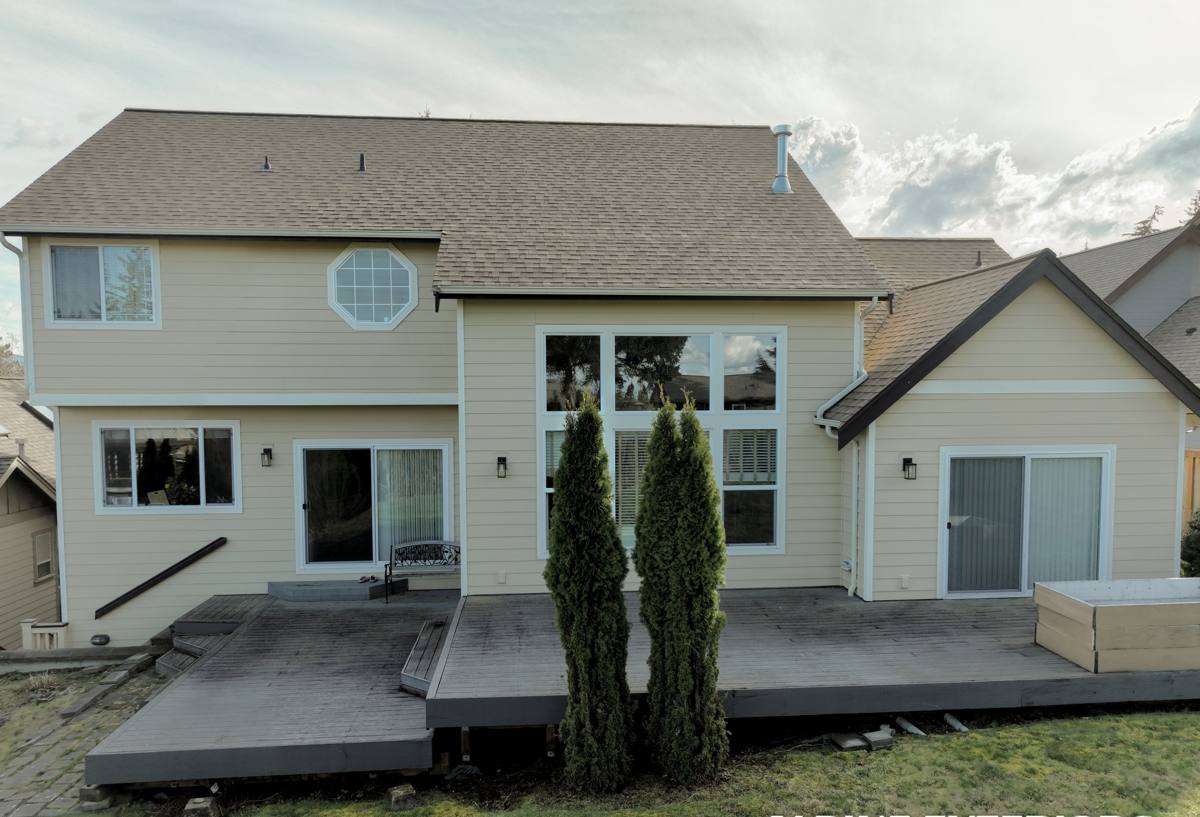
What Makes a Birch Point Deck Different From an Inland Build
Three site factors show up over and over on Birch Point projects, and each one changes a decision somewhere in the build.
Proximity to Salt Water
Airborne salt accelerates corrosion on any exposed metal — nails, screws, joist hangers, railing brackets. Standard galvanized hardware that would be fine twenty minutes inland can start rusting and staining decking boards within a couple of seasons this close to the shoreline.
Wind-Driven Rain
Storms off the Strait don't just drop rain, they drive it horizontally into ledger connections, stair stringers, and any gap where water can get behind a board or under a flashing lap. Flashing detail at the house connection matters more here than it does on a sheltered inland lot.
Tree Cover and Shade
Many Birch Point properties have mature trees close to the house for privacy and wind break, which is great for comfort but means parts of the deck may see limited direct sun for much of the year. Shaded, damp surfaces are exactly where moss and algae take hold fastest.
Framing and Fasteners: Where Coastal Decks Actually Fail
Most deck failures we get called out to inspect in this area aren't dramatic structural collapses — they're slow problems that start at a handful of predictable points: the ledger connection, the footings, and the fasteners themselves.
Ledger Flashing and the House Connection
The ledger board is where the deck attaches to the house, and it's the single most common source of hidden water damage on any deck, anywhere. In a driving-rain climate like Blaine's, we treat ledger flashing as non-negotiable: proper step flashing integrated with the house's water-resistive barrier, a sloped drip cap, and butyl or peel-and-stick membrane at every penetration. Skipping or shortcutting this detail is how homeowners end up with rot inside the rim joist or wall framing years down the road, long after the deck itself looks fine.
Footings for Coastal Soil Conditions
Footing depth and bearing need to account for local soil and frost conditions, and on waterfront-adjacent lots we also pay attention to drainage around the footing itself so water doesn't pool against buried concrete or post bases. We follow current Whatcom County building code for footing depth and post-to-footing connections rather than guessing based on what a neighbor's deck looks like.
Fastener and Hardware Selection
This close to the water, we default to stainless steel or high-grade coated fasteners (rated for ACQ-treated lumber contact) for structural connections, and stainless or coated hidden fastener systems for the decking surface itself. It costs more up front than standard hardware. It also means you're not looking at rust streaks bleeding down your fascia board in three years.
Choosing a Decking Material for Salt Air and Moss Season
There's no single "best" decking material — there's a best material for a given budget, maintenance appetite, and site condition. For a shaded, salt-exposed Birch Point lot, here's how the common options actually compare in practice.
| Material | Moss/Algae Resistance | Salt Air Behavior | Maintenance | Typical Lifespan |
|---|---|---|---|---|
| Pressure-treated wood | Low — porous surface holds moisture | Fasteners need upgrading; wood itself tolerates salt air fine | Annual cleaning and periodic sealing | 15-20 years with upkeep |
| Cedar | Moderate — natural oils help but fade over time | Handles salt air well; needs UV/moisture sealer | Sealing every 1-2 years | 15-25 years with upkeep |
| Composite decking | Better — capped boards shed water, but shaded areas still need periodic washing | Excellent — won't corrode or absorb salt | Occasional washing, no sealing | 25-30+ years |
| PVC decking | Best — fully non-porous surface | Excellent — inert to salt exposure | Lowest — soap and water as needed | 30+ years |
For heavily shaded Birch Point lots specifically, we lean toward capped composite or PVC decking more often than we would on a sunny inland lot, simply because a non-porous surface gives moss and algae far less to hold onto. That said, plenty of homeowners still prefer the look and feel of real wood, and a well-built cedar or treated deck with a disciplined cleaning and sealing schedule holds up fine — it just asks more of you over time.
Moss, Algae, and Drainage: Designing for the Wet Months
Moss doesn't grow because a deck is poorly built — it grows because moisture sits somewhere long enough to let it take hold. Good design fights that at the source rather than leaving it to a pressure washer twice a year.
- Board spacing sized to shed water quickly instead of trapping it in tight gaps
- Joist tape over the framing to keep water off structural lumber even when the decking above holds moisture
- A slight slope away from the house so water sheets off rather than pooling mid-deck
- Under-deck drainage systems where a covered dry space below is wanted, so water is captured and channeled out rather than dripping through
- Gaps kept clear of leaf litter and debris at the perimeter, where organic matter feeds moss growth fastest
None of this eliminates the need for occasional cleaning in a climate like this — Whatcom County's wet season is simply long enough that some moss and algae growth is normal. But a deck designed with drainage in mind needs a lot less scrubbing, and a lot less risk of the surface becoming slick underfoot during the wetter months.
Railings, Stairs, and Local Code Requirements
Any deck more than a modest height off grade needs code-compliant guardrails, and stairs need proper rise/run consistency and graspable handrails under current building code. We pull permits and build to the code cycle currently adopted by Whatcom County rather than relying on outdated assumptions, since deck-specific code requirements (guard height, baluster spacing, stair geometry, footing depth) get revised periodically. On a waterfront-adjacent property, we also think about wind load on railings and any view considerations that might affect railing material choice — glass or cable rail instead of solid balusters, for example, where an unobstructed water view matters to the homeowner.
Our Process for a Birch Point Deck Project
A custom deck build goes better when the site gets evaluated on its own terms rather than treated as a generic template. Here's what that looks like in practice.
- On-site walkthrough. We look at sun exposure, tree cover, existing drainage patterns, soil conditions, and the house's siding and structural connection points before recommending anything.
- Design and material conversation. We talk through decking material trade-offs honestly — cost, maintenance, and how the site's shade and salt exposure factor in — rather than pushing one product.
- Permitting. We handle the permit application and inspections through Whatcom County so the finished deck is fully code-compliant and documented, which matters at resale.
- Framing and flashing. Ledger flashing, footings, joist layout, and joist tape go in first, since this is the work nobody sees once decking boards are down — and the work that determines how the deck ages.
- Decking, railings, and stairs. Installed with corrosion-resistant fasteners and hardware sized for this environment, not generic inland-spec hardware.
- Final walkthrough. We go over basic care — cleaning frequency, what to watch for at the ledger and post bases, and sealing schedule if wood decking was chosen.
Maintenance That Actually Matters in This Climate
Homeowners get a lot of generic deck maintenance advice online that doesn't account for a shaded, salt-air, high-rainfall site like Birch Point. A more realistic maintenance rhythm looks like this:
| Task | Frequency Here | Why It Matters More at Birch Point |
|---|---|---|
| Surface cleaning (soap/water or mild cleaner) | 1-2x per year, more in heavy shade | Longer wet season and tree cover accelerate moss and algae growth |
| Hardware inspection (railing brackets, fastener heads) | Annually | Salt air accelerates corrosion faster than inland exposure |
| Wood sealing (cedar or treated decking) | Every 1-2 years | Driving rain and humidity break down sealers faster than a dry climate |
| Ledger and flashing check | Annually, especially after storms | Wind-driven rain is the main way water gets behind flashing over time |
| Gutter/debris clearing near the deck | Seasonally | Trapped leaf litter under tree cover holds moisture against the deck surface |
Why Local Birch Point Experience Actually Matters
Deck-building fundamentals don't change from town to town, but the judgment calls do — how much you upgrade fastener grade, whether you push a client toward composite over cedar, how aggressively you detail ledger flashing, how you handle footing drainage in this specific soil. A crew that's built decks up and down the Birch Point shoreline and elsewhere in Blaine has already made those calls, seen which choices held up and which ones didn't, and isn't guessing on a property like yours. That's the difference between a deck that needs real attention by year five and one that's still doing its job with minimal fuss well past year fifteen.
If you're planning a new deck or replacing one that didn't hold up to Birch Point's weather, we're happy to take a look and put together a straightforward, no-pressure estimate. Use the form below to get started — there's no obligation, just an honest read on what your project actually needs.