 Blaine Siding
 Siding Replacement in Custer: What Local Homes Are Up Against
Custer sits close enough to the water and open farmland north of Bellingham that its homes take a different kind of weather beating than a house tucked into a sheltered subdivision. Wind off the Strait carries salt and moisture inland, driving rain comes in sideways during the fall and winter storm cycle, and the shaded, damp stretches of the year let moss and algae get a foothold on anything that stays wet too long. If your siding is starting to show soft spots, peeling paint, warped panels, or a green film that comes back no matter how many times it's washed, that's not bad luck — it's Whatcom County doing what it does to exterior materials that weren't built to handle it.
Siding replacement here isn't just a cosmetic upgrade. It's the difference between a wall assembly that sheds water and one that slowly lets it in. We've replaced enough failing siding in this area to know the pattern: the problem almost never starts at the panel itself — it starts at a seam, a fastener, a trim detail, or a water-management layer that was never installed correctly in the first place.
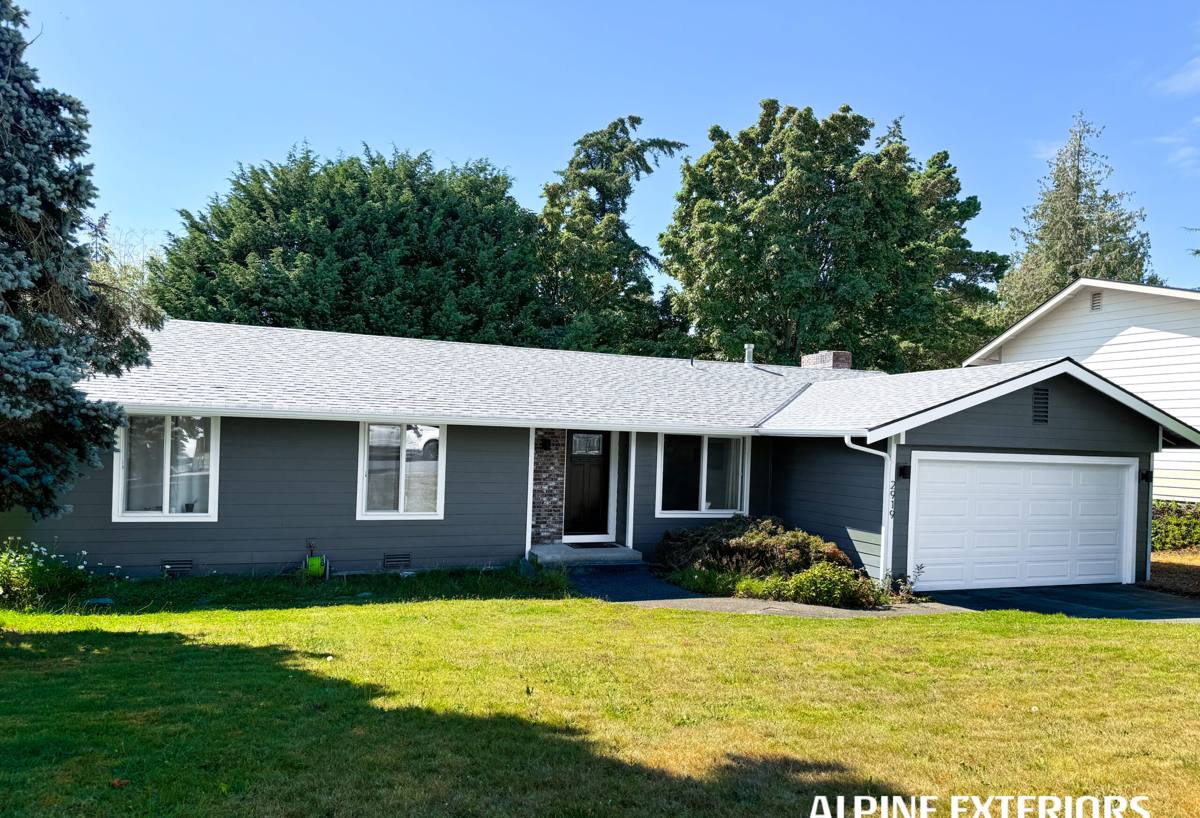
Why Custer's Climate Is Harder on Siding Than People Expect
Salt Air and Moisture
Proximity to Semiahmoo Bay and the broader Strait of Georgia means airborne salt settles on exterior surfaces more than most homeowners realize. Salt accelerates corrosion on fasteners and metal flashing, and it holds moisture against a wall longer than plain rainwater would. Materials that rely on paint film or factory coatings to keep moisture out are only as good as that coating — once it's compromised, salt-laden moisture gets underneath and the clock starts on rot, delamination, or swelling.
Driving Rain
Custer doesn't get gentle, straight-down rain for much of the year. Wind-driven rain pushes water sideways into laps, seams, and butt joints — exactly the places where siding is most vulnerable if it wasn't installed with the right gaps, flashing, and caulking discipline. A siding system can look fine from the ground and still be failing behind the face if those details were rushed.
Long Moss Season
Between the tree cover common in this part of Whatcom County and the extended damp season, north- and shade-facing walls are prone to sustained moss and algae growth. This isn't just an appearance issue — moss holds moisture against the surface, and on materials sensitive to sustained dampness, that's a slow path to decay underneath a surface that still looks intact from a distance.
What a Correct Siding Replacement Involves
Replacing siding correctly is a sequence, and skipping steps is exactly how a new-looking wall ends up with the same failures a few years later. On a home in Custer, we treat every one of these steps as non-negotiable:
- Full tear-off and inspection. Old siding comes off so the sheathing underneath can actually be inspected — not guessed at. Soft, delaminated, or water-stained sheathing gets addressed before anything new goes up.
- Weather-resistive barrier. A proper house wrap or building paper layer goes on correctly lapped, shingle-style, so water is directed down and out rather than trapped behind the siding.
- Flashing at every penetration. Windows, doors, hose bibs, vents, and roof-to-wall intersections all get flashed so driving rain has nowhere to collect.
- Proper fastening and clearances. Correct fastener type, spacing, and the right gap at the bottom of the wall and around trim so water can't wick or pool.
- Factory-finished siding installed to manufacturer spec. This is where product choice and installation discipline both matter — a good product installed loosely still fails, and a mediocre product installed perfectly still has ceiling-level limits.
Why We Only Install James Hardie Fiber Cement
We've made a deliberate call not to install vinyl siding, LP SmartSide, cedar, primed spruce, or fiber cement alternatives like Cemplank or Allura. Each of those has a place in the market, and some of them are reasonable products in the right climate. But for a coastal-influenced, high-moisture, moss-prone area like Custer, we don't think they hold up as well as James Hardie over the long run, for a few specific reasons:
| Material | Trade-off in this climate |
|---|---|
| Vinyl siding | Can warp or become brittle with temperature swings, and seams give wind-driven rain a path behind the panel |
| Cedar / primed spruce | Natural wood needs consistent maintenance to resist moisture and rot; salt air and shade accelerate both |
| LP SmartSide (engineered wood) | Wood-based core is more moisture-sensitive at cut edges and seams than fiber cement |
| Other fiber cement brands | Similar base material, but we've standardized on Hardie's ColorPlus finish and climate-specific HZ formulation for consistency and warranty terms |
James Hardie fiber cement is non-combustible, dimensionally stable, and resists moisture absorption far better than wood-based products. Its ColorPlus factory finish is baked on and warrantied against fading and peeling, which matters when salt air and UV are working against a painted surface every day. Hardie's HZ5 product line in particular is engineered for the kind of moisture exposure the Pacific Northwest sees. It's a system we can install to spec, back with a real warranty, and expect to perform for decades rather than years.
Signs a Custer Home Needs Siding Replacement (Not Just a Patch)
- Panels that feel soft, spongy, or visibly bowed when pressed
- Paint that's peeling, bubbling, or chalking heavily, especially on shaded or wind-facing walls
- Persistent moss or dark streaking that returns shortly after cleaning
- Visible gaps, warping, or separation at seams and corners
- Interior signs like musty smells, peeling interior paint, or damp drywall near exterior walls
- Siding that's simply original to a much older home and has never been replaced
A patch or partial repair can make sense for isolated, recent damage. But once moisture has been getting behind the siding for a while, patching one section usually just delays the same conversation for the next section over.
Our Process for a Custer Siding Replacement
1. On-Site Assessment
We walk the exterior, check for soft spots and moisture entry points, and look at how the home is oriented relative to prevailing wind and rain. A wall facing the water gets different attention than a sheltered side.
2. Straightforward Estimate
We explain what we're seeing, what it will take to fix it correctly, and give a clear, no-pressure estimate. No inflated scope, no upsell into work that isn't needed.
3. Tear-Off and Sheathing Check
Old material comes off, sheathing gets inspected, and any necessary repairs happen before the new water-resistive barrier goes on.
4. Correct Installation
House wrap, flashing, proper clearances, and James Hardie siding installed to manufacturer specification — not just nailed up quickly to get the job closed out.
5. Final Walkthrough
We walk the finished job with you, point out what was done and why, and make sure you're comfortable with the result before we consider it complete.
Why Hiring a Crew That Already Works This Area Matters
A contractor who works Whatcom County regularly already knows what driving rain off the Strait does to a poorly flashed window, and what a shaded, moss-prone north wall needs that a south-facing wall doesn't. That's not something you can fake with a generic install checklist written for a drier climate. It shows up in the small decisions — how much clearance is left at the bottom of the wall, how flashing is lapped at a window head, which walls get extra attention because of wind exposure — and those small decisions are exactly what separates siding that lasts twenty-plus years from siding that needs attention again in five.
What This Costs
Siding replacement pricing depends on the size of the home, the condition of the sheathing underneath, the amount of trim and detail work, and how much of the old material needs to come off versus what can be reused. We don't publish blanket prices because every Custer home we've looked at has been a little different — a house with hidden water damage costs more to do right than one where the sheathing is sound. What we can tell you is that we price the job after we've actually inspected it, not off a phone estimate, so the number you get reflects the real scope of work.
If your siding is showing wear, moss, or signs of moisture getting in, we're happy to take a look and give you a straightforward, no-pressure estimate — no obligation, just an honest read on what your home actually needs. The form below gets you started.