 Blaine Siding
 Windows in Cherry Point Take a Different Kind of Beating
Cherry Point sits close enough to the water that homes here deal with a combination most inland Whatcom County properties don't: salt-laden air off the Strait of Georgia, wind-driven rain that hits window walls sideways instead of straight down, and a long, damp moss season that keeps everything green and wet for months at a time. None of that is a problem a window can shrug off forever. It's a slow, steady load that finds every weak point in a frame, a seal, or a flashing detail.
A window that would perform fine in a drier part of the state can fail early out here if it isn't installed with this specific environment in mind. That's the difference between a generic install and one built for Cherry Point: the materials, the sealing approach, and the flashing sequence all have to account for salt exposure and near-constant moisture, not just rain in general.
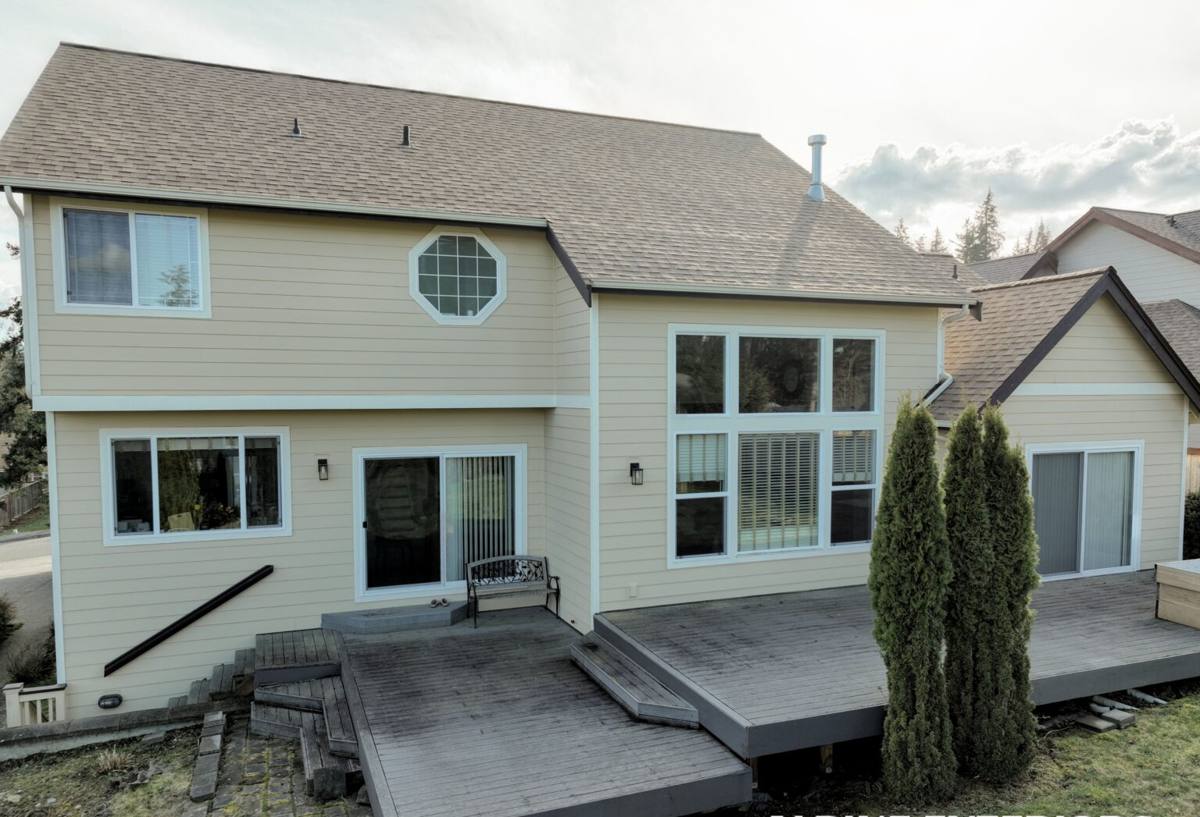
What Salt Air, Driving Rain, and Moss Actually Do
Salt Air
Airborne salt is corrosive to metal hardware, fasteners, and some window frame components. Over years, it accelerates pitting and corrosion on anything that isn't rated for coastal exposure — hinges, cranks, and lesser-grade screws in particular. It also degrades certain finishes faster than inland weather would.
Driving Rain
Wind off the water doesn't just drop rain on a roof — it drives it horizontally into window walls and around trim. That means water pressure against seals and flashing that a calm, straight-down rain would never create. Any gap in the flashing plane, any shortcut in the sill pan, becomes an entry point sooner rather than later.
Moss Season
Extended damp periods keep exterior wood trim, sills, and siding around windows wet for long stretches. That moisture retention is what feeds moss and mildew growth, and it's also what slowly breaks down caulk, primer, and unprotected wood if the installation didn't account for drainage and drying.
Individually, each of these is manageable. Together, over years, they're exactly why window installation quality matters more in Cherry Point than it does in a sheltered inland neighborhood.
Signs a Cherry Point Home May Need New Windows or a Re-Install
- Fogging or a permanent haze between the panes of a double- or triple-glazed unit (a sign the seal has failed)
- Soft, discolored, or crumbling wood trim or sill around the window frame
- Visible gaps, cracked caulk, or daylight showing around the frame edges
- Windows that are hard to open, close, or lock — often a sign the frame has warped or shifted
- Persistent drafts near the window even when it's fully closed and locked
- Musty smell or bubbling paint/drywall on the interior wall near a window
- Metal hardware showing rust, pitting, or white corrosion residue
- Moss or dark staining building up on the sill or the trim just below the window
Any one of these on its own might just need a repair. Several at once, especially on the weather-facing side of the house, usually means it's time to talk about replacement rather than patching.
What a Correct Window Installation Actually Involves
The window unit itself matters, but in this climate the installation detail work is what determines whether it lasts. A rushed or shortcut install is often the real cause of an early failure — not the window product.
Removing the Old Window Without Hidden Damage
Before a new window goes in, the opening gets checked for rot, water staining, or soft framing that the old window may have been hiding. In a salt-air, high-rain environment, this step catches problems that would otherwise get sealed up behind a new window and left to keep spreading.
Flashing the Opening Correctly
Proper flashing directs any water that gets past the exterior finish back out, rather than letting it pool at the sill or work into the wall cavity. This includes a correctly lapped sill pan, jamb flashing, and head flashing installed in the right order so each layer sheds water onto the one below it — never the reverse.
Sealing With the Right Materials
Not every sealant or backer rod holds up the same way under constant damp and salt exposure. The sealing approach needs to allow the assembly to manage moisture rather than trap it, with attention paid to weep paths so any water that does get in has somewhere to go.
Setting the Window Level, Plumb, and Square
A window that's out of square puts uneven stress on the frame and hardware, which shows up later as operating problems or premature seal wear — accelerated here by corrosion-prone hardware if the window isn't rated for coastal use.
Insulating and Finishing the Interior
Proper low-expansion foam or insulation around the frame (not stuffed too tight, not left with gaps) keeps the assembly performing as designed and avoids compressing the frame out of true.
Choosing Materials That Hold Up Out Here
Frame material and hardware grade matter more in a salt-air environment than they would a few miles inland. Here's how the common options generally compare for this specific setting:
| Frame Material | How It Handles Salt Air & Moisture | Maintenance Load |
|---|---|---|
| Vinyl | Doesn't corrode; performs well against salt exposure; some lower-grade vinyl can become brittle over many years of UV and weather cycling | Low — occasional cleaning |
| Fiberglass | Very stable dimensionally, strong resistance to moisture and corrosion, holds paint finishes well | Low — occasional cleaning, repaint if desired |
| Aluminum | Prone to corrosion in coastal air unless it has a marine-grade or properly anodized/clad finish | Moderate — needs a coastal-rated finish to hold up |
| Wood (unclad) | Beautiful but requires diligent upkeep in a damp, moss-prone climate; exposed wood is the most vulnerable to rot here | High — regular painting/sealing needed |
| Wood-clad (exterior) | Combines a wood interior with a protective exterior shell, shielding the wood from direct rain and salt exposure | Low to moderate |
We're honest with homeowners about these trade-offs rather than pushing one product for every home. The right call often depends on the home's exposure — a window on the weather side of the house facing open water deserves more corrosion resistance than one tucked on a sheltered wall.
Our Installation Process
- On-site assessment: We look at each window opening, the surrounding trim and siding condition, and the home's exposure to prevailing wind and rain direction.
- Product recommendation: Based on that exposure and your budget, we recommend frame materials and glazing that fit the specific wall, not a one-size answer for the whole house.
- Opening inspection at removal: Old windows come out carefully so we can check the framing underneath before anything new goes in.
- Flashing and sealing: Sill pan, jamb, and head flashing installed in the correct sequence, with sealants suited to sustained damp and salt exposure.
- Setting and securing: The window is shimmed level, plumb, and square, then fastened per manufacturer spec.
- Insulation and interior finish: Proper foam or insulation, then trim work to match the home.
- Final check: Operation, locking, and a visual seal check before we call the job done.
What Affects the Cost of a Window Installation Here
| Cost Factor | Why It Matters in Cherry Point |
|---|---|
| Frame material | Coastal-rated finishes and fiberglass generally cost more upfront but reduce corrosion-related maintenance |
| Number and size of openings | Larger or custom-sized windows take more labor and material |
| Condition of the existing opening | Rot or water damage found during removal adds repair time before the new window can go in |
| Wall exposure | Weather-facing walls may warrant upgraded flashing details or hardware, adding some cost for long-term durability |
| Trim and finish work | Matching existing exterior trim, especially on older homes, can add labor |
We don't quote from a distance — every estimate is based on actually looking at your windows and openings, because the condition behind the old trim tells us as much as the window itself.
Why It Matters That We Already Work in Cherry Point
A crew that regularly installs windows in this specific stretch of Whatcom County has already seen how salt air, driving rain, and moss season play out on real homes over years — not just in theory. That experience shows up in small decisions: which sealant actually holds up here, how tight to set weep paths given the rain direction, when a hardware upgrade is worth the extra cost and when it isn't. It also means we're a known, local crew — not a traveling install team that's gone before the first winter tests the work.
After Installation: Keeping Windows Performing in This Climate
- Rinse salt residue off exterior frames and glass periodically, especially after storms
- Keep weep holes at the base of the frame clear of debris and moss so water can drain
- Check and refresh exterior caulk lines every year or two, since sealants age faster under constant damp cycling
- Trim back vegetation or moss buildup near window trim to reduce sustained moisture contact
- Operate locks and hardware periodically even on windows you don't open often, to catch corrosion early
A well-installed window in this climate should need very little from you beyond this kind of basic upkeep. If you're seeing drafts, fogging, sticking hardware, or trim damage around your windows, it's worth getting an honest look before those small issues turn into structural repair costs. We're happy to come out, take a real look at your windows and openings, and give you a straightforward, no-pressure estimate — just fill out the form below.