 Blaine Siding
 Cherry Point's Coastal Climate Is Harder on a Deck Than It Looks
Cherry Point sits out on the water in unincorporated Whatcom County, a few miles from Blaine, and that exposure changes what a deck has to survive. It isn't just rain — it's rain carried sideways on wind off open water, salt-laden air that settles on every metal surface, and long stretches of gray, damp weather that never quite dry things out. Add tree cover and shaded north sides common on rural lots out here, and you get near-constant surface moisture for months at a time. That combination is what drives moss and algae growth, corrodes hardware, and rots framing lumber long before most homeowners expect it to fail.
A deck built for a drier inland climate, or built to a generic spec sheet, doesn't hold up the same way out here. The materials matter, but so does the substructure underneath them, the fasteners holding it together, and the details at the house connection where water actually gets in. This page is specifically about composite decking for Cherry Point properties — what the climate demands, what a correct installation looks like, and what to check before you hire someone.
Why Composite Makes Sense Here — and What It Doesn't Solve on Its Own
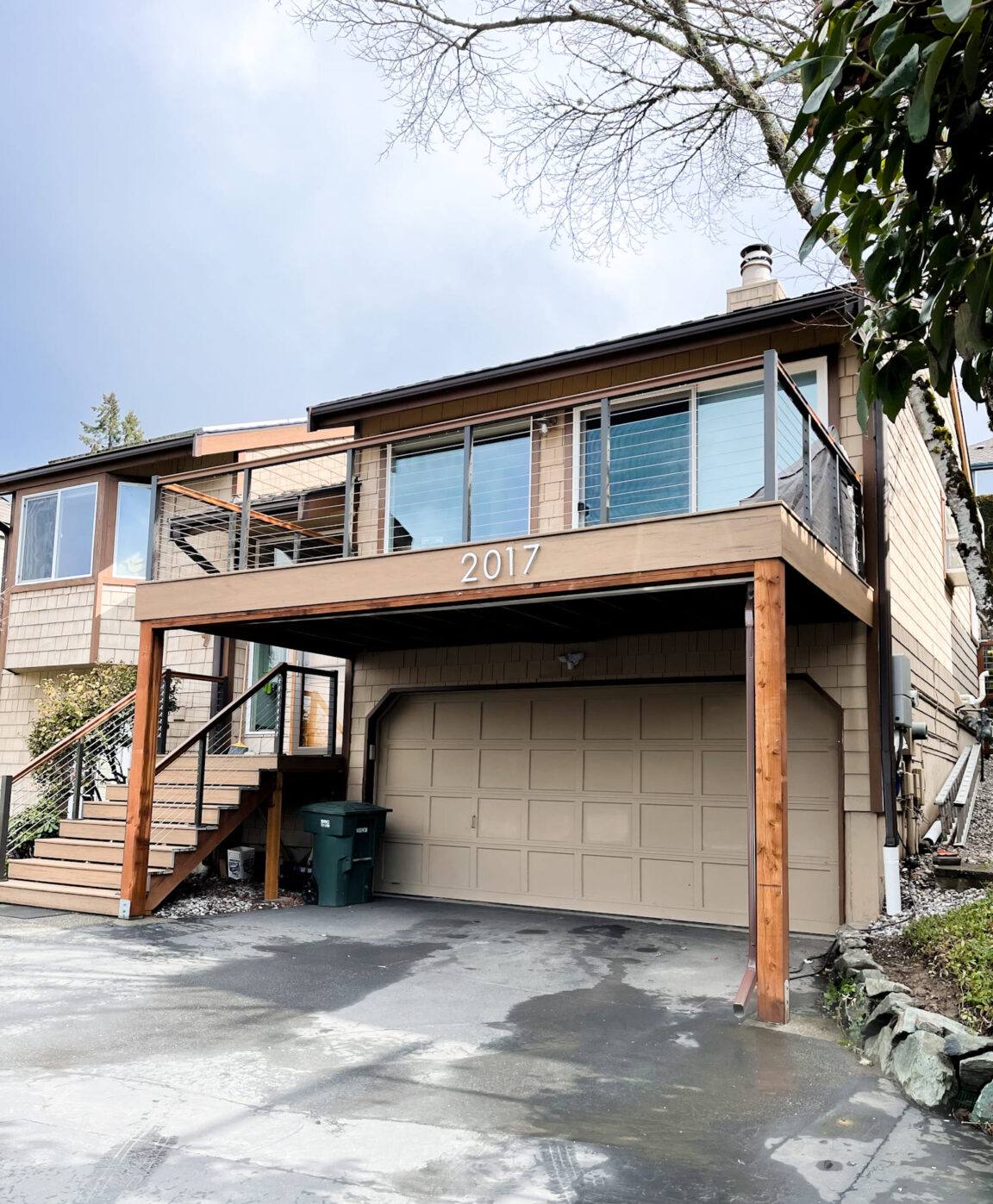
Composite decking (wood-plastic composite or capped polymer/PVC boards) doesn't rot, splinter, or need annual staining the way wood does, which is a real advantage in a climate that keeps wood wet for weeks at a stretch. That's the main reason it's become the default choice for decks in coastal Whatcom County.
But composite boards are only one part of a deck. The framing underneath — joists, beams, ledger board, and posts — is almost always still pressure-treated lumber, and that structure is exactly as vulnerable to rot and fastener corrosion as it would be under a wood deck. Composite decking that looks great for ten years on top of a substructure that was flashed or fastened poorly is a common failure pattern we get called out to fix. Choosing composite is the right call for the surface; it doesn't excuse cutting corners underneath it.
What Salt Air Specifically Attacks First
In our experience working coastal Whatcom County properties, the earliest failures on a deck near the water are almost never the composite boards themselves. They're:
- Exposed carbon-steel screws and fasteners that rust and stain the decking around them
- Galvanized joist hangers and hardware that corrode faster than their rated lifespan when salt spray reaches them directly
- Ledger board flashing that was skipped or installed with the wrong lap sequence, letting water track into the rim joist
- Post bases and hardware at or near grade, where standing moisture and salt exposure combine
None of that is visible from the top of a finished deck. It's why the build quality underneath matters as much as the brand of composite board on top.
Getting the Substructure Right for a Marine Environment
Framing lumber should be rated for ground contact where it's near grade, and every cut end or drilled hole needs to be sealed, not left exposed. Joist tape or a comparable flashing membrane on top of each joist keeps water from wicking into the wood through fastener penetrations — a detail that's easy to skip and hard to inspect once decking is down.
Ledger board flashing at the house is the single most important detail on any deck built against a structure in this climate. It has to shed water down and away from the wall, lap correctly with the house's existing weather-resistant barrier, and never rely on caulk alone to do the job long-term. Get this wrong and you're not looking at a deck problem — you're looking at hidden rot in the rim joist and wall framing behind the siding.
Footings and posts also deserve attention on Cherry Point lots specifically. Wet, poorly draining soil is common near the water, and posts set without adequate depth or proper drainage around the footing can shift over a few wet seasons even where frost isn't the driving concern it is inland.
Choosing the Right Composite Board and Fastening System
Not all composite decking behaves the same in a wet, shaded, salt-exposed environment. The two decisions that matter most for a Cherry Point deck are the board's cap/surface type and the fastening system.
| Factor | What to Consider Here |
|---|---|
| Capped vs. uncapped composite | Fully capped (PVC-wrapped) boards resist moisture absorption and staining far better than older uncapped wood-plastic composite, which can swell or discolor with constant dampness |
| Grooved (hidden-fastener) vs. square-edge boards | Grooved edges hide fasteners cleanly but can trap organic debris and moisture along the groove in shaded, damp spots — square-edge, face-screwed boards are easier to keep clear of buildup in high-moss areas |
| Fastener material | Stainless steel or coated fasteners rated for coastal/marine exposure hold up where standard carbon-steel screws will rust and streak the decking within a few seasons |
| Board color | Darker boards show less water spotting and pollen/moss staining than very light colors, though this is a secondary factor next to substructure and fastener choices |
| Substructure material | Pressure-treated wood framing is standard and fine if properly flashed and fastened; some homeowners near the water opt for composite or aluminum joist systems for a longer-term, lower-maintenance frame |
There's no single "best" board for every Cherry Point property — a shaded, tree-covered lot and an open, wind-exposed bluff lot call for slightly different priorities. We walk through these trade-offs with the specific site in mind rather than defaulting to one product line.
Our Installation Process
The steps themselves aren't unusual, but the order and the details we don't skip are what separate a deck that holds up in this climate from one that doesn't.
- Site evaluation — checking existing drainage, sun/shade exposure, wind direction, and how close the deck sits to salt spray or standing moisture
- Tear-out and substructure inspection — if replacing an existing deck, we check the framing, ledger connection, and footings before assuming they're reusable
- Ledger flashing and house connection — done to shed water away from the wall assembly, not just sealed with caulk
- Framing — treated lumber sized and spaced for the board and fastening system chosen, with joist protection tape on all top surfaces
- Fastener and hardware selection — stainless or coastal-rated hardware throughout, not just at visible connections
- Decking installation — hidden-fastener or face-screw system installed per manufacturer spacing and gapping specs, which vary by board and by expected wet-season expansion
- Railing, stairs, and edge details — matched to the decking system and to the wind exposure typical of open Cherry Point lots
- Final walk-through — covering maintenance expectations specific to a marine, moss-prone climate
Maintenance That Actually Matters in This Climate
Composite decking is low-maintenance, not no-maintenance, and the maintenance that matters most here is different from what a manufacturer's general care sheet assumes for a drier climate. The priority is keeping organic debris and standing moisture from sitting on the surface long enough to grow moss or algae.
- Sweep leaves, needles, and pollen off the deck regularly, especially in shaded sections — organic buildup is what feeds moss growth on composite surfaces
- Clean grooved or hidden-fastener boards periodically with a stiff (non-metal) brush to clear debris out of the channels
- Check that gaps between boards and at the deck perimeter stay clear so water can drain through rather than pool on top
- Rinse salt residue off railings and hardware periodically if the deck faces open water or takes direct spray
- Inspect under the deck once a year for signs of moisture at the ledger connection, post bases, or joist hangers
- Use a composite-safe cleaner for moss and algae rather than a pressure washer on high setting, which can etch or fray the board surface
Permitting Near Blaine and Unincorporated Whatcom County
Cherry Point falls outside Blaine's city limits, in unincorporated Whatcom County, so permitting for a new deck or a significant rebuild typically runs through the county rather than the city. Requirements can also shift depending on proximity to the shoreline, since shoreline management rules add another layer of review for properties near the water. We don't guess at this — we confirm what applies to a given lot before work starts, rather than assuming the same rules that apply a few miles away in Blaine proper carry over automatically.
Why a Crew That Already Works Cherry Point Is Worth It
A lot of what causes decks to fail early out here isn't visible on a spec sheet — it's knowing which details a generic installation crew skips because they don't build in this specific combination of salt exposure, shade, and constant moisture. A crew that regularly works Cherry Point and the surrounding Blaine area already knows to spec coastal-rated hardware as standard, not an upsell; already treats ledger flashing as non-negotiable rather than optional; and already understands which board and fastening choices actually resist moss in the shaded, damp conditions common on these lots.
That local pattern-recognition is the difference between a deck that needs its first hardware repair in three years and one that doesn't need attention for well over a decade. It also means fewer surprises during the county permitting process, since we know what documentation and shoreline considerations tend to come up for properties in this area.
Getting an Honest Estimate
Every Cherry Point lot handles wind, shade, and water exposure a little differently, so a real estimate has to start with a look at your specific site rather than a phone-quoted number. We're happy to walk your property, talk through board and hardware options suited to your exposure, and give you a straight answer on what a correctly built composite deck will take. There's no pressure and no obligation — use the form below to request a free estimate.