 Blaine Siding
 Decks Built for How California Creek Actually Weathers
California Creek sits close enough to the water that homes here deal with a different set of conditions than decks built ten or fifteen miles inland. Salt-laden air moves through the area steadily, wind-driven rain hits decks at angles that shed roofs don't have to deal with, and the shaded, damp stretches of the year give moss and algae a long runway to take hold on any horizontal surface that doesn't drain and dry properly. A deck built here needs to be planned around those realities from the first framing member, not patched for them after the fact.
We build custom decks specifically for this stretch of Whatcom County, and the choices we make on material, fastener type, and drainage detail are shaped by what we've seen hold up — and what we've seen fail early — on homes in this exact area.
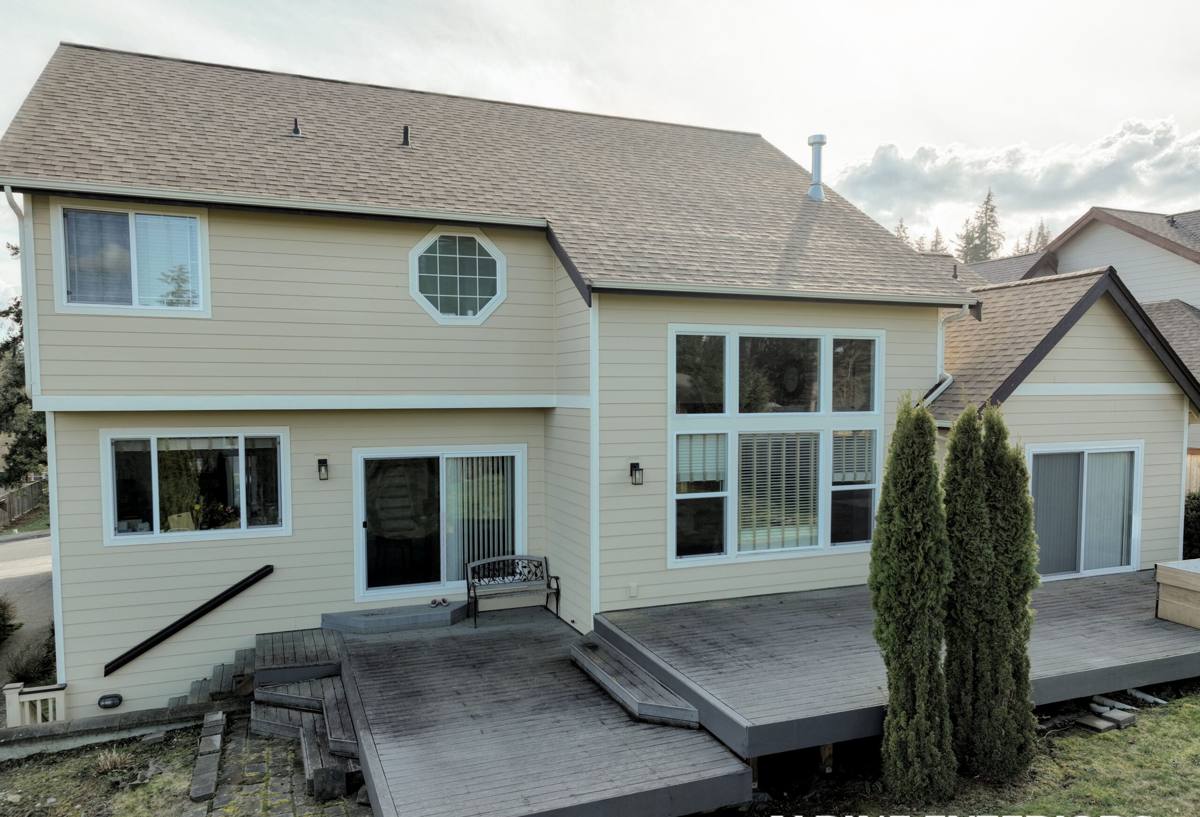
What California Creek Homes Are Actually Up Against
Three conditions drive almost every decision on a deck build out here:
Salt Air
Even a modest distance from saltwater is enough to accelerate corrosion on standard fasteners, hinges, and low-grade metal railing components. Over a few seasons, cheap hardware will streak, weaken, or seize long before the decking above it shows any wear.
Driving Rain
Rain in this part of Washington rarely falls straight down. Wind pushes it sideways into ledger boards, fascia, and any gap where a deck meets the house. That means flashing details and the water path behind the decking matter as much as the decking itself.
A Long Moss Season
Cool, damp, partially shaded conditions for much of the year give moss and algae plenty of time to establish on boards that don't shed water quickly. Once moss gets a foothold, it holds moisture against the surface, which is exactly what accelerates rot in wood decking and staining in composite.
None of these are exotic problems — they're the normal cost of building this close to the water in the Pacific Northwest. The difference between a deck that looks good for two years and one that holds up for two decades is whether the build accounted for them up front.
Choosing the Right Decking Material for This Neighborhood
There's no single "best" decking material — there's a best material for this climate and this homeowner's maintenance tolerance. Here's how the common options actually perform under salt air, driving rain, and heavy moss exposure:
| Material | Salt Air Resistance | Moss/Moisture Behavior | Maintenance Needed |
|---|---|---|---|
| Pressure-treated wood | Good with correct fasteners | Needs regular cleaning and sealing to resist moss staining | Annual cleaning, re-sealing every 2-3 years |
| Cedar | Naturally decent, fades over time | Prone to moss if not kept clean and ventilated | Regular cleaning, periodic oil or stain |
| Composite decking | Excellent — no corrosion risk in the board itself | Sheds water well; still needs occasional cleaning to prevent surface algae film | Low — periodic washing |
| PVC decking | Excellent | Very resistant to moisture staining | Low |
We install all of these depending on the homeowner's budget and look they're after. What we won't do is install any of them without adjusting the build for our climate — that means correct board spacing for drainage, proper ventilation underneath, and fasteners rated for coastal exposure regardless of which decking surface goes on top.
A Note on Wood vs. Composite in This Specific Area
Wood decking can absolutely work well here, but it asks more of the homeowner. If you're not planning to clean and treat it on a regular schedule, moss and moisture staining will get ahead of you within a season or two in a shaded, damp yard. Composite and PVC cost more up front but ask far less of you long-term — that trade-off is worth talking through honestly before you decide, and we'll give you our straight read on it based on your yard's sun exposure and how it sits relative to prevailing wind and rain.
Framing and Substructure: Where Deck Failures Actually Start
Most deck problems we get called out to inspect aren't failures of the decking boards themselves — they're failures underneath, where nobody was looking. The substructure carries the load and takes the brunt of standing moisture, and it's the part most likely to get shortcut on a lower-cost build.
- Ledger board flashing — this is the single most common point of hidden rot on decks attached to a house. It needs to be flashed to shed water away from the house framing, not just caulked and hoped for.
- Joist spacing and sizing — undersized or overspaced joists flex over time, which stresses fastener connections and decking, especially under wet-season swelling and drying cycles.
- Ground clearance and airflow — decks built too close to grade trap moisture underneath, which is exactly the damp, shaded condition moss and rot both thrive in.
- Post footings — footings need to be set below frost depth and properly sized for the soil conditions on your lot; this is not a place to guess.
We build the substructure to hold up under our wet season for the life of the deck, even on sections that will be covered by the decking material and never seen again once the project is finished.
Fasteners, Hardware, and Railings for Salt-Air Exposure
This is where a lot of decks near the water quietly fail early, and it's almost entirely avoidable. Standard galvanized fasteners can corrode faster than expected in salt-influenced air, leading to streaking on the decking and, eventually, weakened connections you can't see until something moves underfoot.
For California Creek builds, we use fasteners and structural hardware rated for coastal or marine-grade exposure — typically stainless steel or heavy-duty coated options depending on the application — and we choose railing hardware with the same standard in mind. It costs a bit more than the hardware store default, but it's the difference between hardware that lasts the life of the deck and hardware that needs replacing in five years.
Drainage, Grading, and Under-Deck Moisture Management
Water management is the quiet backbone of a deck that lasts in this climate. Board spacing, deck slope, and grading beneath the structure all work together to keep water moving off the deck and away from the house instead of pooling.
For decks over living space, patios, or storage areas, an under-deck drainage system can keep the space below usable and dry — worth discussing if you're planning to use the area underneath your deck for anything beyond gravel and shade. For ground-level decks, correct grading and gapping is usually enough, but it has to be done right the first time, since retrofitting drainage under an existing deck means partial teardown.
Our Process, Start to Finish
- On-site walkthrough — we look at your yard's sun and wind exposure, existing drainage, soil, and how the deck will connect to your home, then talk through what you actually want to use the space for.
- Design and material selection — we lay out size, shape, railing style, and decking material based on your budget and how much upkeep you're realistically willing to do.
- Permitting — depending on size, height, and attachment to the home, your project may require a permit through the local building jurisdiction. We handle that process rather than leaving it to you to figure out.
- Build — footings, framing, flashing, decking, and railing, in that order, with inspection points along the way rather than just at the end.
- Final walkthrough — we go over the finished deck with you, including basic care guidance specific to the material you chose.
Permits and Local Considerations Around Blaine
Deck projects in and around Blaine and unincorporated Whatcom County can fall under different permitting requirements depending on the deck's height, size, and whether it's attached to the home. Setback rules can also matter more on lots close to the water or to steep grade changes, which isn't unusual for property in this part of the county. We handle the permitting conversation as part of the process rather than treating it as the homeowner's problem to solve — it's one less thing you should have to chase down yourself.
Keeping a New Deck Looking Good Through the Wet Season
A well-built deck in this climate still needs some seasonal attention — the goal of a correct build is to minimize that work, not eliminate it entirely. A simple annual routine goes a long way:
- Sweep debris off the deck regularly, especially in fall when leaves and needles collect and hold moisture against the surface
- Rinse off surface grime and early moss growth before it has a chance to establish and stain the boards
- Check railings and stair connections once a year for any looseness, especially after the first full wet season
- Keep gutters and downspouts near the deck clear so runoff isn't dumping extra water onto or under the structure
- For wood decking, plan on resealing or re-staining on the schedule appropriate to the product — skipping this is the number one reason wood decks age poorly here
- Confirm under-deck drainage or ventilation gaps haven't been blocked by stored items, planters, or landscaping over time
Why Hiring a Crew That Already Works California Creek Matters
A deck built to a generic national spec can still fail early here, because generic specs assume average conditions — not a marine-influenced climate with driving rain and a long moss season. Crews who haven't built in this specific area tend to under-spec hardware, under-detail flashing, or pick decking without accounting for how much shade and dampness a given lot actually gets. We work this neighborhood regularly, which means we already know what this climate does to a deck over five, ten, and twenty years — and we build accordingly the first time, instead of learning it from a callback.
Get a Straightforward, No-Pressure Estimate
If you're planning a new deck or replacing one that hasn't held up to the weather here, we're happy to walk your property, talk through material and design options honestly, and put together a clear estimate — no pressure, no upsell. Use the form below to get started.