 Blaine Siding
 Decking Built for the California Creek Environment
California Creek sits in that stretch of Whatcom County where the weather off the water and the weather off the tree line both have a say in how your outdoor space holds up. Some lots here are shaded by mature fir and cedar, some sit more open toward Drayton Harbor and Semiahmoo Bay, and most get a mix of both depending on the season. A deck that works well on one property can struggle on the one next door for reasons that have nothing to do with how it was built and everything to do with how much rain, salt, and shade it actually sees.
Composite decking has become the default choice for a lot of homeowners in this area, not because it's trendy, but because it holds up to the specific combination of conditions this part of Blaine deals with every year: long wet stretches, salt-laden air, and a moss season that can run from fall through spring. This page covers what that means for a deck built in California Creek specifically, what a correct installation looks like, and what to expect from the process.
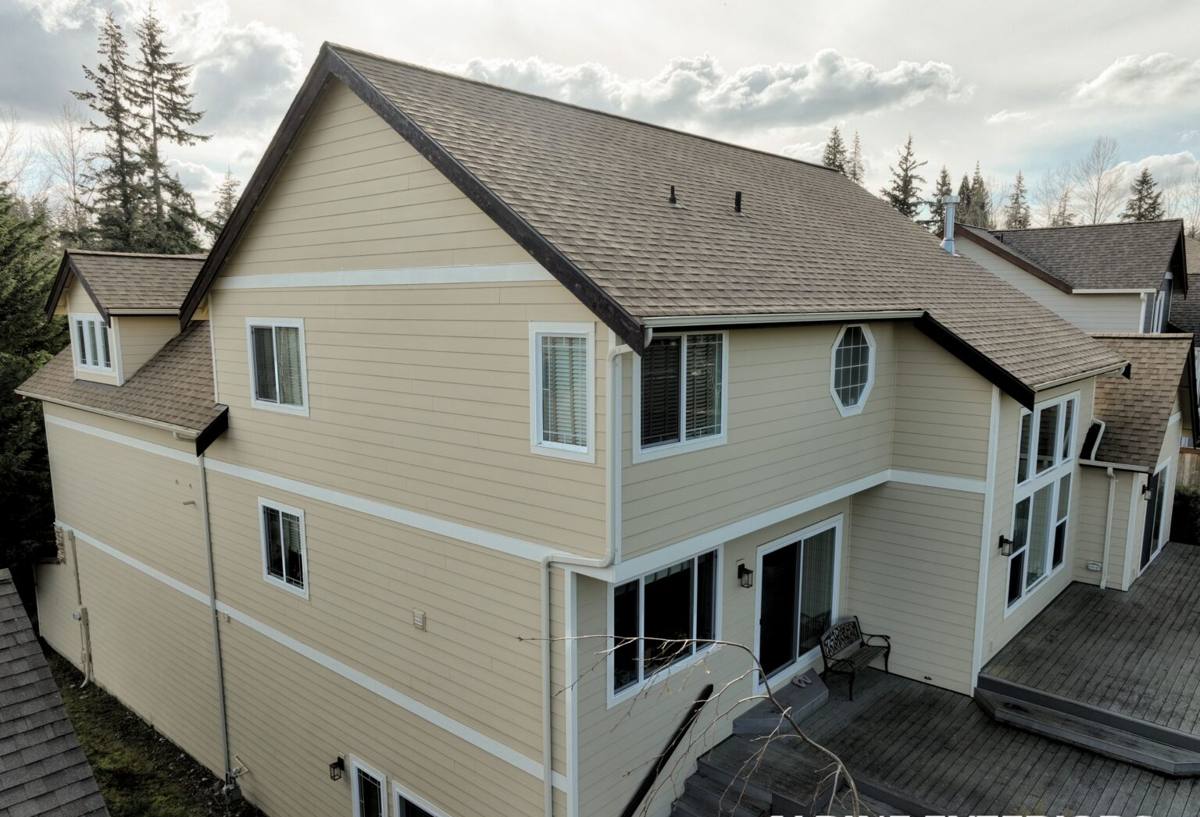
What This Climate Actually Does to a Deck
It helps to be specific about the forces at work, because they don't all show up the same way or on the same timeline.
Salt Air and Hardware
Properties closer to Drayton Harbor and Semiahmoo Bay get airborne salt carried in on the wind, even if the home isn't waterfront. Salt accelerates corrosion in fasteners, brackets, and any exposed metal. On a wood deck this often shows up first as rust streaking down the boards from screw heads. On a composite deck, the boards themselves don't corrode, but the fasteners, ledger flashing, post bases, and any structural hardware underneath still need to be rated for a coastal environment or they'll be the first thing to fail.
Driving Rain and Substructure Moisture
Blaine gets weather that comes in sideways as often as it comes straight down. Driving rain finds its way under railings, around ledger boards, and into any gap in the framing that wasn't detailed correctly. The composite boards on top can be doing their job perfectly while the wood substructure underneath quietly rots, because that framing is still typically pressure-treated lumber, not composite. A deck failure in this climate is almost always a substructure and flashing problem, not a surface material problem.
Moss and Algae in the Shade
Wherever tree cover, fences, or the house itself block direct sun for long stretches, moss and green algae film build up on any horizontal surface, deck boards included. This isn't a defect in the material — it's biology finding a damp, shaded surface to grow on. It matters for board selection and for how a deck should be cleaned, which we cover below.
Why Composite Fits This Environment
Wood decking isn't a bad product, and we still build with it when a homeowner wants that look and understands the upkeep. But for California Creek's specific mix of salt exposure, sustained moisture, and shade-driven moss growth, composite generally holds up with less maintenance burden over the life of the deck. The trade-offs are worth being honest about in both directions.
| Factor | Wood Decking | Composite Decking |
|---|---|---|
| Response to sustained moisture | Swells, cups, and splits over time; needs sealing to slow this down | Boards don't absorb water the way wood fibers do; dimensionally more stable |
| Salt air exposure | Accelerates fastener corrosion and finish breakdown | Board material unaffected by salt; fasteners and hardware still need coastal-rated components |
| Moss and algae in shaded areas | Grows into the wood grain, harder to fully clean out | Grows on the surface of capped boards, easier to rinse and scrub off |
| Annual maintenance | Sealing or staining every 1-3 years, regular sanding of rough spots | Periodic washing; no sealing, staining, or sanding required |
| Upfront material cost | Lower | Higher |
| Appearance over 10+ years | Requires consistent upkeep to keep looking good | Color and texture hold up with minimal intervention if quality-graded |
The honest trade-off is upfront cost versus long-term labor. Composite costs more to install; it costs less in weekends spent sealing, sanding, and re-staining, and it doesn't develop splinters or soft spots the way wood eventually does.
What a Correct Installation Involves Here
Composite decking is often marketed as low-maintenance, which is true for the boards themselves, but the installation underneath them is where a deck actually earns its lifespan in a climate like this one. We treat a few things as non-negotiable on every California Creek project.
Substructure and Ledger Flashing
Where the deck attaches to the house, the ledger board and flashing details determine whether driving rain gets diverted away from the wall assembly or funneled straight into it. This is the single most common point of failure we see on older decks in this area, and it's invisible until something has already gone wrong.
Fasteners and Hidden Clip Systems
We use coastal-rated, corrosion-resistant fasteners and hidden clip systems suited to the specific composite board profile being installed. Hidden fastening also keeps water from pooling around screw heads on the surface, which matters when a board is going to sit wet for days at a time during a Blaine winter.
Drainage and Airflow Underneath
A deck built tight to the ground or against a foundation with no airflow underneath stays damp longer after every rain, which feeds both wood rot in the framing and moss growth on the surface. Proper joist spacing, ventilation, and grading underneath the deck let it dry out between storms instead of staying saturated all winter.
Board Selection for Shade and Sun Mix
Capped composite boards resist moisture penetration and staining better than uncapped boards, which matters most in the shaded, moss-prone sections of a property. Color selection also plays a role — darker boards show less algae film between cleanings, while lighter boards show dirt and pollen more but hide less moss buildup. We'll walk through this trade-off based on where your deck actually sits relative to tree cover.
Our Process
The process is the same whether the job is a full rebuild or new construction, adjusted for what's already on the property.
- On-site assessment. We look at sun and shade exposure, proximity to the water, existing substructure condition if this is a replacement, and any drainage issues around the foundation.
- Design and material selection. We go over board profiles, colors, railing options, and fastening systems suited to the specific spot on your property.
- Permitting. Deck projects in Whatcom County and the City of Blaine typically require a permit depending on size and height; we handle that paperwork as part of the job.
- Demolition and substructure work, if needed. On replacements, this is where we find out what the old deck was hiding — rot, undersized framing, or flashing that was never done correctly.
- Framing, flashing, and drainage detailing. This is the part of the job that determines how the deck performs in five years, not just how it looks on day one.
- Composite board and railing installation. Hidden fastening, proper board spacing for expansion, and clean edge and stair details.
- Final walkthrough. We go over care basics specific to your deck's sun exposure before we consider the job done.
Cost Factors Specific to California Creek Projects
Composite decking costs more per square foot than wood, and the total cost of any individual project depends on more than just size. A few factors we see come up regularly in this area:
| Factor | Why It Affects Cost |
|---|---|
| Substructure condition | Replacement jobs often need new or reinforced framing, especially on older decks near the water |
| Height and stairs | Elevated decks and multi-level stair systems add framing, railing, and labor complexity |
| Board profile and color | Grooved-edge boards for hidden fasteners, higher-end capped boards, and certain colors run higher than base-tier lines |
| Railing system | Composite or aluminum railing costs more than basic wood but needs far less upkeep in salt air |
| Site access | Tree cover, slope, and how close a lot sits to the water can affect equipment access and staging |
We give straightforward, itemized estimates rather than a single vague number, so you can see exactly where the cost is going and where there's room to adjust the scope if needed.
Maintenance in a Moss-Prone, Salt-Air Setting
Composite decking cuts out sealing and staining, but "low-maintenance" doesn't mean "no maintenance," especially in a spot with this much moisture and shade. A simple seasonal routine keeps a composite deck looking right and keeps moss from getting a foothold.
- Sweep debris — leaves, needles, pollen — off the deck regularly, especially in fall when it builds up fast under trees
- Rinse the deck with a garden hose every few weeks during the wet season to keep moss spores from settling in
- Scrub shaded or algae-prone areas with a soft-bristle brush and a mild soap and water solution a couple times a year
- Avoid pressure washers on high settings directly on composite boards — they can damage the cap layer over time
- Rinse salt residue off railings and hardware periodically if the property is closer to the water
- Check that gaps between boards stay clear of debris so water keeps draining through as designed
- Inspect fasteners and railing connections annually for any early signs of corrosion or loosening
Why Hire a Crew That Already Works This Area
A lot of the problems we get called to fix on older decks in California Creek trace back to installation decisions that made sense in a drier, milder climate but don't hold up here — undersized flashing, standard-grade fasteners instead of coastal-rated ones, or framing with no airflow underneath. A crew that already works Whatcom County's coastal side knows to plan for salt air and driving rain from the start, not as an afterthought after the first winter exposes the gap.
We're also familiar with the permitting process through Blaine and Whatcom County, which keeps the job moving instead of stalling out on paperwork. And because we're local, we're not disappearing after the install — if something needs a look five years from now, we're still around and still working in your neighborhood.
Get a Straight Answer for Your Property
Every lot in California Creek handles sun, shade, and moisture a little differently, and the right deck build reflects that instead of using a one-size-fits-all approach. If you're planning a new deck or replacing one that's showing its age, we're happy to come take a look and give you a straightforward, no-pressure estimate using the form below.