 Blaine Siding
 Deck Replacement Built for Birch Point's Shoreline Conditions
Birch Point sits close enough to the water that the same salt air giving these homes their view is also working against the wood underfoot. Decks here don't fail the way they do further inland. Salt-laden air accelerates corrosion on fasteners and hardware, driving rain off the Strait finds every gap in flashing and ledger connections, and Whatcom County's long, damp winters give moss and algae months to colonize any surface that doesn't drain and dry quickly. A deck built to a generic spec sheet, without accounting for those three factors together, tends to show real trouble inside five to eight years instead of the fifteen-plus you should expect from a properly built replacement.
We replace decks specifically with this exposure in mind — not as an afterthought, but as the starting point for every material and fastener decision we make.
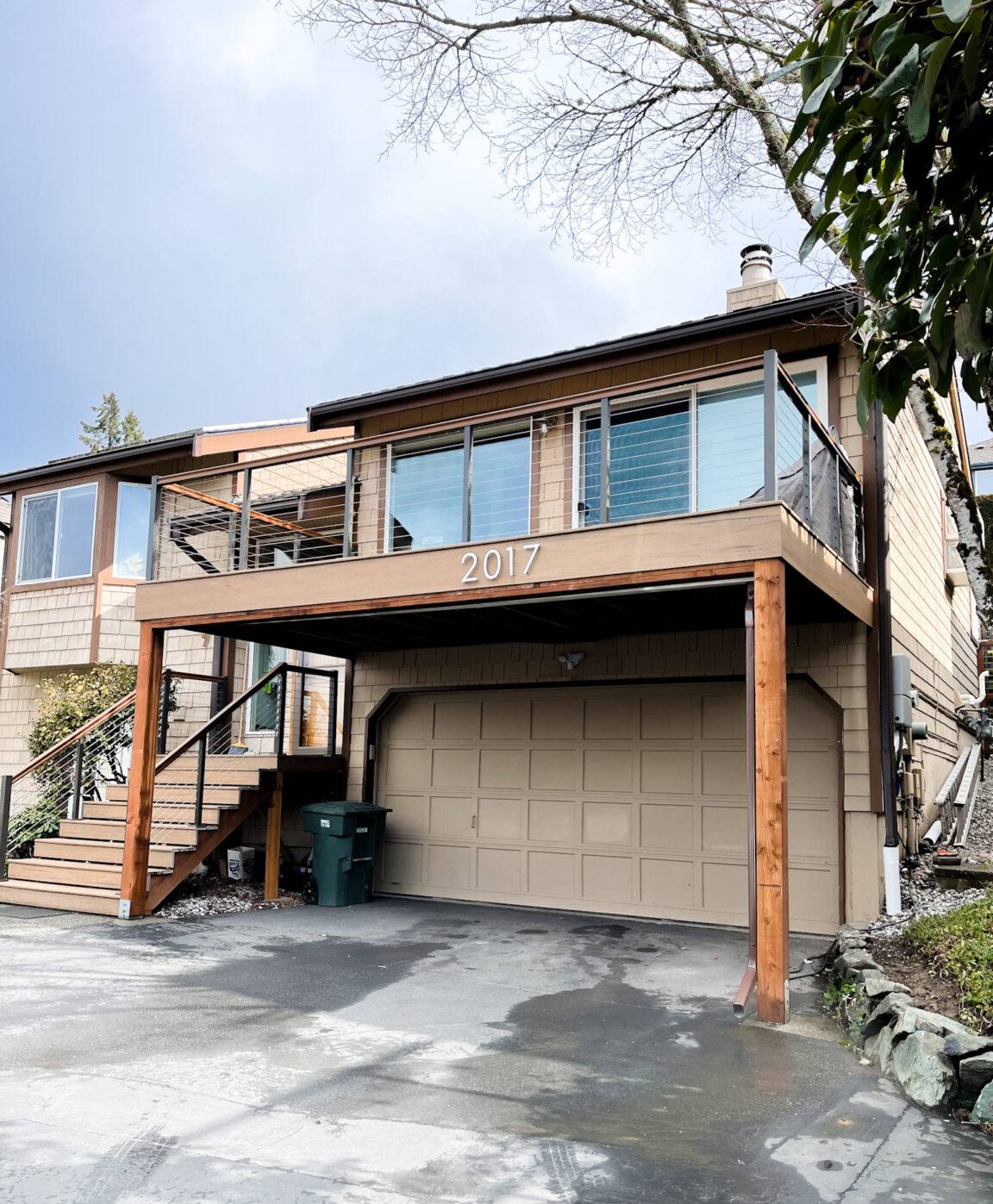
Signs a Birch Point Deck Needs Replacement, Not Another Repair
Repair makes sense when the problem is isolated. Replacement is the honest call when the structure itself has been compromised, because patching individual boards on a failing frame just moves the next failure a year or two down the road. Watch for:
- Soft, spongy, or spring-back decking boards, especially near the house or along the perimeter
- Visible rot or dark staining at the ledger board where the deck attaches to the house
- Rust streaking or crumbling around fastener heads and joist hangers
- Persistent green or black growth that returns within weeks of cleaning
- Railing posts that wiggle at the base, which often means the framing beneath has softened
- A deck more than 20 years old that has never had the substructure inspected
If more than one or two of these apply, you're usually looking at a structural issue, not a cosmetic one, and that's a replacement conversation.
What a Correct Deck Replacement Actually Involves
Starting With the Ledger and Frame
The ledger board — where the deck bolts into the house — is the single most common failure point in this climate, because it's the hardest spot for water to drain away from. A proper replacement means pulling the old ledger, inspecting the rim joist and sheathing behind it for hidden rot, and installing new flashing that actually sheds water away from the house rather than trapping it against the wall. We won't reuse a ledger connection that shows any sign of past moisture intrusion, even if it looks structurally sound today.
Framing and Fasteners
Joists, beams, and posts get sized to current code, not just matched to what was there before — older decks around Blaine are frequently underbuilt by today's standards. Every fastener, from joist hangers to structural screws, needs to be rated for the specific decking and framing material used, since mismatched metals accelerate corrosion in salt air far faster than either material alone.
Drainage and Airflow
Water that can't get out from under a deck is what feeds moss, rot, and mildew through the wet season. Correct spacing between boards, proper slope away from the house, and clear airflow underneath the structure are not optional details — they're what determines whether the deck is still solid in year fifteen.
Choosing Decking Material for Salt Air and a Long Moss Season
There's no single "right" decking material for every Birch Point home — it depends on budget, how much upkeep you want to do, and how close to the water the deck sits. Here's how the common options actually perform under this specific combination of salt exposure, rain, and moss pressure.
| Material | How It Handles Salt Air | Moss/Algae Resistance | Maintenance |
|---|---|---|---|
| Pressure-treated lumber | Fair — fasteners are the weak point over time | Low without regular cleaning | Annual cleaning and periodic sealing |
| Cedar | Good natural rot resistance, but surface graying accelerates near salt air | Moderate; needs cleaning to prevent staining | Regular sealing to maintain color and resistance |
| Capped composite | Excellent — outer cap resists moisture and salt intrusion | High; smooth cap sheds growth more easily | Occasional washing, no sealing or staining |
| PVC decking | Excellent — fully synthetic, no wood fiber to absorb moisture | High | Lowest; occasional washing |
We won't push everyone toward the highest-end material — a well-built pressure-treated deck with correct drainage and stainless fasteners can still give you a solid, honest deck for a reasonable budget. But if the deck sits closer to the water or gets heavy shade and moss pressure, we'll say so plainly, because that's where a low-maintenance capped or PVC product earns its cost difference.
Hardware and Railing Choices That Actually Hold Up
Corrosion is the quiet failure mode in coastal decks — it doesn't announce itself until a fastener snaps or a railing post shifts. For Birch Point replacements, we standardize on hardware rated for coastal and salt-air exposure rather than the general-purpose fasteners that work fine further inland. Before we consider a deck finished, it should meet this checklist:
- Structural screws and joist hangers rated for coastal/high-corrosion exposure, not standard galvanized
- Stainless steel or coated fasteners at all railing connections, which take the most weathering and load
- Flashing at every ledger and post connection that sheds water outward, not inward
- Post bases set to keep wood off standing water or damp soil contact
- Consistent board spacing that allows drainage without becoming a hazard
- Railing height and baluster spacing that meet current code, especially on elevated decks
Cost Factors for a Birch Point Deck Replacement
Every deck is different, so we won't quote a number without seeing the site, but these are the factors that actually move the price up or down:
| Factor | Effect on Cost |
|---|---|
| Deck size and shape (multi-level, curves, wraparounds) | Increases labor and material |
| Height off grade and stair count | Adds framing and railing complexity |
| Extent of hidden rot found at demo | Can add framing or ledger repair not visible beforehand |
| Decking material selected | Widest swing factor — pressure-treated to PVC covers a broad range |
| Railing style and material | Cable, glass, and composite railings cost more than basic wood or metal |
| Site access | Tight or waterside lots can add setup and material handling time |
We'd rather walk the deck, open up a suspect area if needed, and give you a number based on what's actually there than hand you a placeholder estimate that changes once we start.
How Our Process Works, Start to Finish
- On-site assessment — we inspect the existing deck, ledger, and framing, and check for hidden moisture damage where possible before quoting
- Honest scope and estimate — a written breakdown of what needs replacing versus what can stay, with material options explained in plain terms
- Permitting — where the scope requires it, we handle the paperwork with the local jurisdiction so you're not chasing it yourself
- Demo and framing inspection — old decking and framing come off, and we confirm the substructure condition before building forward
- Build-out — framing, flashing, decking, and railing installed to spec, with coastal-rated fasteners throughout
- Final walkthrough — we go over the finished deck with you, including basic care guidance for whatever material was installed
Permits and Local Considerations in Blaine
Deck replacement projects in and around Blaine, Whatcom County, can trigger permitting depending on the scope of the work, the deck's height, and its proximity to property lines — this is especially relevant for shoreline-adjacent properties like those in Birch Point, where setback and critical area rules can come into play. We check what applies to your specific property before work starts rather than assuming, and we handle the coordination so the project stays on track instead of stalling on paperwork partway through.
Why Hire a Crew That Already Works Birch Point
A contractor who mostly builds decks inland can still do quality framing, but they may not default to coastal-rated fasteners, may not think twice about ledger flashing detail, and may not flag moss-prone shaded areas as a maintenance issue up front. Working regularly in Blaine's coastal neighborhoods means we've already seen how decks age here — which connections fail first, which materials hold up, and which shortcuts show up as problems in year three instead of year fifteen. That local pattern recognition is part of what you're paying for, not just the labor.
If your deck in Birch Point is showing soft spots, rust, persistent moss, or is simply old enough that you're wondering whether it's still safe to use, we're glad to take a look. Request a free, no-pressure estimate using the form below and we'll walk the deck with you and give you a straight answer on repair versus replacement.