 Blaine Siding
 Why Birch Bay Roofs Wear Differently Than Roofs Inland
Birch Bay sits right where Puget Sound weather meets the open exposure of Whatcom County's coastline, and that combination is hard on asphalt shingle roofs in ways that don't show up on a roof twenty miles inland. Salt-laden air drifts off the water and settles on every exterior surface, including shingle granules and exposed metal fasteners. Add in wind-driven rain that comes at the roof sideways instead of straight down, and you have a recipe for water finding its way under laps and around flashing that would otherwise hold up fine in a calmer setting.
Then there's moss. Whatcom County's long, wet, mild winters give moss and algae months of ideal growing conditions on north-facing and shaded slopes. A roof that never fully dries out between rain events becomes a host for organic growth that traps moisture against the shingle mat, which shortens the life of the roofing system faster than sun exposure ever would in this part of the state. None of this means asphalt shingles are the wrong choice for Birch Bay — they're not — but it does mean the details of the installation matter more here than in a drier, less coastal climate.
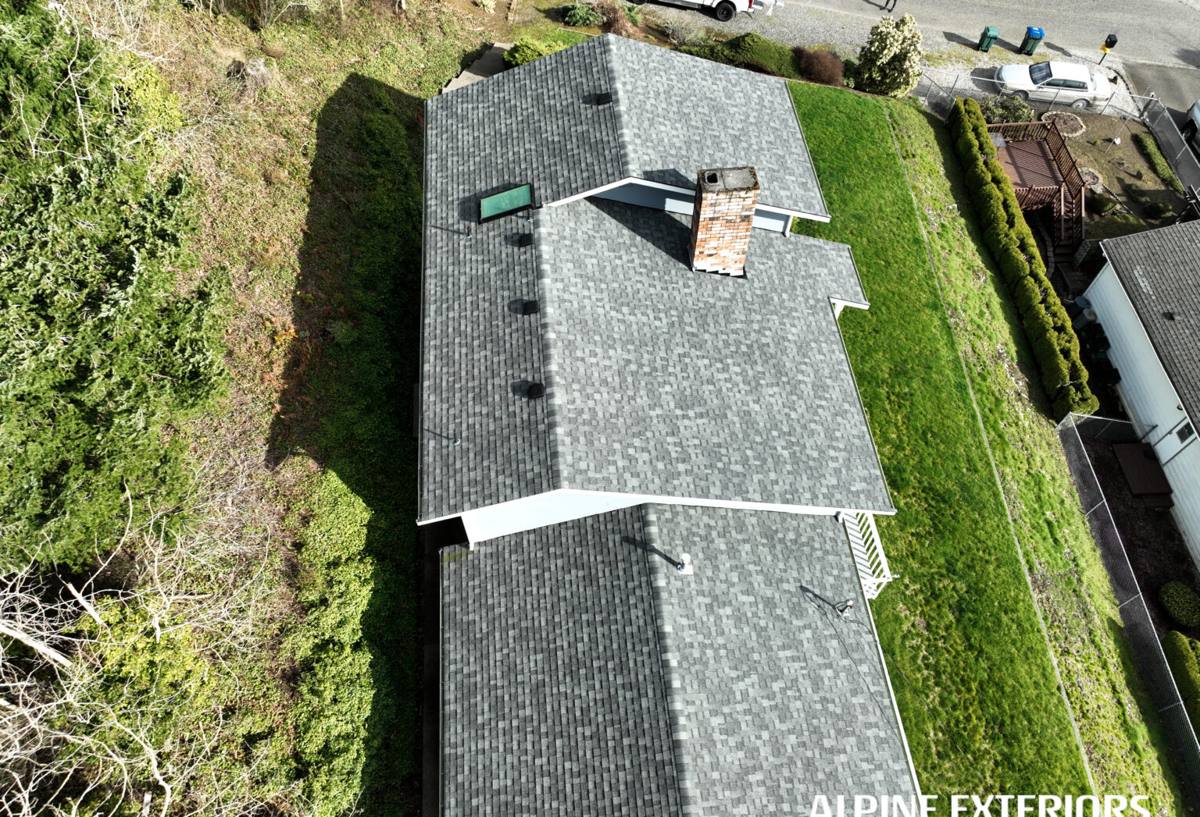
What "Correct" Actually Means for a Birch Bay Asphalt Shingle Roof
A shingle roof is a system, not a single product. The shingle itself gets all the attention, but the parts underneath and around it are what actually keep a Birch Bay home dry through a wet winter.
Underlayment That Can Handle Wind-Driven Rain
In an exposed, coastal-influenced area, we treat synthetic underlayment as the baseline, not an upgrade, and we pay close attention to lap overlaps and fastening pattern rather than just rolling it out and stapling it down. On eave edges, valleys, and any low-slope transitions, self-adhered ice-and-water membrane gives a second line of defense against water that gets pushed uphill by wind before gravity can pull it back down.
Flashing That Doesn't Rely on Sealant Alone
Step flashing at walls, counter-flashing at chimneys, and properly formed valley metal are what actually stop leaks — caulk and roofing cement are backup, not the plan. Salt air accelerates corrosion on cheaper or improperly coated metal, so we use flashing rated for the exposure rather than whatever is cheapest to source.
Ventilation That Lets the Roof Deck Dry Out
A roof deck that stays damp underneath because of poor attic ventilation will rot from the inside regardless of how good the shingles on top are. Balanced intake at the eaves and exhaust at the ridge keeps air moving, which matters even more in a marine climate where the air itself is already carrying more moisture than average.
Shingle Selection for Algae and Moss Resistance
Most major manufacturers now offer shingles with algae-resistant granules (copper- or zinc-infused) built specifically for regions like ours. On a Birch Bay home, especially anything with shaded or north-facing roof planes, we consider this a practical necessity rather than an optional upgrade.
Signs a Birch Bay Roof Needs a Closer Look
- Dark streaking or greenish-black staining, especially on shaded slopes — early algae growth, not just cosmetic dirt
- Visible moss cushions, even small patches, along the lower courses or in valleys
- Granules collecting in gutters or at downspout outlets
- Curling, cupping, or lifted shingle edges, particularly on the side of the roof that faces prevailing wind and rain
- Soft spots or slight sagging felt when walking the roof deck (a sign of trapped moisture below)
- Rusty streaking near flashing, vent pipes, or metal valleys
- Daylight or water stains visible from inside the attic near the ridge or eaves
- A roof age of 18-20+ years with no major work done, regardless of how it looks from the ground
Any one of these on its own isn't necessarily an emergency, but a Birch Bay roof showing two or three of them at once is usually telling you it's past due for a real inspection rather than another look from the driveway.
Our Process for Birch Bay Asphalt Shingle Roofing
1. On-Site Assessment
We walk the roof (weather permitting) and check the attic from inside, looking at ventilation, deck condition, insulation contact with the roof deck, and any existing moisture staining. This tells us whether we're looking at a repair, a partial re-roof, or a full replacement, and we explain which and why in plain terms.
2. Honest Scope and Written Estimate
You get a written scope that spells out underlayment type, flashing work included, ventilation changes if needed, and the specific shingle product being quoted — not just a lump-sum number. If there are two or three reasonable ways to approach the job at different price points, we lay those out instead of picking one for you.
3. Tear-Off and Deck Inspection
Old roofing comes off down to the deck so we can actually see what's underneath — this is often where hidden moss-related rot or old storm damage shows up that wasn't visible from a surface inspection. Any soft or delaminated decking gets replaced before anything new goes down.
4. Underlayment, Flashing, and Ventilation Installed to Spec
This is the stage that determines how the roof performs in year 8 and year 15, not just how it looks in month one. We install ice-and-water membrane at vulnerable transitions, synthetic underlayment across the field, new step and counter-flashing where needed, and correct intake/exhaust ventilation.
5. Shingle Installation
Shingles go down per manufacturer specification for fastener placement and count — under-fastening is a common shortcut that shows up as blow-offs in the first big windstorm off the water. Starter strips, ridge caps, and exposure lines are installed to spec, not eyeballed.
6. Final Walkthrough and Cleanup
We walk the finished roof with you, review what was done and why, and do a magnetic sweep of the yard and driveway for stray fasteners. You get documentation of the materials and workmanship warranty in writing.
Shingle Options for a Coastal Whatcom County Home
| Shingle Type | Typical Lifespan | Best Fit for Birch Bay When... |
|---|---|---|
| 3-tab strip shingle | 15-20 years | Budget is the primary driver and the roof has good sun exposure and slope for drainage |
| Architectural (laminated) shingle | 25-30 years | You want better wind resistance and a heavier profile — our most common recommendation here |
| Algae-resistant architectural shingle | 25-30 years | The roof has shaded or north-facing slopes prone to moss and algae, which is common in this area |
| Impact-rated (Class 4) shingle | 25-30+ years | You want maximum durability against wind-driven debris and potential insurance premium credit |
We don't push the most expensive option on every job. A well-ventilated, sun-exposed roof plane can do fine with a standard architectural shingle, while a shaded slope on the same house may genuinely need the algae-resistant version to avoid repeat moss problems within a few years.
Cost Factors Homeowners Should Actually Weigh
| Factor | Why It Moves the Price |
|---|---|
| Roof pitch and access | Steeper or harder-to-access roofs take longer and require more safety equipment |
| Deck condition | Rotted or delaminated plywood found during tear-off adds material and labor |
| Number of penetrations | Chimneys, skylights, and multiple vents each need individual flashing detail |
| Ventilation upgrades | Adding proper intake/exhaust venting where none existed is an investment that pays off in shingle lifespan |
| Shingle tier chosen | Algae-resistant and impact-rated products cost more per square than standard architectural |
| Layers being removed | Tearing off two existing layers costs more in labor and disposal than one |
We'd rather walk you through these line items honestly than give a number that doesn't reflect what's actually going to be found once we open the roof up.
Living with Moss and Salt Air Between Roofing Jobs
A correctly installed roof still needs some basic upkeep in this climate. Keeping gutters clear so water isn't backing up under the eave edge, trimming back overhanging branches that keep shaded areas damp, and having moss physically removed (not just chemically treated) before it establishes a thick mat all extend the life of the shingles significantly. We generally advise against pressure washing shingle roofs, since it can strip granules and shorten shingle life rather than help it — a soft wash approach or manual removal is safer for the roofing material itself.
Why a Crew That Already Works Birch Bay Matters
Roofing crews who mostly work drier, inland climates sometimes under-spec underlayment or skip ventilation upgrades because those shortcuts don't cause visible problems for years in a less demanding environment. In Birch Bay's marine exposure, those same shortcuts show up as leaks, premature moss growth, or shingle failure well before the rated lifespan is up. We build every asphalt shingle roof here assuming salt air, wind-driven rain, and a long wet season are the normal operating conditions, not the exception — because in this part of Whatcom County, they are.
If your Birch Bay roof is showing its age, dealing with moss, or you're simply planning ahead before the next wet season sets in, we're happy to take a look and give you a straight answer about what it needs. Reach out for a free, no-pressure estimate using the form below.