 Blaine Siding
 Why Bellingham Siding Wears Differently Than Siding Inland
Bellingham sits close enough to the Salish Sea, and close enough to us here in Blaine, that homes in this part of Whatcom County take on a specific combination of punishment: salt-laden air rolling in off the water, long stretches of driving rain through fall and winter, and a moss season that can run half the year on shaded and north-facing walls. Siding that would hold up fine in a drier climate can start failing in patches here — while the rest of the wall looks perfectly normal. That's what makes repair work in this area different from a generic patch job: you have to understand why a section failed before you decide how to fix it.
Salt Air and Fasteners
Salt-influenced air accelerates corrosion on exposed fasteners, flashing, and any metal trim tied into the siding system. When a nail head rusts and backs out, or a piece of flashing starts to fail quietly behind a joint, the siding above it can look fine for years right up until it doesn't. Repairs in this area need to check fastener condition and flashing integrity, not just the visible siding surface.
Moss, Moisture, and the North-Facing Wall Problem
Shaded and north-facing walls in Whatcom County hold moisture longer, and moss loves that. Moss isn't just cosmetic — as it builds up in seams, laps, and around trim, it holds water against the siding surface for extended periods. On products that aren't dimensionally stable or that absorb moisture readily, that constant damp exposure is what leads to swelling, soft spots, and paint failure. Any honest repair estimate for a Bellingham-area home should include a look at moss buildup and drainage, not just the damaged board itself.
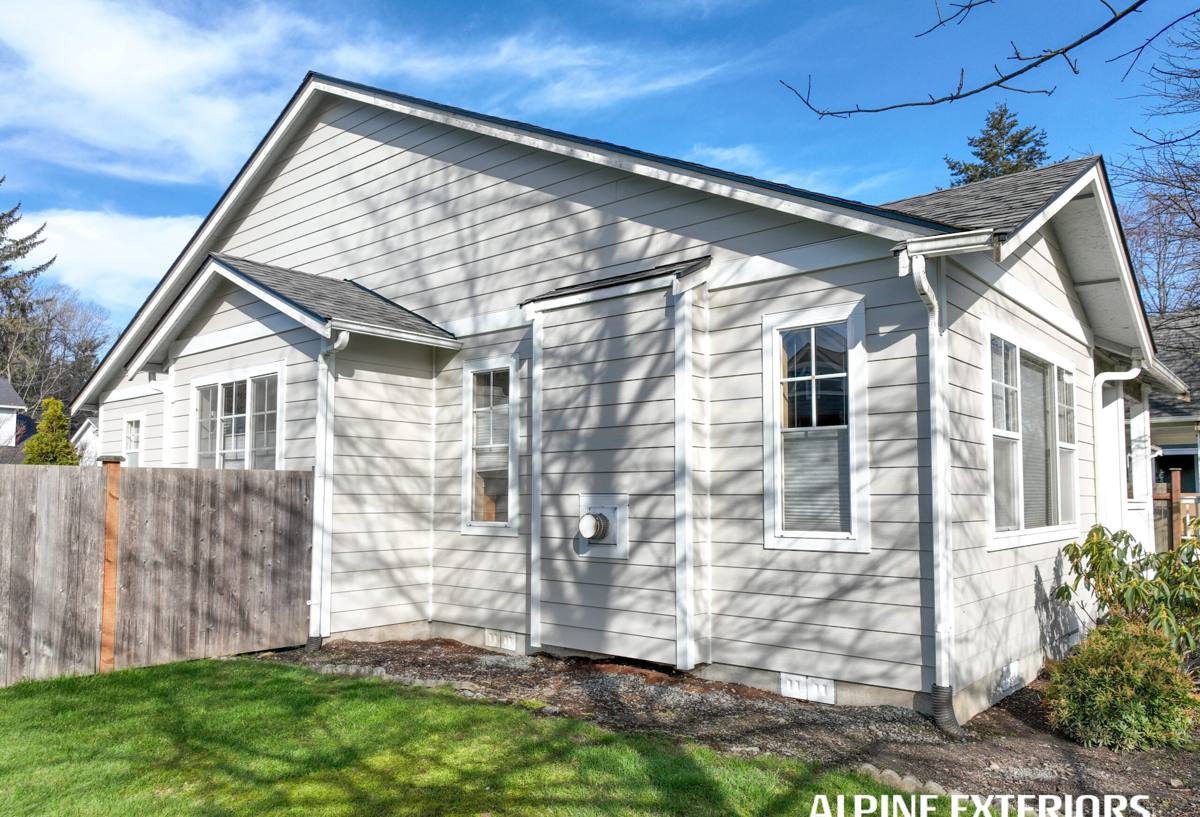
Signs Your Siding Needs Repair (Not Full Replacement)
Most homeowners call us because they've noticed one obvious problem — a soft spot, a stain, a cracked panel — and want to know if that means the whole house needs new siding. Usually it doesn't. Here's what we look for to separate a repair-scope job from a replacement-scope job:
- Localized soft spots or visible swelling in only one or two boards or panels
- Cracking or chipping isolated to impact areas (near gutters, downspouts, or foot traffic zones)
- Persistent moss or algae staining concentrated on shaded walls, with the siding itself still structurally sound underneath
- Failed caulk joints or gaps at trim and corners letting water track behind the siding in specific spots
- Paint or finish failure limited to certain elevations, usually the ones facing prevailing wind and rain
- No widespread buckling, warping, or soft siding across multiple walls (that's a replacement conversation, not a repair one)
If the damage is spread across most of the house, or if pulling one bad board reveals rot in the sheathing behind it, repair stops making financial sense and it's time to talk about a full re-side. We'll tell you honestly which category your house is in — we don't pad a repair estimate into a replacement sale, and we don't recommend replacement when a repair will genuinely hold.
What a Correct Siding Repair Actually Involves
Matching Material, Not Just Patching
A repair that just gets a new piece of siding nailed over the old spot is a temporary fix at best. Done correctly, a repair means removing the damaged section back to sound material, checking the water-resistive barrier and flashing underneath, and installing a properly matched replacement piece — same profile, same reveal, same fastening pattern — so the repaired section performs identically to the surrounding siding rather than becoming the next weak point.
The Water-Resistive Barrier Underneath
Most siding failures we find in this area trace back to what's happening behind the siding, not the siding itself. If house wrap or flashing was installed incorrectly, or has torn or degraded over time, water gets behind the cladding and causes damage that keeps recurring no matter how many times the visible siding gets patched. A repair that skips checking the barrier underneath is a repair that's likely to fail again in the same spot within a few wet seasons.
Sealing and Trim Detail
Caulk and sealant at trim boards, corners, and penetrations do a lot of quiet work keeping water out. Part of a correct repair is replacing failed sealant with the right product for the substrate, not just smearing more caulk over old, cracked joints.
Why We Repair — and Replace — With James Hardie Fiber Cement Only
We install and repair exclusively with James Hardie fiber cement siding. That's a deliberate standard, not a default. Fiber cement doesn't absorb moisture the way wood-based products can, it's non-combustible, and Hardie's ColorPlus factory finish is baked on and warranted against fading and peeling in a way field-applied paint isn't. For a climate like ours — salt air, sustained damp, long moss exposure — those properties matter more than they would somewhere drier. Hardie also engineers specific HZ5 product lines for regions with harsher moisture and freeze-thaw exposure, which fits the Pacific Northwest coastal band better than a one-size-fits-all siding product does.
We don't install LP SmartSide, vinyl, Cemplank, Allura, or primed wood siding, and we won't repair a house by mixing those products into a Hardie system. When we repair a Hardie home, we can match it correctly because we know the product line, the coursing, and the finish options. When we're asked to patch a different product, we'll say so honestly and explain what the trade-offs are rather than quietly bolting on something that won't perform the same way over time.
Comparing Common Repair Approaches
| Approach | What It Involves | Best For | Long-Term Outlook |
|---|---|---|---|
| Caulk and paint patch | Surface-level seal and repaint over existing damage | Cosmetic issues with no underlying rot or moisture intrusion | Short-term; doesn't address hidden moisture damage |
| Section replacement | Remove damaged boards back to sound material, check barrier, install matched Hardie replacement | Isolated damage on one or two walls or sections | Durable when barrier and flashing are also verified |
| Elevation-level replacement | Re-side one full wall (commonly the weather-facing or shaded side) | Damage concentrated on a single exposure, rest of house sound | Solves the recurring problem area without a full re-side cost |
| Full re-side | Remove all existing siding and barrier, install new system house-wide | Widespread damage, failed barrier across multiple walls, or aging original siding | Resets the clock on the whole exterior |
Our Repair Process for Bellingham-Area Homes
- Inspection first. We look at the damaged area, the surrounding siding, and the barrier underneath before quoting anything, so we're scoping the actual problem instead of the visible symptom.
- Moisture check. We check for hidden moisture and soft sheathing around the damaged section, since that changes whether it's a repair or a bigger job.
- Material match. We confirm the existing Hardie profile, reveal, and color so the repaired section blends in rather than standing out as a patch.
- Repair and reseal. Damaged material comes out, barrier and flashing get corrected if needed, and the matched replacement goes in with proper fastening and sealant.
- Walkthrough. We show you what we found and what we did, including anything we think you should keep an eye on going forward.
Why a Crew That Already Works Whatcom County Matters
Siding repair timing in this part of Washington is genuinely weather-dependent — there's a real window between wet spells when board removal, barrier repair, and sealant work can be done properly, and a crew that already works Blaine and Bellingham regularly plans around that instead of scrambling. Local familiarity also means we're not guessing at how Hardie products hold up against this specific combination of salt air and rain; we're repairing homes we already understand, in a climate we work in every week, using the one siding system we stand behind.
Keeping Repaired Siding Ahead of the Next Wet Season
Once a repair is done right, a little seasonal attention keeps it that way. Rinse moss and algae off shaded walls before it builds up rather than after, keep gutters and downspouts clear so water isn't sheeting down the siding face, and take a look at caulk joints at trim and corners once a year — catching a failed seal early is a five-minute fix, while ignoring it for a season can turn back into the same repair you just paid for.
If you're dealing with a soft spot, moss staining, or a section of siding that's not matching the rest of the house anymore, we're happy to take a look. We offer free, no-pressure estimates for Bellingham-area homes — fill out the form below and we'll get back to you with an honest read on what the repair actually needs.