 Blaine Siding
 Siding Repair in Everson: What the Whatcom County Climate Does to a House
Everson sits inland from the coast, but that doesn't mean it's spared from the moisture load that defines exterior work across Whatcom County. Driving rain moves through on a regular winter cycle, humid air off the Nooksack valley keeps north- and west-facing walls damp longer than homeowners expect, and a long moss season means anything that traps organic debris — a shaded corner, a low eave, a spot where two siding courses meet poorly — stays wet for weeks at a time. On breezy days, damp, salt-tinged coastal air off the Strait carries inland too, and it adds just enough extra corrosion and moisture stress to fasteners and trim that a marginal repair doesn't hold as long here as it might somewhere drier.
None of that means Everson homes need exotic solutions. It means siding repair here has to be done with an honest read on moisture, not just a patch that looks fine from the driveway. We've repaired enough siding around this area to know which failures are cosmetic and which ones are the first sign of something worse underneath.
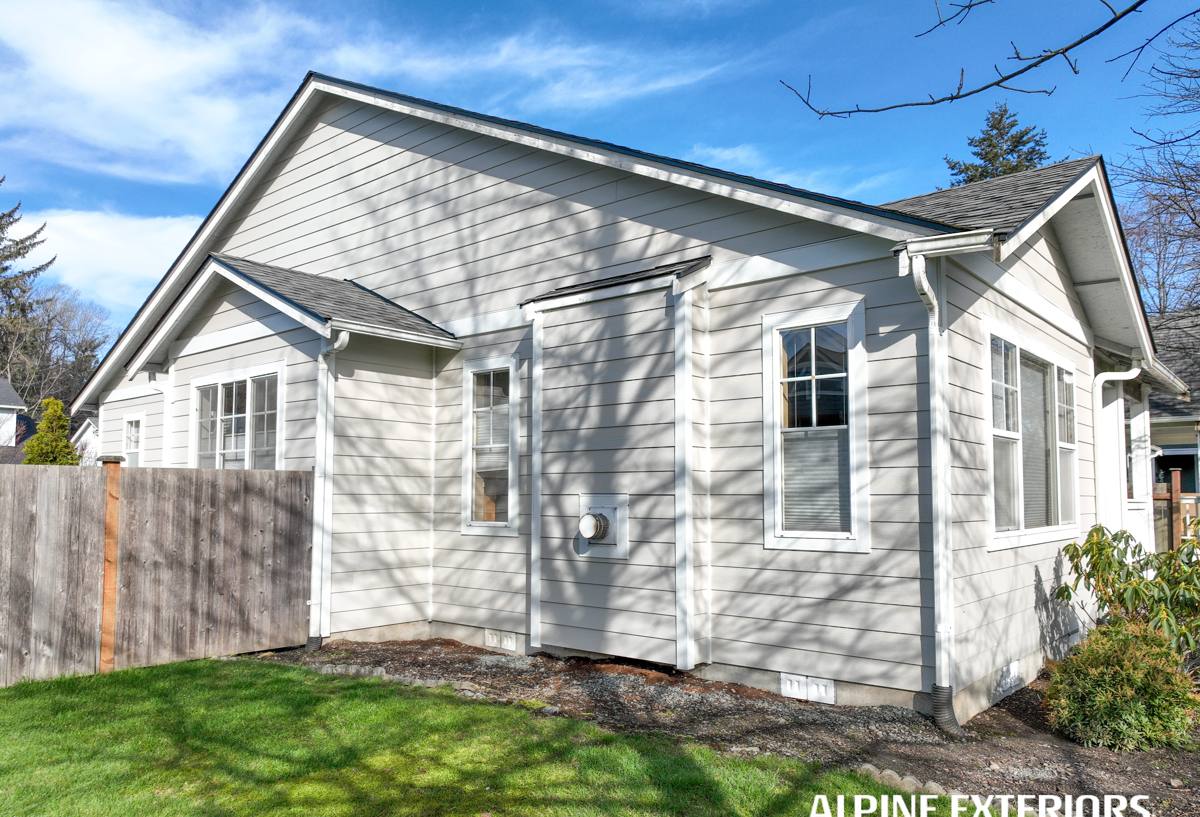
What Siding Repair Actually Means Here
"Siding repair" covers a wide range of jobs, and the right approach depends entirely on what's causing the damage — not just what it looks like from the ground. On Everson homes we're most often called out for:
- Cracked, split, or delaminating boards, usually where a board wasn't back-primed or was installed too tight to a butt joint
- Soft or spongy siding around windows, doors, and hose bibs — almost always a flashing or caulk failure, not a siding failure
- Moss and algae staining on shaded north walls and under overhangs, which holds moisture against the surface far longer than an exposed wall
- Fastener failure — nails or staples popping, streaking, or rusting, especially on older installations
- Impact damage from storms, falling branches, or yard equipment
- Buckling or warping near the foundation line where splash-back and poor grading keep the bottom courses wet
A correct repair starts by figuring out which of these you actually have, because the fix is different for each one. Replacing a damaged board without addressing the flashing behind it just buys you a year or two before the same spot fails again.
Why Diagnosis Matters More Than the Patch
The most common mistake we see in prior "repairs" — whether done by a previous owner, a handyman, or a contractor working fast — is treating the symptom instead of the cause. A rotted section of siding gets cut out and replaced, but the window flashing that let water behind it in the first place never gets touched. Six months to a year later, the same spot is soft again, sometimes worse because the new material was installed over a moisture problem that never went away.
We open up damaged areas before quoting a fix. That means pulling back the failed siding to look at the house wrap, the flashing, and the sheathing underneath. If the sheathing is soft or the wrap is torn, that's part of the repair scope — not an upsell, just what it actually takes to stop the problem from coming back.
Repair vs. Replacement: How We Make That Call
Not every damaged section needs a full re-side, and not every repair is worth doing instead of a larger replacement. Here's how we think through it on an Everson home:
| Situation | Typical Recommendation | Why |
|---|---|---|
| Isolated impact damage, sound siding elsewhere | Spot repair | The rest of the wall is performing fine — no reason to touch it |
| Rot concentrated at one or two flashing points | Targeted repair with flashing correction | Fixes the actual cause, not just the visible damage |
| Rot or moisture damage spread across multiple walls | Full or partial re-side | Widespread failure usually points to a systemic issue — old material, failed house wrap, or original install quality |
| Siding is original wood, hardboard, or older composite nearing end of service life | Replacement, not repair | Patching a product that's already at the end of its usable life is a short-term fix on a long-term problem |
| Cosmetic moss/algae staining only, material otherwise sound | Clean and treat, no repair needed | No reason to replace siding that's structurally fine |
We'll tell you honestly when a repair is the right call and when it isn't. A patch job on siding that's already failing broadly doesn't save money — it just delays a bigger job and adds cost on top of it.
What We Repair With — and Why It Matters
We install and repair with James Hardie fiber cement exclusively. When we're patching into existing Hardie siding, that's straightforward — we match the profile, the exposure, and the color as closely as the product line allows. When we're repairing a home sided in something else — vinyl, older hardboard, primed wood, or another fiber cement brand — we'll do honest patch work where that's the right call, but we'll also tell you plainly if the underlying material is the reason the damage keeps happening.
We don't install LP SmartSide, vinyl, Cemplank, Allura, primed spruce, or cedar, even for repair work, because we've standardized our crews, our fastening schedules, and our warranty backing entirely around Hardie's system. That's not a knock on every one of those products — it's a decision about what we can install correctly and stand behind every time, on every wall, in this climate. Hardie's fiber cement doesn't absorb moisture the way wood-based products do, it's non-combustible, and the ColorPlus factory finish means a color-matched repair board isn't a field-painted patch that fades differently than the rest of the wall over the next few years.
Matching Existing Hardie Siding
If your home already has Hardie siding, repair work is more precise than most homeowners expect:
- We confirm the exact profile (lap width, reveal, texture) before ordering replacement boards
- ColorPlus finishes are matched by product line and color name — not eyeballed and field-painted
- Fastening follows Hardie's published nailing schedule for the specific product and exposure, which matters for wind and moisture performance
- Caulk and flashing details are brought up to current best practice even if the original install predates them
Our Repair Process
- On-site inspection. We look at the visible damage and everything around it — nearby walls, roofline drainage, grading, and any prior repair work — before forming an opinion.
- Open and assess. Where damage suggests moisture intrusion, we pull back the affected siding to check the house wrap, flashing, and sheathing before quoting anything.
- Written scope and price. You get a clear explanation of what's damaged, what caused it, and what the repair includes — no vague line items.
- Correct the cause first. Flashing, wrap, and sheathing issues get fixed before new siding goes back on. A repair over a wet substrate isn't a repair.
- Install and match. New material is fastened to spec and matched to the surrounding siding as closely as the product allows.
- Walkthrough. We show you what we found and what we did about it, in plain terms.
Preventing the Same Repair Twice
A few habits go a long way toward keeping Everson homes from developing the same siding problems year after year:
- Keep gutters clear so overflow doesn't run down the wall behind the siding
- Trim back landscaping and tree limbs that keep a wall shaded and damp longer than it should be
- Rinse moss and algae buildup off north-facing and shaded walls before it holds moisture against the surface for months
- Check caulking around windows, doors, and penetrations annually — it's cheap to redo and expensive to ignore
- Watch for soft spots or discoloration near ground level, especially where sprinklers or downspouts splash back onto the wall
Why It Matters to Hire a Crew That Already Works This Area
Siding failure patterns in Whatcom County aren't identical to what you'd see in a drier climate. The moisture cycle here — long wet stretches, a real moss season, and damp air that lingers even when it's not actively raining — means flashing and drainage details that would be marginal in a dry region can become active failure points here within a few years. A crew that repairs siding around Everson and the surrounding towns regularly has already seen how these houses fail, and knows to check the flashing before ever cutting into a wall.
We're not guessing at what a Whatcom County repair needs. We show up, open up the problem area, tell you honestly what we find, and fix the actual cause — not just the visible damage.
If you've got a soft spot, a cracked board, or a stretch of siding that just doesn't look right anymore, we're glad to take a look. Reach out for a free, no-pressure estimate — we'll tell you straight what's going on and what it would take to fix it right.