 Blaine Siding
 Why Grandview Roofs Wear on a Different Schedule
Grandview homes sit close enough to the water that the air itself is part of the maintenance equation. Salt-laden moisture off the Salish Sea works its way into fasteners, flashing, and shingle granules year-round, and it doesn't take a storm to do it — a normal foggy Whatcom County morning is enough. Add in Blaine's long stretch of wet months and a moss season that can run from fall through spring, and a roof here is simply carrying a heavier load than the same roof would in a drier inland town. That doesn't mean Grandview roofs need to fail early. It means they need to be built and replaced with that load in mind, not with a generic install that would be fine somewhere else.
We've replaced roofs across Blaine long enough to know which failure patterns show up first in this neighborhood specifically — corroded fasteners before the shingles themselves are worn out, moss lifting tab edges on north-facing slopes, and soffit rot from moisture that never had anywhere to go. A roof replacement done right here addresses those patterns from the start instead of waiting for them to become emergency repairs.
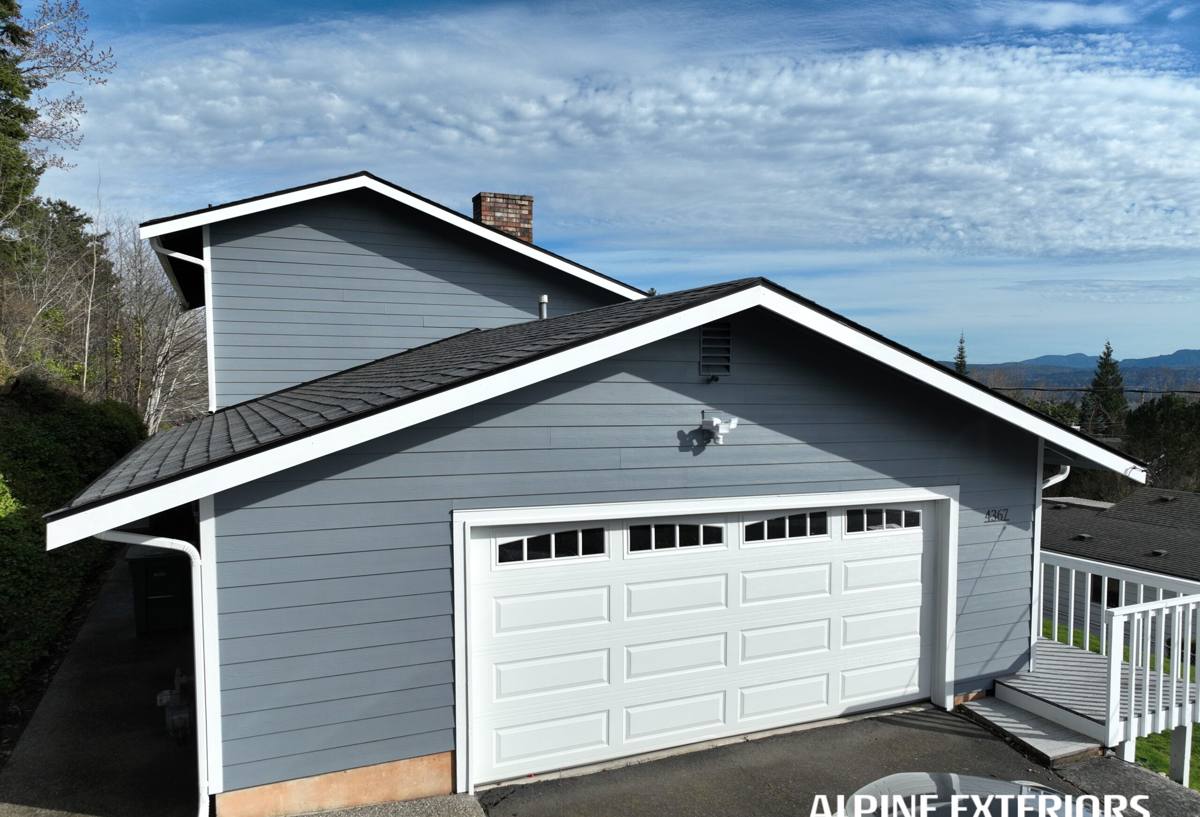
What Salt Air, Driving Rain, and Moss Actually Do to a Roof
Salt Air and Corrosion
Salt accelerates corrosion on any exposed metal — nail heads, flashing, drip edge, vent stacks. Once corrosion starts on a fastener, water finds a path along the shaft into the deck below, and that damage is invisible from the ground for years. Materials and fastener coatings matter more here than in most of the state.
Driving Rain
Wind off the water doesn't just drop rain straight down — it pushes it sideways and up under laps, ridge caps, and flashing details that would shed water fine in a calmer climate. Roof replacements in Grandview need flashing and underlayment choices that account for wind-driven rain, not just gravity.
Moss Season
Whatcom County's long damp stretch gives moss and algae months to establish themselves, especially on shaded, north-facing slopes common on wooded Grandview lots. Moss doesn't just look bad — it holds moisture against the roofing material, lifts shingle edges as it grows, and works into gaps at the granule level. A roof replacement is the right time to build in moss resistance, because retrofitting it later is far less effective.
Signs a Grandview Home Needs a Roof Replacement, Not Another Repair
- Granule loss showing up in gutters, especially after a windy or rainy stretch
- Moss or dark algae streaking that comes back within a season or two of cleaning
- Shingles that are curling, cupping, or losing their tab edges, particularly on north- or west-facing slopes
- Soft spots in the decking when walked, or sagging visible from the street
- Rust staining around nail heads, vents, or flashing
- Daylight or water stains visible from inside the attic
- A roof past 20-25 years old, regardless of how it looks from the ground
- Repeated repair calls to the same section of roof over the last couple of years
Any one of these can sometimes be handled with a targeted repair. Two or three together, especially on an older roof, usually means the material is failing broadly and a repair is just delaying the same outcome at a higher total cost.
Choosing the Right Roofing System for Coastal Whatcom County
There's no single "best" roofing material — the right choice depends on the home's exposure, roof pitch, budget, and how much long-term maintenance the homeowner wants to take on. Here's how the common options hold up against Grandview's specific conditions:
| Material | Salt Air Performance | Moss Resistance | Typical Lifespan Here | Maintenance Burden |
|---|---|---|---|---|
| Architectural asphalt shingle | Good, with corrosion-resistant fasteners and flashing | Good with algae-resistant granules; needs periodic cleaning on shaded slopes | 20-30 years | Low to moderate |
| Standing seam metal | Very good with proper coating and fastener spec | Excellent — moss has little to grip on a smooth panel | 40-50+ years | Low |
| Cedar shake | Moderate — requires vigilant maintenance near salt air | Poor without regular treatment; moss establishes easily in the grain | 20-30 years with upkeep | High |
| Composite/synthetic shingle | Good | Good, varies by product | 30-50 years | Low |
We install architectural asphalt and standing seam metal most often on Grandview homes, largely because they hold up to the salt-and-moss combination with the least ongoing maintenance. Cedar shake can still be the right call on a home where it matches the existing character of the street, but we're upfront that it asks more of the homeowner in a climate like this one — more frequent treatment, more attention to moss, and a shorter practical lifespan unless that maintenance actually happens.
What a Correct Roof Replacement Involves
Tear-Off and Deck Inspection
Every replacement starts with a full tear-off, not an overlay. That's the only way to actually see the deck and catch soft or rotted sheathing before it's sealed under new material. In our experience, coastal Blaine homes turn up deck issues around vent penetrations and eave edges more often than the roof's overall age would suggest.
Underlayment Built for Wind-Driven Rain
We use synthetic underlayment rated for high wind exposure, with self-adhered ice-and-water membrane at eaves, valleys, and around every penetration — the places wind-driven rain actually gets pushed. This is one of the details that separates a roof built for this specific coastline from a standard inland install.
Flashing and Fasteners
Corrosion-resistant flashing and fasteners aren't an upgrade here, they're the baseline. Step flashing at walls, proper counter-flashing, and sealed penetrations matter more in salt air than they would fifty miles inland, and cutting corners on this detail is where most premature leaks start.
Ventilation
Balanced intake and exhaust ventilation keeps the attic dry and the deck at a stable temperature, which slows moss growth from underneath and prevents the trapped moisture that leads to soffit and fascia rot. We check and correct ventilation as part of every replacement, not as an add-on.
Moss and Algae Protection
On shingle roofs, we use algae-resistant products and, where the slope and shading call for it, add zinc or copper strips at the ridge — a simple, low-maintenance way to slow moss regrowth on the slopes that see the least sun.
Our Roof Replacement Process, Start to Finish
- On-site inspection — we walk the roof and attic, document the actual condition, and explain what we find in plain terms.
- Written estimate — a clear scope and price, with material options laid out so you can compare rather than guess.
- Scheduling around the weather — we work with Blaine's rain patterns to protect your home during tear-off, and we don't leave a deck exposed overnight without protection.
- Tear-off and deck repair — full removal, inspection, and repair of any compromised sheathing before anything new goes down.
- Installation — underlayment, flashing, ventilation, and roofing material installed to the standard described above.
- Cleanup and walkthrough — magnetic sweep for debris and fasteners, and a final walkthrough so you know exactly what was done.
What Roof Replacement Typically Costs — and What Moves the Number
Every roof is priced on its own specifics, but the factors below are what actually move the estimate on a Grandview home:
| Factor | Why It Matters |
|---|---|
| Roof size and number of planes | More material and more seams, valleys, and edges to flash |
| Pitch and access | Steeper or harder-to-access roofs take more time and safety setup |
| Deck condition | Rotted sheathing found at tear-off adds material and labor |
| Material choice | Asphalt, metal, and composite carry different material costs |
| Layers to remove | Multiple existing layers add tear-off time and disposal cost |
| Ventilation and flashing upgrades | Bringing an older roof's ventilation up to standard |
Most full replacements on a typical Grandview home land in a broad mid-five-figure range, with metal roofing running higher up front and asphalt lower — but the only way to get a real number is a roof-specific walkthrough, since deck condition and access vary house to house.
Protecting the Investment: What Homeowners Can Do After Installation
- Clear gutters and downspouts at least twice a year, more often under overhanging trees
- Have moss or algae growth treated promptly rather than letting it establish over a season
- Keep tree branches trimmed back from the roofline to reduce shading and debris
- Check attic ventilation isn't blocked by insulation or storage
- Schedule a roof check after any major windstorm, even if nothing looks wrong from the ground
- Keep a copy of your warranty and installation details in case of future work
Why a Crew That Already Works in Grandview Makes a Difference
A roof replacement isn't a one-size-fits-all job, and a crew that hasn't worked this stretch of Whatcom County coastline doesn't always know which details to prioritize. We've replaced roofs on homes with the same salt exposure, the same wind patterns off the water, and the same moss pressure that Grandview deals with, so the material choices and installation details in this page aren't generic — they're what we've actually found holds up here. That local pattern recognition is often the difference between a roof that needs attention again in eight years and one that goes the full length of its warranty without a callback.
If you're weighing a repair against a full replacement, or you just want an honest read on where your current roof stands, we're happy to take a look. Reach out for a free, no-pressure estimate using the form below, and we'll walk your roof and give you a straight answer about what it actually needs.