 Blaine Siding
 Why Roofs in the Nooksack Area Wear Differently
Homes in the Nooksack area near Blaine sit in a corner of Whatcom County where three things stack up against a roof at the same time: salt-laden air off the nearby marine waters, long stretches of driving rain, and a moss season that can run most of the year in shaded, north-facing sections of a roof. None of these alone is unusual for a Pacific Northwest roof. Together, over years, they accelerate wear in ways that a roof repair estimate has to account for, not just patch over.
Salt air is corrosive to exposed metal fasteners, flashing, and drip edge long before most homeowners notice a leak. Driving rain, especially when it comes in at an angle during winter storms, finds its way into laps and seams that would stay dry in a straight-down rain. And moss doesn't just look bad — its root structure lifts shingle edges and holds moisture against the roof deck, which is where slow, hidden rot usually starts. A repair that doesn't address all three factors tends to fail again within a season or two.
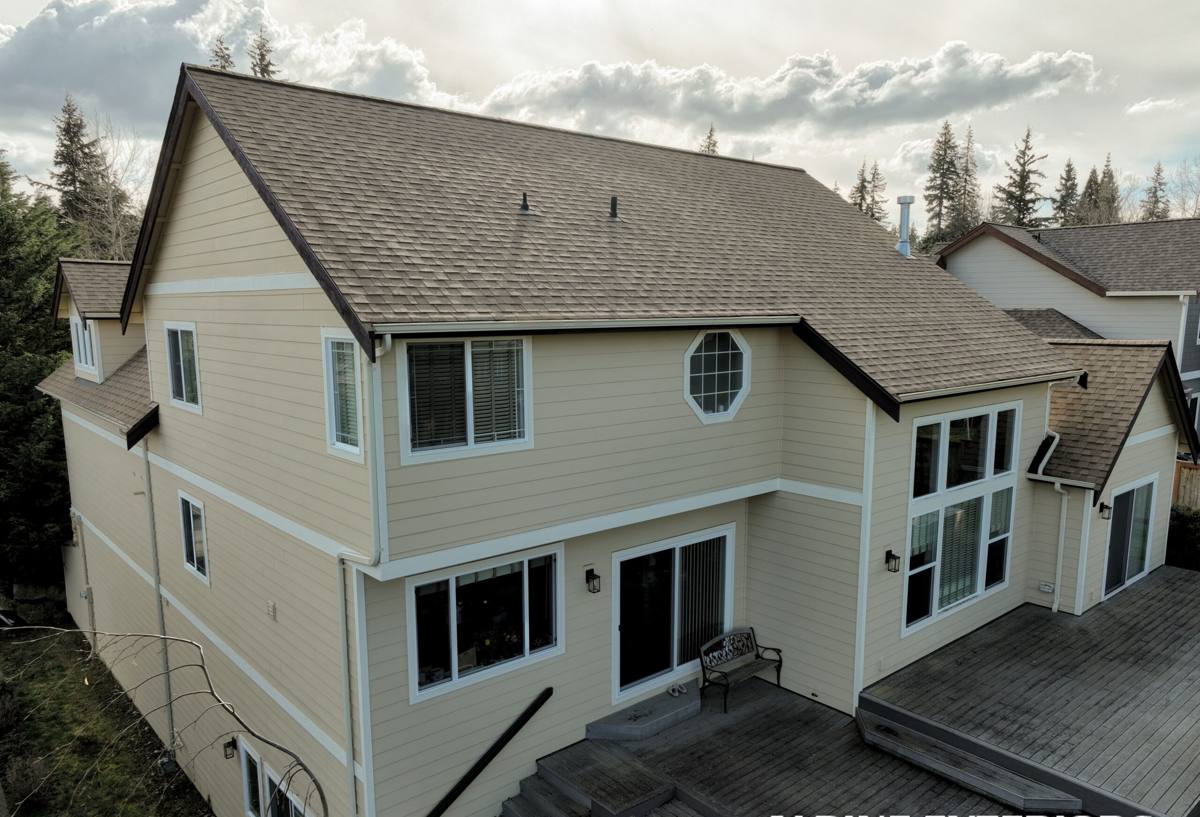
Signs a Nooksack-Area Roof Needs Repair
Roof problems in this climate rarely announce themselves with a dramatic leak on day one. More often, they show up as small, easy-to-miss signs first. If you're seeing any of the following, it's worth a proper inspection before the next wet season:
- Granules collecting in gutters or at downspout outlets, a sign shingles are wearing thin
- Dark streaking or green-black moss growth concentrated on shaded slopes
- Curling, cracked, or lifted shingle edges, especially on the roof faces that catch the most wind-driven rain
- Rusty or corroded flashing around chimneys, vents, and skylights
- Soft or spongy spots on the roof deck when walked (a sign of trapped moisture)
- Water stains on interior ceilings or in the attic, particularly near valleys or penetrations
- Daylight visible through the roof deck from inside the attic
- Sagging in the roofline between rafters
Any one of these on its own might be minor. Two or more together, especially combined with the roof's age, usually means it's time to have someone look closer.
What a Correct Roof Repair Actually Involves
Diagnosis Before Tools Come Out
A repair that starts with tearing off shingles before anyone has traced the actual water path is a repair that's likely to miss something. Water travels sideways under a roof surface before it shows up as a stain inside the house, so the visible damage and the actual entry point are often several feet apart. A correct repair starts with tracing that path from the interior stain or attic evidence back out to the roof surface, then confirming it from the outside.
Flashing Gets as Much Attention as Shingles
Most roof leaks in this climate trace back to flashing, not the field of the roof. Step flashing along walls, counter-flashing at chimneys, and pipe boot seals all take a beating from driving rain and salt-air corrosion. A repair that replaces a section of shingles but reuses old, corroded flashing underneath is a repair that will leak again. We replace flashing and pipe boots as part of the repair when they show wear, not just when they've already failed outright.
Matching Materials, Not Just Covering the Spot
Shingles fade and wear unevenly across a roof, so a patch using new material next to old will often stand out and, more importantly, won't shed water the same way as the surrounding courses if the profile or weight doesn't match. We match shingle type, weight, and where possible color as closely as the existing roof allows, and we tie new courses into old ones using proper overlap and fastening patterns rather than surface-gluing a patch.
Underlayment and Deck Condition
If shingles are being pulled back for a repair, that's the moment to check the underlayment and the roof deck underneath. Older felt underlayment breaks down faster under repeated wetting, and a deck that's been damp for a while can be soft enough that fasteners won't hold properly. We check both before closing the repair back up, because covering a compromised deck with new shingles just delays the next call.
Common Roofing Materials in the Area and How They Hold Up
The right repair approach depends partly on what the roof is made of. Here's how the materials we most commonly repair on homes in this area tend to perform against local conditions:
| Material | Typical Weak Point Locally | Repair Considerations |
|---|---|---|
| Asphalt composition shingle | Granule loss, curling from UV and moisture cycling | Most common; matching age/color takes care but repair is usually straightforward |
| Architectural/laminate shingle | Edge lifting in high wind areas, sealant strip failure | Heavier profile holds up well to driving rain but costs more to match |
| Wood shake or shingle | Moss and moisture retention, rot in shaded sections | Requires more frequent maintenance in this climate; repairs need careful moss removal first |
| Metal roofing | Fastener corrosion from salt air, sealant washer failure | Long-lasting overall, but fastener and seam inspection matters more near the coast |
We don't push homeowners toward a particular material during a repair conversation. If your existing roofing is holding up reasonably well for its age and material type, a targeted repair is almost always the right call over a premature full replacement.
Our Roof Repair Process
1. On-Site Inspection
We start by walking the roof and the attic, not just looking from the ground. Ground-level assessments miss too much — flashing wear, granule loss, and soft decking are all things you have to see up close.
2. A Clear, Written Estimate
You get a written scope of what we found, what we recommend fixing, and what it costs before any work starts. If we find something during inspection that changes the picture — a soft deck section, for example — we tell you before proceeding, not after.
3. The Repair Itself
Work is done carefully around your landscaping and gutters, with tarps and containment for debris. We don't leave a roof partially opened up overnight if rain is in the forecast — Whatcom County weather doesn't give you much warning, and an incomplete repair exposed to a storm can cause more damage than the original problem.
4. Cleanup and Walkthrough
Nails and debris get magnet-swept from the yard and driveway. We walk the finished repair with you so you can see exactly what was done.
5. Follow-Up
We stand behind the work and are reachable if anything comes up after the repair, particularly through the first heavy rain of the following season, which is the real test of any roof work.
Repair vs. Replacement: How We Help You Decide
Not every roof problem calls for a full replacement, and not every repair is a good long-term investment. The honest answer depends on a handful of factors we walk through with you during the estimate:
| Factor | Leans Toward Repair | Leans Toward Replacement |
|---|---|---|
| Roof age | Under 15-20 years, depending on material | Near or past the material's expected service life |
| Extent of damage | Localized — one slope, one flashing area, one valley | Widespread granule loss or curling across most slopes |
| Deck condition | Solid, dry decking under the damaged area | Soft or rotted decking found in multiple spots |
| Leak history | First occurrence or isolated issue | Repeated leaks in different locations over time |
| Moss/algae extent | Surface growth, removable without shingle damage | Moss has lifted shingles or degraded the surface underneath |
We'll always tell you honestly which side of that table your roof falls on. A repair that's really a stopgap on a roof near the end of its life isn't a good use of your money, and we'll say so rather than let you spend on something that won't hold.
Moss, Algae, and Salt Air: Protecting the Repair After We Leave
A good repair can still be undone by neglect afterward, and moss is the biggest ongoing threat to roofs in this part of Whatcom County. Shaded, north-facing slopes and roofs under overhanging trees stay damp longer, which is exactly what moss needs to establish. Left alone, moss roots work under shingle tabs and lift them, which is how a small moss patch turns into a leak two winters later.
A few habits go a long way toward protecting the work we've done:
- Keep gutters and downspouts clear so water isn't backing up under the lowest courses of shingles
- Trim back overhanging branches to reduce shade and debris buildup on the roof
- Have moss treated or removed before it spreads, rather than after it's visibly lifting shingles
- Check flashing and pipe boots annually — sealant and rubber components degrade faster with sun and salt-air exposure than the shingles around them
- Address small leaks immediately; a slow drip that sits ignored for a season causes far more deck damage than the same leak caught early
Driving rain off the water is a fact of life here, and no roof can be made completely immune to it. What we can do is make sure the roof's defenses — flashing, underlayment, shingle overlap — are in good working order so that rain does what it's supposed to do: run off, not in.
Why Hire a Crew That Already Works This Area
Roofing generally follows the same principles everywhere, but knowing which slopes on a given roof style take the worst of the wind-driven rain, how aggressively moss establishes on shaded roofs near the water, and how quickly salt air corrodes exposed fasteners is something you learn by working roofs in this specific climate repeatedly. A crew that repairs roofs across Blaine and the surrounding Whatcom County communities on a regular basis brings that pattern recognition to your estimate — they're not guessing at what's likely to be the real cause of a leak, they've seen the same failure show up on similar roofs nearby.
Local also means accountability. A contractor with an ongoing presence in the Nooksack and Blaine area has a reputation to protect here, and is easy to reach if a question comes up after the work is done. That matters more with roofing than with almost any other exterior trade, because a roof problem that resurfaces doesn't show up right away — it shows up during the next big storm, when you need someone who'll actually pick up the phone.
Get a Straight Answer on Your Roof
If you're seeing granules in the gutters, moss creeping across a shaded slope, or a stain that appeared on the ceiling after the last storm, it's worth having someone look before it turns into a bigger repair. We offer free, no-pressure estimates for roof repair work in the Nooksack area and throughout Blaine — use the form below to get one scheduled.