 Blaine Siding
 Deck Replacement Built for Birch Bay's Coastline
Birch Bay sits right on the water, and that changes what a deck has to survive. Salt-laden air corrodes fasteners and hardware faster than it does a few miles inland. Wind-driven rain off the bay finds its way into every gap, seam, and joint that isn't detailed correctly. And the long, wet Whatcom County winters keep decks damp for months at a time, which is exactly what moss and algae need to take hold. A deck that's fine in a drier part of the state can fail early out here if it wasn't built with these conditions in mind.
We work on decks throughout Blaine and Birch Bay, and the pattern we see is consistent: decks don't usually fail because the wood rotted from the top down. They fail from the inside out — ledger connections that trapped moisture, joists that never dried between rain events, fasteners that corroded and lost their grip, or a coating that looked fine until the substrate underneath was already compromised. Deck replacement done right in this area means addressing those failure points, not just swapping old boards for new ones.
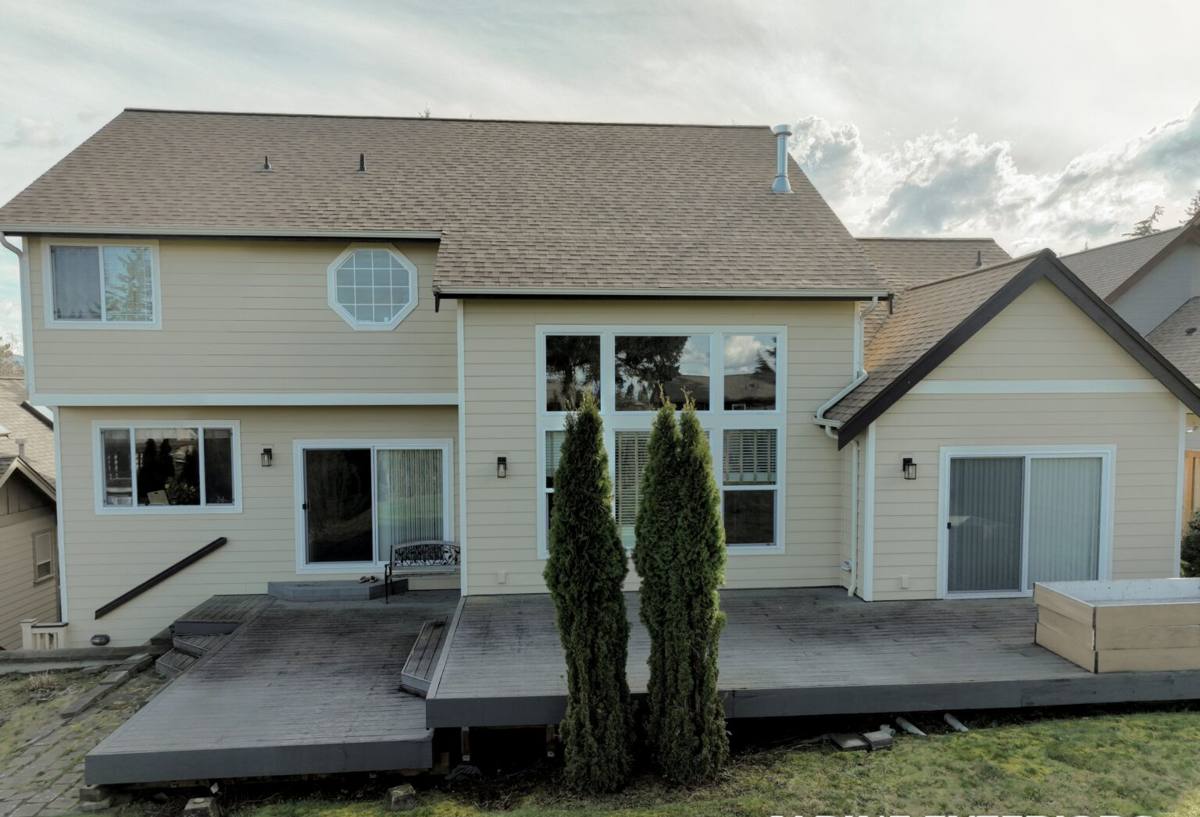
Signs a Birch Bay Deck Needs Replacing, Not Just Repair
Not every tired-looking deck needs a full replacement. But there are signs that tell us the structure itself is compromised and repair would just be a temporary patch.
- Soft or spongy spots in the decking, especially near the house or in shaded areas that stay damp longer
- Visible rot or splitting at the ledger board where the deck attaches to the house
- Rusted, corroded, or failing fasteners and joist hangers — common here given the salt air
- Persistent moss or algae growth that returns within weeks of cleaning
- Railings or stairs that feel loose or have visible movement under normal use
- A deck more than 15-20 years old built to older code, especially if ledger flashing or proper joist hanger hardware wasn't standard practice at the time
If you're seeing one or two of these, it may be a repair. If you're seeing several, or if the structural framing underneath is affected, replacement is usually the more honest recommendation — and often more cost-effective than chasing repairs on a deck that keeps failing.
What a Correct Deck Replacement Involves
Starting With What's Underneath
The visible decking is the least important part of a deck replacement from a durability standpoint. What matters most is what's underneath: the ledger connection, the flashing that keeps water out of that connection, the joist layout and hardware, and the footings. We inspect all of this before quoting, because a deck that looks structurally sound from the surface can have a compromised ledger or under-spec'd footings that a straightforward board swap won't fix.
Ledger and Flashing Details
The ledger board — where the deck attaches to the house — is the single most common point of moisture failure on decks in this region. Proper flashing here isn't optional. It needs to shed water away from the house framing, not funnel it behind the siding or into the rim joist. On a coastal property like Birch Bay, we treat this connection as a priority, not an afterthought.
Fasteners and Hardware
Salt air degrades standard fasteners faster than most homeowners expect. We use fasteners and structural hardware rated for coastal exposure — hot-dip galvanized or stainless where it matters most — because replacing a deck only to have hardware corrode in a few years defeats the purpose of doing the work.
Drainage and Airflow Underneath
Decks that stay wet underneath grow moss and mildew faster and rot faster. We grade and detail the space under the deck so water has somewhere to go, and we don't box in framing in ways that trap moisture against wood that needs to dry out between storms.
Decking Material Options for a Coastal Climate
There isn't one "right" decking material for every home — it depends on budget, maintenance appetite, and how close the deck sits to the water. Here's how the common options hold up under Birch Bay conditions specifically.
| Material | Coastal Performance | Maintenance | Honest Trade-Off |
|---|---|---|---|
| Pressure-treated lumber | Good if properly sealed and maintained | Annual cleaning, periodic re-sealing | Lowest upfront cost, but requires the most ongoing attention to prevent moss and moisture damage |
| Cedar | Naturally resists rot and insects, but salt air and constant damp will still gray and weather it faster than inland use | Regular cleaning and refinishing to maintain appearance | Attractive natural look, but a real maintenance commitment on a bay-front lot |
| Composite decking | Excellent — resists moisture absorption, rot, and moss growth better than wood | Periodic washing, no sealing or staining | Higher upfront cost, but far less maintenance burden over the life of the deck in this climate |
| PVC decking | Very strong moisture resistance; least susceptible to moss and mildew staining | Low — mostly just washing | Highest material cost; some homeowners prefer the look of wood-grain composite over solid PVC |
For homes closer to the water where salt air and wind-driven rain are most intense, we generally steer clients toward composite or well-detailed pressure-treated framing with composite or PVC decking on top — the framing does the structural work while the wearing surface handles the moisture and moss exposure. That said, plenty of homeowners choose wood for the look and are happy with it as long as they understand the maintenance schedule going in.
Framing: The Part Nobody Sees but Everyone Relies On
We treat framing lumber as a separate decision from decking material, because it's the part doing the structural work and the part most exposed to trapped moisture. Pressure-treated joists and beams, correctly sized for the span and rated for ground contact where applicable, are standard on our replacements. Joist hangers and structural connectors are coastal-rated hardware, not the standard-grade fasteners that work fine inland but corrode faster this close to the bay. This is one of those details that doesn't show up in a photo but determines whether the deck is still solid in fifteen years or needs work again in five.
Our Replacement Process
- On-site assessment. We look at the existing structure — ledger, framing, footings, and decking — to determine what's actually failing and why, not just what's visible.
- Honest scope and estimate. We tell you what needs full replacement versus what can reasonably be reused, and walk through material options and cost factors so you're deciding with real information.
- Demo and disposal. Old decking, framing, and hardware are removed and hauled off; we protect landscaping and the surrounding property during teardown.
- Structural rebuild. Ledger flashing, footings, framing, and hardware are installed to current code and detailed for this climate, not just to pass a minimum inspection.
- Decking, railing, and stairs installed. Fastening patterns and gapping are set to allow for wood movement and drainage, which matters more here than in drier regions.
- Final walkthrough. We go over the finished deck with you, including what maintenance (if any) the material you chose will need going forward.
What Ongoing Care Looks Like After Replacement
Even a well-built deck in Birch Bay needs some seasonal attention, and being upfront about that is part of doing this job honestly.
- Sweep debris and standing water off the deck surface regularly during the wet months to slow moss growth
- Wash the deck surface at least once or twice a year — more often for wood, less for composite or PVC
- Check and clear the area underneath the deck so airflow isn't blocked by stored items or overgrown vegetation
- Inspect railings and stair connections annually for any looseness
- For wood decking, plan on re-sealing or refinishing on the schedule appropriate to the product — skipping this is the single biggest cause of early wood deck failure we see
Why Local Experience With Birch Bay Homes Matters
A deck built to a generic spec sheet doesn't account for what a property right on the bay actually deals with year-round. We work in Blaine and Birch Bay regularly, which means we've seen how quickly salt air chews through the wrong hardware, how much moss pressure a shaded, damp deck can face through a Whatcom County winter, and which ledger and flashing details actually hold up here versus which ones fail in three or four years. That local pattern recognition shapes every replacement we quote — it's not guesswork, it's what we've watched happen on decks like yours.
We're also familiar with permitting expectations for this area, which keeps the process moving instead of stalling out on paperwork issues partway through the job.
Get a Straight Answer About Your Deck
If your deck is showing soft spots, corroded hardware, persistent moss, or is simply old enough that you're wondering whether it's still safe, we're happy to take a look. We'll give you a straightforward assessment of whether you're looking at repair or replacement, walk through material options that make sense for your home's exposure to the bay, and provide a free, no-pressure estimate — use the form below to get started.