 Blaine Siding
 Asphalt Shingle Roofing Built for Grandview's Climate
Grandview sits close enough to the water that homes here take a different kind of weathering than roofs further inland in Whatcom County. Salt-laden air off the Strait of Georgia works on exposed metal and shingle granules year-round, wind-driven rain finds every weak seam and nail pop, and the wet, shaded months stretch long enough that moss gets a real head start before summer ever dries things out. An asphalt shingle roof that's installed and detailed correctly can handle all of that for two decades or more. One that's installed generically, the way it might be in a drier or more sheltered part of the state, tends to show problems years earlier — soft spots at the eaves, moss ridges along the north slope, granule loss that shows up as bald patches by the fifteen-year mark instead of the twenty-five-year mark.
This page covers what asphalt shingle roofing work actually looks like for homes in and around Grandview: what the climate demands, what a properly done job includes, and how we approach the work when we're on your roof.
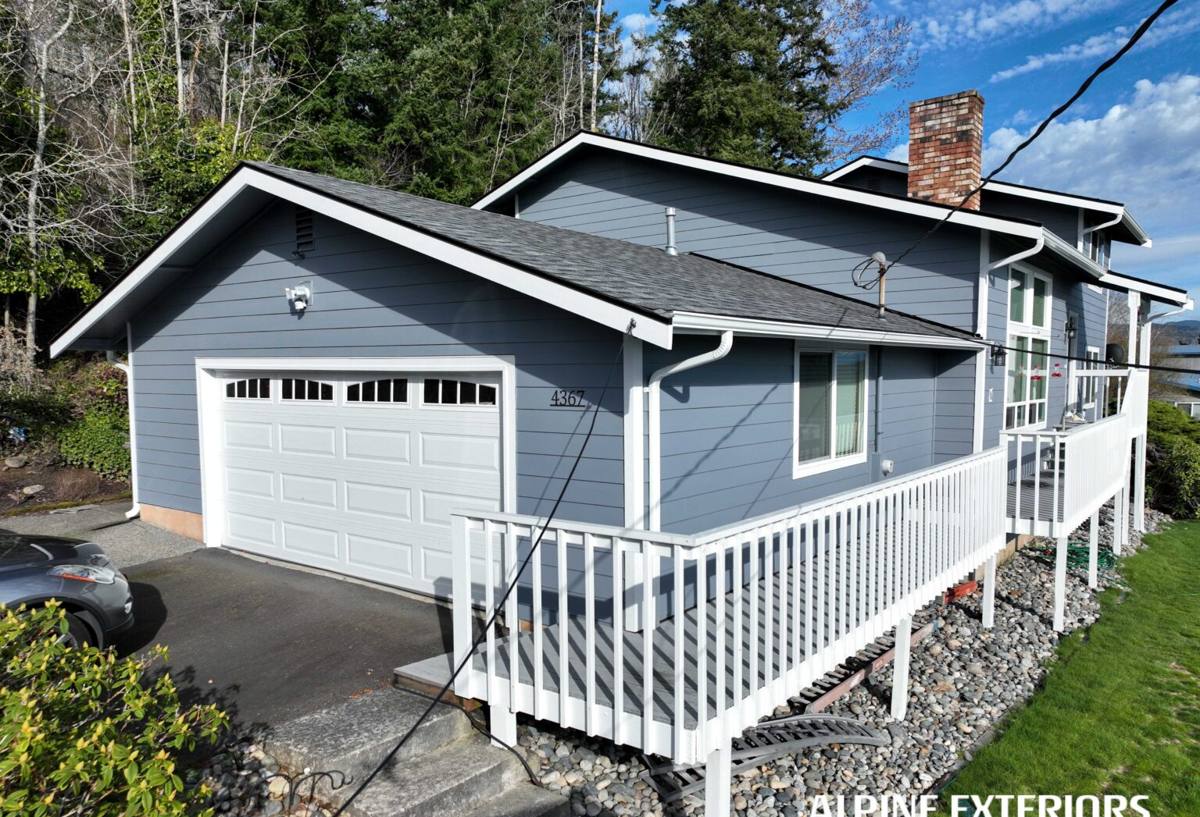
What Blaine and Whatcom County Weather Does to a Shingle Roof
Three conditions drive almost every asphalt shingle problem we see on homes near the water in this part of Washington:
Salt Air
Airborne salt accelerates corrosion on exposed metal — flashing, nail heads, vent stacks, gutter hardware. On a shingle roof, the flashing and fasteners usually fail before the shingles themselves do, which is why the metal components matter as much as the shingle brand you choose.
Driving Rain
Storms coming off the water don't fall straight down. Wind-driven rain gets pushed sideways and upward under shingle tabs, around chimneys, and along valleys — areas that a roof in a calmer inland climate could get away with underlayment cutting corners. Here, underlayment coverage and flashing detail work is what actually keeps water out, not just the shingle layer itself.
Long Moss Season
Grandview gets extended stretches of damp, shaded weather, especially on north- and east-facing slopes and under tree cover. Moss doesn't just look bad — it holds moisture against the shingle surface, lifts tabs as it grows, and shortens the life of the roof underneath it if it's left unaddressed for multiple seasons.
What a Correct Asphalt Shingle Job Includes
A shingle roof is a system, not a single product. Skipping or shortcutting any layer is where premature failures near the coast usually start.
- Deck inspection and repair — soft, delaminated, or water-stained sheathing gets replaced before anything new goes down, not covered over.
- Ice-and-water shield at vulnerable points — eaves, valleys, and roof-to-wall transitions get a self-adhering membrane, not just felt, given how much wind-driven rain this area sees.
- Synthetic underlayment across the full deck — a continuous water-resistant layer beneath the shingles as the actual backup barrier.
- Corrosion-resistant flashing — step flashing, counter-flashing, and valley metal chosen and installed to hold up against salt air, not just to pass a quick visual check.
- Proper nailing pattern — correct nail count and placement per shingle course, which matters more in wind-exposed coastal locations than it does further inland.
- Balanced attic ventilation — intake at the eaves and exhaust at the ridge, sized to move moist air out before it condenses under the deck.
- Ridge cap and edge detail — the finishing details that determine whether wind can get up under the shingle field in a storm.
Repair, Restore, or Replace?
Not every roof near Grandview needs full replacement. The right call depends on the roof's age, how the damage is distributed, and how much of the underlying system is still sound.
| Situation | Typical Approach | Why |
|---|---|---|
| Isolated leak, roof under 12-15 years old | Targeted repair | Deck and underlayment are usually still in good shape; the fix is localized flashing or shingle damage. |
| Heavy moss coverage, shingles otherwise intact | Moss treatment and cleaning, then monitor | Removing moss and slowing regrowth can add years of life without replacing sound shingles. |
| Granule loss, curling, or brittle shingles across multiple slopes | Full replacement | Widespread wear means the shingle's protective layer is failing broadly, not in one spot. |
| Soft decking or repeated leaks in the same area | Full replacement with deck repair | Underlayment and deck damage usually can't be fixed with a patch — it needs to be opened up and rebuilt correctly. |
| Roof approaching 20-25 years, minor issues appearing | Replacement planning | Coastal exposure shortens the practical lifespan versus the shingle's rated life; better to plan than to wait for a failure. |
Choosing Shingles for a Coastal Whatcom County Home
Standard three-tab shingles are the least expensive option, but architectural (dimensional) shingles are what we recommend for most homes in this area. They're thicker, hold up better to wind uplift, and carry a heavier algae- and moss-resistant treatment — a real advantage given how long this area stays damp. Many manufacturers also offer shingles with copper or zinc granule strips specifically to slow moss and algae growth on north-facing slopes, which is worth discussing if your roof has shaded sections that stay wet most of the year.
We're selective about ultra-budget shingle lines and certain lightweight product tiers for homes this close to the water — not because a given product is defective, but because thinner mat weights and lower wind ratings show their limits faster under sustained salt exposure and driving rain. That's a maintenance and longevity trade-off we'd rather explain up front than have a homeowner discover in year eight.
Our Process on Grandview Roofs
The work sequence doesn't change much house to house, but the details we pay closest attention to are shaped by working this specific area repeatedly.
- On-site inspection — we look at the deck, existing flashing condition, ventilation, and moss or algae patterns before quoting anything.
- Written scope and materials — what's being replaced, what underlayment and flashing are being used, and why, so there's no ambiguity about what you're getting.
- Tear-off and deck assessment — old material comes off and the deck gets inspected in daylight before new material goes down.
- System installation — ice-and-water membrane, underlayment, flashing, shingles, and ridge detail installed in the sequence that actually sheds wind-driven rain.
- Ventilation check — intake and exhaust balance confirmed, since poor attic ventilation is one of the more common hidden issues we find on older coastal homes.
- Final walkthrough — we go over what was done and what to expect from the roof going forward, including realistic moss maintenance timing for your specific tree cover and roof orientation.
Why Local Experience Matters Here
A shingle roof installed by a crew that hasn't worked this stretch of coastline will still look fine on installation day. The difference shows up two, five, and ten years later — in whether the flashing held up against salt air, whether the underlayment kept wind-driven rain out during a real winter storm, and whether moss was addressed early enough to matter. Crews that work Blaine and the surrounding Whatcom County coastline regularly build habits around those specific failure points: heavier attention to flashing material and detail, underlayment choices that assume sideways rain, and honest guidance on moss management instead of a one-time treatment and no follow-up plan.
We also know which parts of a roofing job get shortcut most often when contractors are unfamiliar with coastal exposure — usually flashing quality and ventilation balance — and we build our process specifically to not skip them.
Maintaining an Asphalt Shingle Roof in Grandview
A few habits go a long way toward getting the full service life out of a shingle roof this close to the water:
- Have moss growth addressed before it forms thick mats, not after — thin coverage is a quick treatment, heavy coverage risks shingle damage during removal.
- Keep gutters clear so water isn't backing up under the lower courses of shingles during heavy rain.
- Trim back overhanging branches to reduce shade, debris buildup, and the moss-friendly conditions they create.
- Have flashing points — chimneys, vents, valleys — checked periodically, since these fail before the shingle field usually does in salt-air environments.
- Confirm attic ventilation is intact, especially after any attic insulation or remodeling work that may have blocked soffit vents.
Get a Straight Answer About Your Roof
If you're dealing with a leak, visible moss, aging shingles, or you're just trying to plan ahead for a home in Grandview, we're happy to take a look and give you an honest read on where your roof stands. There's no pressure and no pushy sales pitch — just a clear assessment and, if work is needed, a straightforward explanation of what it involves and why. Reach out using the form below to schedule a free estimate.